Anecdotally, it's not BS by any means. It definitely works in DESERT (ie DRY) climates. High humidity will decrease the efficacy, probably to the point of being useless or detrimental. For the record I grew up in the deserts of AZ and also spent many summers in the humidity of So. Ill, so I am particularly aware of my own hydration levels. Also the Buff I used was the original buff which is made of polyester.
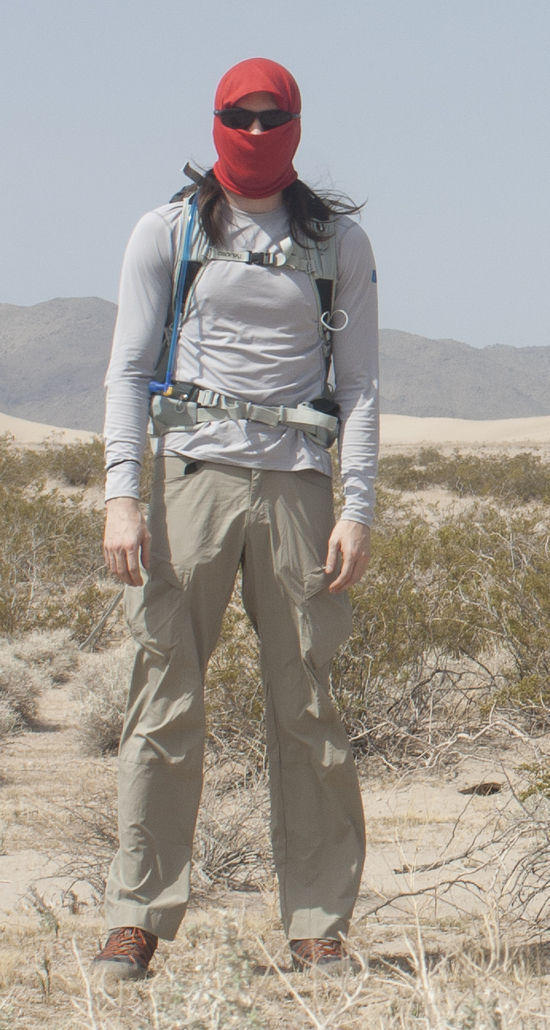
I'm a recent convert to using a buff to cover the face during summer hiking. I experimented with it just this past spring break in Death Valley. I hiked out in the cool morning (started in low-mid 70s) to some dunes using my normal technique of uncovered face. Naturally I was constantly sipping on my camelbak to moisten my parched throat. On my return hike (starting around noon, temps rising to high 80s low 90s) I was fed up with the dust and sun reflection so I wore my buff balaclava style. I instantly noticed a dramatic improvement in comfort! Not only did it keep grit out (which soaks up moisture) but it created a micro-climate for my nose/mouth.
It's this micro-climate that makes a HUGE difference in comfort. I drank considerably less water on the way back in without feeling dehydrated at all. Even with the higher temps and lower humidity they brought. Obviously this wasn't scientific so I didn't measure my body's water content or anything but I can tell you I FELT better which may be just as important.
I will go so far as to hypothesize that some kind of light weight face covering does decrease moisture loss (ie dehydration). The reasoning is actually the same concepts as the psolar masks and similar used by Alpinists and cold weather adventurers.
The buff traps humidity creating a micro-climate that is considerably more humid than the ambient air. This in effect provides a "pre-moisturizing" chamber similar to the function of the sinuses (which is why nose breathing in heat is recommended). This is conserving/utilizing your exhaled moisture to moisten the inhale.
On top of this the Buff absorbs some moisture and holds it. As you inhale you force hot and dry air through the fibers. Heat is removed from the air to vaporize the moisture collected in the fabric fibers (as well as warm the fibers directly) which cools the inhale breath. It's definitely noticeable, especially when you take a big/deep breath in. With cooler incoming air, less moisture is lost as well.
Again this "science" is purely hypothetical but I would bet money that a proper experiment would show some benefit to wearing a light face covering.
CONS: There are some. The micro-climate can become very humid, and with the perceived reduction in air flow it can feel stifling to wear the face mask. This is really more of a psychological issue that passes once you get used to it.
The polyester buff fits somewhat snug around the face but has a loose weave so does not trap much heat. I wonder if a cotton bandana or loose weave nylon cloth (both of which are far more hydrophilic than polyester) may provide more benefit by absorbing more moisture. Wool may do the same but would have to be fit loose enough to allow air to flow between your skin and the fabric, it's just too insulating when fit snug (I can wear snug wool shirts to about 75F before I'm looking for a loose and stinky synthetic).
I do now always wear some face covering in dry (and especially hot) environments. Here I am representing the American Bedouins: