Topic

Rainbow vs Lunar solo vs Contrail

  • This topic is empty.
Viewing 12 posts - 1 through 12 (of 12 total)
Zack Karas BPL Member
PostedNov 30, 2006 at 9:14 pm

Okay, here’s the deal: I like light, simple shelters (have the Squall and the Cloudburst by TT, like both but both have their flaws) but I hate having to put on my raingear in the middle of the night to change the pitch of the shelter when it starts to rain. To me, that is the one major flaw of a shelter–that when it rains, you have to go and get in the rain to re-pitch it and now your shelter is more confined. It seems like the Rainbow and the Lunar solo would only require you to close the vestibule when it rains, but I’ve read some posts here regarding the Contrail in storms–lowering the back struts which seems to greatly reduce foot space, and re-guying the bathtub floor at the foot end, and so on.
So how is the netting on the Rainbow and the Contrail sewn to the bathtub floor? Is it sewn to the very edge of it (so if rainwater came down the netting, it could pool inside) or is it sewn in such a way that it wouldn’t come inside? From photos I’ve seen, the roll-down flap at the foot of the Contrail appears to be on the inside of the netting (as opposed to how it is on the Cloudburst). Any problems with this?
Also, I’ve read the the Lunar solo can be testy when pitching it. Is this just for people new to the shelter, or is this something that doesn’t go away with familiarity? I like the weight of the Lunar and the contrail, but it seems the Lunar is more storm worthy (larger vestibule, larger floor space, netting isn’t sewn to the outside edge of the tarp). Does anyone have both, and what is your opinion?
Thanks for the help.

PostedDec 1, 2006 at 11:04 am

Zack,

It’s true that some people have some difficulty with initial setup of the Lunar Solo. It’s one of the artifacts of having a shelter with both a floating canopy and floating floor. Balancing the tensions for proper setup takes a bit of mental dexterity. However, once you’ve quickly mastered the setup, you shouldn’t have any problems in the field getting a quick taut setup.

We are working on better documentation to minimize the learning curve and also possible changes that will hopefully simplify the setup.

PostedDec 1, 2006 at 11:31 am

I slept in the Lunar Solo almost every night of my 36 day Colorado Trail Through-hike this past summer. Before I started the hike, I’d only set up the LS maybe 4 times. It took me 5-10 minutes. By the end of the first week on the CT, I could consistently erect it in about 3 minutes.

The best way I found is to stake the two corners that are away from the door. Then I set up the trekking pole and staked the vestibule guy line. This makes a nice equilateral triangle of staked corners. Then I staked the two front corners on the door side. The last point was the rear most loop of the tent. Starting with the triangle gave me an even upright tent, and the other three corners fell into place very easily then.

PostedDec 1, 2006 at 12:21 pm

Shawn,
If I am interpreting your method correctly, it is the opposite of Ron’s recommended pitching sequence. Some questions:

1- What type of stakes are you using and how close to the ground are the heads where the straps attach?

2- How long/short are the fly straps when staked; near full extension or shorter?

3- How much tension remains on the shockcord to the floating floor?

4- Most important, what does the netting look like at the inside back corners when fully pitched? Is it relatively taut (providing maximum floor space) or does it sag; if so, how much?

5- Does your tent have the tieout loop on the back center? If so, do you use it to lift the back and provide a little more headroom at the peak?

Any other observations (even pictures) that you or anyone else experienced with this tent would be appreciated. Thanks.

PostedDec 1, 2006 at 1:57 pm

Hey – my very first post @ BPL!

Ron or Shawn – I am interested in the Lunar Solo e and wonder what the “fit” would be like for someone 6′ 2″. Seems like it would be good since the length grew to 88″

Thanks!

Dan

PostedDec 1, 2006 at 2:06 pm

Siegmund,

Actually Shawn’s instruction aren’t that different from my own. He starts with the front three stakes, I start with the two sides opposite the door then the rear. The point in both cases is to stake the rear corners last. Part of the problem most people incur is in over stressing the rear corners in an attempt to raise the canopy. However, due to the dynamics of the tensioning, the more stress the more the canopy collapses. This is opposite your normal intuition. Pulling tightly on the corners causes the canopy into a concave shape which collapses the netting and reduces ventilation.

You can get a very taut and wind worthy shelter with fairly minimal stress on the canopy. It’s all about balancing the forces.

I will have to try Shawn’s method of setup an see if it’s easier to explain.

1- What type of stakes are you using and how close to the ground are the heads where the straps attach?

We recommend 5 – 6” stakes set fairly flush to the ground. Then a 6th 9” stake for the main guyline. This line has the most stress and is more likely to be tripped on, so a longer stake is better.

2- How long/short are the fly straps when staked; near full extension or shorter?

In general the webbing connecting the canopy to the stake should be fairly well extended. This allow you the ability to re-tension the tent as the canopy becomes slack.

3- How much tension remains on the shockcord to the floating floor?

One of the biggest mistakes people do is to over tension the floor. It’s a habit that’s carried over by use of traditional tents. There should be little tension on the bungee attached to the corners of the tent.

4- Most important, what does the netting look like at the inside back corners when fully pitched? Is it relatively taut (providing maximum floor space) or does it sag; if so, how much?

Properly setup the netting in the rear two corners of the tent may droop a couple of inches. This is due in part because the floor has a tendency to rise.

5- Does your tent have the tieout loop on the back center? If so, do you use it to lift the back and provide a little more headroom at the peak?

Only the first generation of the shelter, pre E, had two piece canopies with a distinct break in the rear. The E model went to a larger single piece canopy. There was a carry over of the center rear loop on the first couple of production runs, but it was dropped as it wasn’t needed.

I have modified the Lunar Solo web page to include a link to a pdf that illustrates the setup. It’s still pretty crude and needs better photography and layout. Still it illustrates the basic concepts.


Dan, whether the Lunar Solo will be comfortable for your height depends upon a number of factors. It’s certainly roomier than a small tarp or small tent like the Micro Zoid. At the same time it’s not massive. Size and weight aren’t easy things to balance.
There are a couple of pull out on either end of the tent. You can secure a light cord to the end over your head and attach it to some nearby vegetation. This will help to raise the canopy above your head by several inches. Having a center pole design brings the canopy closer to your head while sleeping. At the same time it also provides you with greater usable space when sitting up and doing chores.

One of the big design criteria I had for the Lunar Solo was to be able to easily access the entire floor of the shelter with minimum contact with the canopy. With long tunnel tents, it’s difficult to access gear that’s pushed to the rear of the tent. When any condensation accumulates on the canopy, you’re forced to either belly crawl to the rear or dump the contents of your tent to avoid getting soaked.

PostedDec 2, 2006 at 10:45 am

“1- What type of stakes are you using and how close to the ground are the heads where the straps attach?”

I use a “y”-shaped stake from Golite. As Ron mentioned, they are about 6″ long and I plant them all the way down to the indented head. The straps just about touching the ground.

“2- How long/short are the fly straps when staked; near full extension or shorter?”

They vary just a bit depending on how level the ground is, but typically, there is 1/2 to 2/3’s of the strap still left to cinch up.

“3- How much tension remains on the shockcord to the floating floor?”

Tension is light.

“4- Most important, what does the netting look like at the inside back corners when fully pitched? Is it relatively taut (providing maximum floor space) or does it sag; if so, how much?”

It sags a bit, but I have plenty of room to sit up, move around and put my mostly empty pack in the triangle of the back of the shelter. As for head room, I am not tall (5’9″) but I have a 19.5″ torso, equivalent to a typical man of about 6’3″. I just have painfully short legs. But when I sit up, I’m sitting pretty tall, and the LS is quite roomy for me.

“5- Does your tent have the tieout loop on the back center? If so, do you use it to lift the back and provide a little more headroom at the peak?”

I don’t have the option, but even if I did I don’t think I would need it.

Any other observations (even pictures) that you or anyone else experienced with this tent would be appreciated. Thanks.
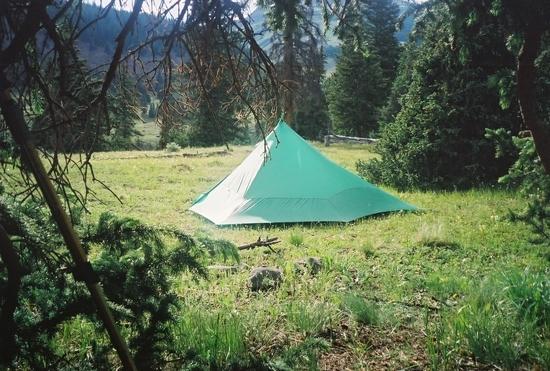
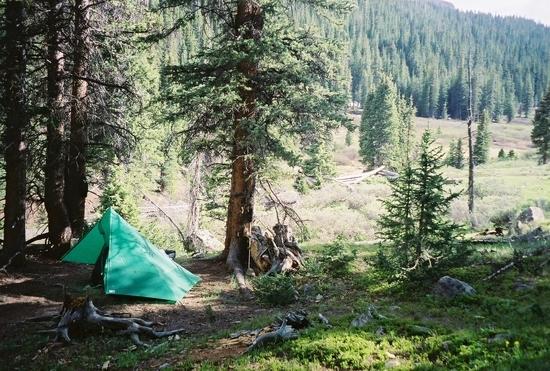
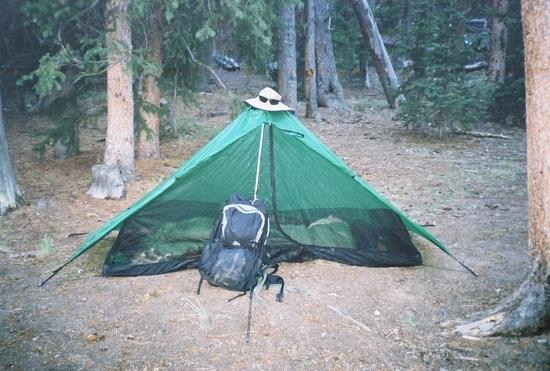
LS (E) rear view

Side view, half opened, my most common setup in mild rain.

My preferred setup, fully open, greatviews and no bugs.......

I can’t say enough good things about the Lunar Solo. It’s so outside the traditional solo tent, you’d have to try it to fully appreciate it. But I LOVE the wide open front. I actually get the feeling of still being connected to every thing around me which I enjoy with a tarp. But setup is much easier, and I don’t have to contend with bugs.

PostedDec 2, 2006 at 3:26 pm

Thanks Ron & Shawn for pitching info. Shawn, pictures are great! One further question I should have asked first time around: what have you found to be the optimum length for the trekking pole? I notice your pole is setting off at an angle (more room near door?) but what is effective vertical height of tent peak? The optional carbon-fiber pole is 45″ long; do you pitch any higher or lower?
Thanks again,
Sig

PostedDec 2, 2006 at 5:07 pm

I kept mine at the same height I hike with, 125 cm, or about 48.5 inches. I always set the pole just a hair to the side so I don’t bump it getting into the tent. It probably has an effective height of about 47 inches.

Zack Karas BPL Member
PostedDec 2, 2006 at 8:02 pm

Hi Ron,
I appreciate your replies to the posts. I have to say that right now I am definitely leaning towards the Lunar solo. I was wondering if you are going to change the design for a 2007 model, or is it going to remain the same? I ask now to see if I should order one to get the current holiday discount or wait for the possible updated version.

Thanks.

PostedDec 3, 2006 at 9:36 am

Zack,

I have no plans to change the Lunar Solo anytime in the near future. I’m quite happy with it’s current features and performance.

Ron

PostedDec 3, 2006 at 9:44 am

One way I countered the re-staking thing in my TT when it starts raining is using a few inches of shock cord at the end of the guy outs. It is stretched tight when you stake it out and takes up a bit of slack when the tarp starts to sag a bit.

Viewing 12 posts - 1 through 12 (of 12 total)
Loading...