


For ye gear freaks who have actual experience with both, how do they compare? Is the five-ounce-heavier All Season model significantly warmer? Please share your feedback.
Topic
Become a member to post in the forums.
For ye gear freaks who have actual experience with both, how do they compare? Is the five-ounce-heavier All Season model significantly warmer? Please share your feedback.
From a real-world perspective… who knows.
The NeoAir (Yellow) has been out a number of years and has been real-world-tested around the world and proven to be solid on both ground and ice and snow.
The new NeoAir Trekker came out at the very end of this years Winter season (for most folks) and thus has not had the time to be tested by the vast majority of people in winter conditions.
John – Ben is actually asking about the All Season version, not the Trekker. I was unaware that the All Season was even available at this time.
My bad.
But, still sortta applies huh. Beyond knowing that the r-value is nearly double the NeoAir Yellow/Trekker, very little we can say about real world value of the All Season.
That said, an additional 6 ounces for a 4.9 r-value verses 2.5, for the large size, could be pretty tempting for a deep winter sleeping pad, eh!

I don't think anyone has real world experience with the all season NeoAir yet, but I think you could make a pretty good decision based on the numbers. For summer/2 season hiking, the regular NeoAir has plenty of R-value, so carrying the heavier NeoAir all season wouldn't be a wise choice unless you're worried about punctures. However, the colder months there really is no lighter way to get R-4.9. Anything else that's around this R-value is heavier and bulkier to my knowledge, so the NeoAir all-season would be a no brainer in the coldest 6 months of the year. For most people that don't hike in the winter and only want to buy one, it might be better to stick with the regular NeoAir and supplement it with a thin CCF pad in the colder months. This way you'd be lighter in the summer and just a little heavier in the cold months.
Thanks, gentlemen, and yeah, the All Season is still spanking new. I was just wondering about its reputed 4.9 R-value rating. Pretty darn good considering the absence of insulation…
Having cut apart a few NeoAir Yellows (for resizing and/or making pillows) I would probably say that all they have done is add a second layer of the silver insulation within it. Each of those layers are rated at around 2.0, so it would make the most logical sense. Between an extra layer of the insulation and the slightly different material.
I think for the average person who is not too concerned about weight this All Season provides a nice option for them. For the UL hiker I think it presents an interesting option that could be a rather difficult decision for some. As Dan said above… you could grab yourself a NeoAir Yellow and a GG pad and maybe get close to the same r-value, have a larger set of available options.
Going to be interesting to see how these things feel. Whether the material is nicer to lay on, whether they slide less, and if the baffles feel the same. Personally, I am more inclined to try the Klymit X Frame XLARGE before I would be the NeoAir All Season.
Dan I bet the a custom Kooka Bay downmat would give these a run for there money in terms of warm/price/weight/bulk.
I am interested to see if the All Season delivers. It will be an excellent commercial offering if it does.
A DAM from KookaBay may offer higher Rvalue at the same of less weight. I have a 13 ounce SAM KookaBay full at R4 or better, can not remember the exact Rvalue.
I just can't see how one can achieve an R-value of 4.9 with (smoke?) and mirrors. I am most definitely looking forward to a real test. Considering the Exped DM #7 is heavily insulated with down and has an R-value of 5.9 but is much, much heavier, it will be interesting to hear the results.
Not directly related to the OP, but attached to the original motivation of being adequately insulated from cold ground:
Are R-Values additive?
That is, if I stack my R 2.5 inflatable on top of an R 2.5 CCF, does that yield an R-Value around 5?
My intuition says it does, but I don't have the physics background…
Nevermind, I asked a couple of Harvard physics grad students… who promptly went to Wikipedia and sent me http://en.wikipedia.org/wiki/R-value_(insulation). Particularly the section on multiple layers. R-Values are indeed additive.
Based on this, I think the NeoAir trumps the All-Season because it's so easily modifiable (stack with a thin CCF pad or reflective blanket) to deliver the desired properties of the all season (increased insulation) at a comparable weight. This way, you still have the option of leaving out that insulation weight for the rest of the year when it's not needed.
The only situations where this doesn't hold is if the user requires an R-Value near 5 year round, which, based on the glowing reviews of the original NeoAir, is rarely the case, or if the user is dramatically more concerned with volume than weight, and the added volume of a second insulating pad is unacceptable.
BANG! Science.
Hi Ben,
It seems likely they added baffling to reduce cell size and convection loss. Perhaps they added another reflective layer as well, but I wonder how much effect that could have on R-value (minor compared to more baffling). It's interesting the thickness is the same.
I look forward to the first brave soul who cuts one of these costy things apart.
cheers,
Rick
As I recall, the NeoAir All Season has 3 reflective barriers instead of one like the original NeoAir. The Thermarest website says 'barriers' so it's definitely more than one. On top of this, all the individual chambers are smaller. One neat thing is that even if you pop the NeoAir All Season, you'll still get R 2.5 by laying on it deflated which should be enough to survive the night. [EDIT: It's R-1.5 when flat]
"I bet the a custom Kooka Bay downmat would give these a run for there money in terms of warm/price/weight/bulk."
In terms of bulk, I think the NeoAir All-Season is going to beat anything. For weight, it seems that the NeoAir method of insulation (chambers and reflective barriers) is lighter than using down, but it might be possible to create a similar or lighter Kookabay DAM with the same R-value by using lighter face fabrics. Thermarest is using a bit heavier materials (75/70D) for this one then the regular NeoAir, whereas Kookabay offers their mats in quite light fabrics (30D?). So you do have the option with Kookabay to save some face fabric weight. I'm not sure how it would all add up, but I suspect if you compare similar face fabrics, you'll find the NeoAir method of insulating to be lighter than down. I haven't actually looked into it though.
"Are R-Values additive?"
Yup, essentially you just add them up. The only exception is when you are using a thick inflatable mat (ie. NeoAir) on top of a CCF. If you toss an R2.5 NeoAir on a R2.5 CCF pad then you'll have R-5 underneath you, but heat can still escape out the sides of the NeoAir where the CCF is not present. So you'd have almost R5 but not quite. It would be difficult to really measure this, but you might wind up somewhere around R4.5. Lots of people put the CCF on top to reduce this effect, but I personally keep the NeoAir on top for comfort reasons and because I feel the difference is minor.
You could be right on bulk…
"it seems that the NeoAir method of insulation (chambers and reflective barriers) is lighter than using down"
I would be very suprised if this is true.
"Thermarest is using a bit heavier materials"
I believe his standard offering is 70D with 30D being an option (maybe even 70bottom with 30top) — though denier isn't nescessarily indicative of material weight.
"Are R-Values additive?"
Not purely additive when trying to figure in equivalent R-Value for resistance to thermal radiation heat transfer.
Would flattened reflective layers provide any insulation whatever? I'd guess the conductive heatloss will overwhelm any benefits from IR reflection.
Cheers,
Rick
When I worked in a window factory as a service manager 28 yrs ago the rule of thumb was that every layer of dead air space added approximatly 1 r factor so doube pane glass 1 R triple pane 2R triple pain withstorm insert in the sash 3 R factor I think this is the principle at work inside a neoair The more air chambers the higher the R value so if the material in the baffles is light enough then you can build more baffles lighter than using insulation
Rick – if you are still interested in seeing the inside of the NeoAir all season, you can checkout http://www.trailspace.com/blog/2011/01/22/outdoor-retailer-all-season-neo-air.html which has a nice cross section photo.
I just received my NeoAir All Season about a week ago and have only had the opportunity to test it out indoors, but I expect to put it to use in the backcountry later this month. Just by laying on it indoors however, I can tell that it is ridiculously comfortable and delivers great support.
I used to have the regular NeoAir, and to me, the All Season version feels even more stable (presumably due to the added baffles/barriers) and comfortable. It's the most "un-bouncy" inflatable pad that I've ever used – and I've tried quite a few, including the original NeoAir, the Exped Downmat 7, the Big Agnes Insulated Air Core, the Nemo Cosmo Insulated, and the Exped Synmat UL 7.
I prefer the horizontal baffles because I personally feel that they do a better job of distributing your weight over the pad than vertical baffles do. I was getting some pressure spots on my shoulder and hip when using some of the pads with vertical baffles, and I am quite confident that I will not experience this when I put the NeoAir All Season to use in the field.
I feel that the All Season does have two drawbacks, but neither are deal breakers for me.
The first is that the included pump sack is a real pain to use in my experience. After spending over 5 minutes attempting to inflate the pad (I have the large size) with the included pump sack, I was still only about halfway done! I got fed up and performed the rest of the inflation with my mouth, which went much more quickly. I honestly can't see anyone turning to the pump sack to inflate the pad. I just purchased an Instaflator (http://www.themillair.com) which I believe will do a much better job inflating the All Season.
The second drawback is that the All Season is quite crinkly sounding when you move around on it. This isn't really a big surprise considering how much reflective foil is inside of the pad – but if you were truly bothered by the noise of the original NeoAir, you may want to steer clear of the All Season. If anything, I think that it may be even louder than the original NeoAir. The noise isn't a very big deal to me, and I consider the pro's of the pad (including its Awesome weight (particularly for a pad made of out 70/75D material), amazing R-Value, superior comfort, and excellent compactibility) to far outweigh these two relatively small cons.
Hope this helps someone who may be considering the All Season!
From the Thermarest web site :
The All Season

and the original
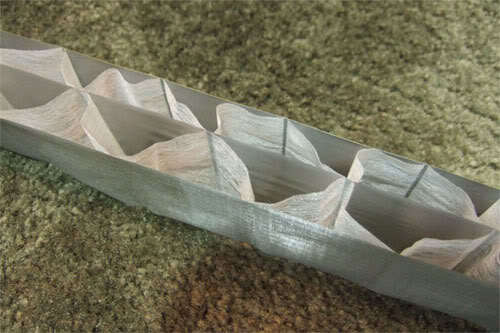
Franco
"Would flattened reflective layers provide any insulation whatever? I'd guess the conductive heatloss will overwhelm any benefits from IR reflection."
The NeoAir All Season still provides R 2.5 when it is 100% deflated as I recall. I could be a little off on the number, but it was around this and defiantly a lot more than I expected.
"it seems that the NeoAir method of insulation (chambers and reflective barriers) is lighter than using down"
"I would be very suprised if this is true."
The regular sized NeoAir All Season tips the scales 19oz. The same sized Kookabay pad with 70D fabrics and NO insulation is 14.9oz. So can you fill this Kookbay pad with down to get to R5 and still wind up at or less than 19oz? In other words, can you get a full sized pad to R5 with 4.1oz of down or less? Note that I'm comparing rectangle pads here, not the 'mummy' shape Bender often sells, because that would be a less apples to apples comparison.
Based on a search here at BPL (ie. Ray Estrella has 8oz of down in his 24×75 Kookabay pad to get to R6), you need ~4.5 to 6oz of down in a full sized pad to get to R5. So it appears that down in about the same or heavier than Thermarest's baffles/reflective layer system.
You can probably get a full length Kookabay pad at R5 for less than 19oz, but I think you'd either need to go with the 30D fabric or with the narrower mummy shape to do so. My research has been pretty limited, but my hypothesis is that Thermarest's insulating system is more effective for the weight than down.
Perhaps more importantly, since these two systems are both quite similar in terms of insulation for the weight, which one is better based on other factors? The NeoAir AS still provides R 2.5 if it's flat. How much R value does a down pad provide? I don't know the answer. Do these down pads require an inflation sack (more weight) or does the down loft it enough to not need one? Again, I'm not sure of the answer.
So can you fill this Kookbay pad with down to get to R5 and still wind up at or less than 19oz?
Not that easy…
You need to keep the down inside the mat (so you need at least a foam barrier) and hopefully not clog up the valve , as well as a way to retain an even distribuition within each chamber.
Franco
When I inquired about a Kookabay pad with synthetic insulation a while back, I got the following information from Bender about weights and R value for a pad with the 70D fabric:
Mummy 72x20x2.5" R5 Synthetic 16.1 oz
Mummy 72x24x2.5" R5 Synthetic 19.5 oz
Rectangular 72x20x2.5" R5 Synthetic 19 oz
Rectangular 72x24x2.5" R5 Synthetic 23 oz
Dan, maybe you missed my point. Though I am sure kookabay could make a 72"X20" R5ish pad that would weigh less, I would elso bet you are correct that using similiar material (70D) the same size pad would be slightly heavier.
The surprise would be if the Neo Air comes in at spec for warmth. I would be very interested in how they came up with R2.5 when flat. I guess they are saying a space blaket would provide R2.5. While I could probably come up with a scenario which that R2.5 was met I bet the ground temp would be much colder than any place you'll find an air pad and certainly too cold for for 2.5 to make a difference (I'm thinking ground temp deep into the negatives) . Or maybe they are assuming that your body won't crush it mostly flat. This claim definatly makes me skeptical of the 4.9 claim.
Downmats should be used with a pump. I use a stuffsack or 4L garbage bag or grocery bag…a little figgity but effective enough (becomes less fun in the cold).
EDIT: My speculation above was based on the incorrect qouted flat Rvalue — as noted elsewhere I should have been using R1.5 in my argument
A Finnish outdoor magazine (Retki) tested some pads in their latest issue – both inflatable and foam ones. The magazine does not really promote lightweight backpacking but there were three pads we could compare: Neoair All Season, Exped Synmat UL 7 and the Ridge Rest SOLite. Unfortunately the original Neoair wasn't tested.
They tested the warmth of the pads with an infrared camera. Pads were put on some sort of net plane to measure the pads from below. A person was lying on the pad for 5 minutes before measuring, to see how much warmth came through. The actual R value wasn't measured but the images and numbers give you something to compare. I do think the test really wasn't perfect. For example if the person doesn't move at all during the test (to "stir" the air) I think it gives an advantage to the inflatable pads.
Neoair was a clear winner of the whole test (warmest pad). Synmat UL 7 was a little bit warmer than Ridge Rest but neither came close to the Neoair. Manufacturers report R-values as 4.9, 3.1 and 2.8. Based on figures and thermal images I could actually buy those reported values…
Neoair All Season was also found very puncture resistant (second best after Exped Synmat non-UL).
Antti
"The surprise would be if the Neo Air comes in at spec for warmth. I would be very interested in how they came up with R2.5 when flat."
Perhaps even when deflated, the baffling acts as spacing between the reflective layers. I'm not too sure how it works, I just don't see any reason to be skeptical of Thermarests numbers. The original NeoAir came in better than the claimed 2.5 R-value in BPLs test:
http://www.backpackinglight.com/cgi-bin/backpackinglight/thermarest_neoair_review.html
Become a member to post in the forums.
 Brynje Mesh BaselayersBrynje baselayers use open mesh construction to move moisture away from the skin, create insulating air pockets, and help regulate body temperature across changing conditions and activity levels.
 © Beartooth Media Group Inc.
 Loading...