Topic

Sustainable UL- the straps

  • This topic is empty.
Viewing 12 posts - 1 through 12 (of 12 total)
PostedJun 16, 2011 at 6:14 pm

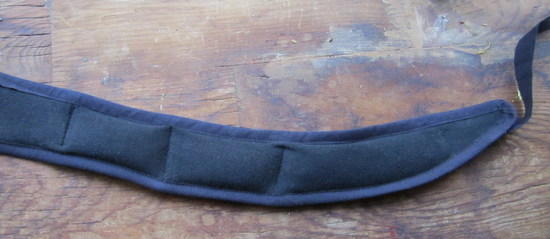
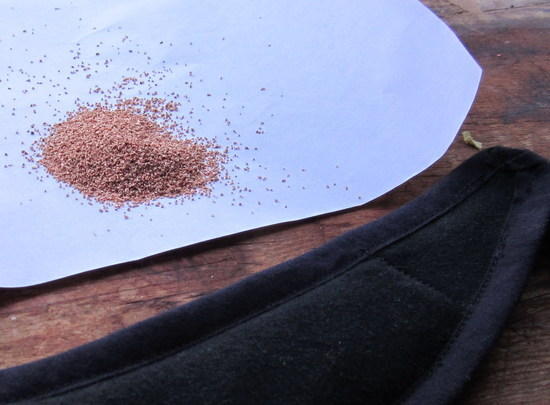
One project Ive been Im working on is to make a petroleum free sustainable pack. I figured the biggest challenge is the straps so I concentrated on those. traditionally pre industrial canvas and packbasket packs used some kind of simple leather or webbing strap. These really aren't comfortable with any real weight so I wanted to see if I could find a way to recreate modern straps with sustainable materials. The biggest challenge was to find a replacement for foam or mesh. It needed to be flexible and non water absorbent (at least reasonably so)After chasing a few dead ends I came up with using natural cork granules. What I did was make "bean bag" straps.
materials:
hemp canvas
hemp/lycra blend for back of strap
hemp/cotton blend grosgrain (bias tape)
metal ladderlock- still to be added
cork granules
weight : under 2 oz a piece, so I think they will be about 4-5 oz for the pair with ladder locks added. Not SUL but I never expected using natural materials would be. Still they are light and Im pretty happy with the weight.

straps front

straps back

chambers

cork

Some things I learned after finishing them,
-They could easily be made simpler and lighter.
-The bias tape is not necessary but looks nice.
-I could probably get away with just 2 chambers of cork instead of 3 making it lighter and simpler.
-I could fill the chambers with less cork
The next step would be to attach these to a bamboo frame or packbasket and see how the straps preform over time and under stress.
I would like to mention that these straps feel really luxurious. They are really plush and the natural materials just feel nice.

Nick Gatel BPL Member
PostedJun 16, 2011 at 8:33 pm

Nice work… very ingenious. BTW, I think Lycra is partially made from petroleum-based products. It is amazing how many common materials we use daily come from petroleum… but I am not entirely sure Lycra is. Any product with polyester fibers typically comes from ethylene, a petroleum product. It has been decades since I took chemistry.

David Drake BPL Member
PostedJun 16, 2011 at 8:39 pm

Really interesting. Did you try cork sheet at all, instead of granules?

PostedJun 17, 2011 at 12:02 pm

@Nick- I do believe Lycra is petroleum based. This is more of a prototype and Im not being really puritanical about it. I also used polyester thread. Both things are not ideal but I had a bunch of it so I used it. I am a little worried about the long term durability of the lycra blend. Next time I would just use canvas on both sides. but it feels real nice against the skin!

@David- I looked at cork sheets but they are too stiff and will just crack. They dont have enough flexibility for what I wanted. the rubberized ones where kind of heavy and even though the flexibility was a little better they still are not flexible enough and just break apart. I thought about sewing small sections of cork sheet into the straps but I think granules is a better solution.
Thanks

PostedJun 17, 2011 at 12:46 pm

This is a really interesting project. I've considered this myself. Heavy silk and linen both have good strength per unit weight, although not quite as good as hemp. They might be appropriate for the pack body fabric. They could be waxed to reduce water absorption. Too bad the efforts to produce spider silk fabrics on a commercial scale have not come to fruition.

What about "green" polymers, produced by a chemical plant but of non-petroleum (milk or starch) origin? Would you consider these? They tend to have poor mechanical properties, and I can't think of an application in which they wouldn't be outperformed by metal, bamboo, or other natural materials. I've seen them used as a matrix in natural-fiber(jute) composites that outperformed fiberglass/epoxy, though. Just curious about your materials-selection process.

Keep us posted. This is very innovative.

Dustin Short BPL Member
PostedJun 18, 2011 at 3:13 pm

Green polymers are definitely worth looking into. Bio-plastics, especially the biodegradeable variety are far from compostable (they barely degrade after 180 days in a compost heap, much slower in a less microbially active environment like a pack) and should hold up well. May be worth looking into.

Lycra is definitely petroleum derived.

PostedJun 19, 2011 at 8:32 pm

The biodegradable/green polymers thing is a little beyond me. I think that is where gear producers should come in. They are the ones who have the money and resources for that kind of thing. I hope someday they will.
But for now Im just going back to basics. I think my idea is to just make a modern pack with more traditional materials.
I just got it in my head one day to do a hike with all natural/sustainable gear. The idea just stuck with me and became a fun challenge. it also reminds me that its strange how an activity that is all about going back to the wilderness and enjoying nature is so full of marketing gear and clothes that are not sustainable. I know most of the reasons are practical but I just got it in my system.

PostedJun 20, 2011 at 10:02 am

Sustainable are fun to work with but their not the answer for the environment. Archeologist are still finding clothes made out of natural fabric from hundreds and thousands of years ago. Metal buckles are croc to produce metal in steel mills cause way more pollution in the air.

Use polypropylene at least it recyclable through Patagonia or other companies.
You could use for example polypropylene webbing ,fabric,fleece for padding and nylon buckles. you would have more environment friendly product because it can be recycled over and over.
IMHO
Terry
http://www.patagonia.com/us/popup/common_threads/faqs.jsp

PostedJun 20, 2011 at 1:47 pm

"Archeologist are still finding clothes made out of natural fabric from hundreds and thousands of years ago."

Terry, It seems to me that you are making the point that natural fabrics don't break down, and using the very small number of fabric scraps recovered at archaeological sites as evidence. That would be silly, though. I must be misunderstanding your point. Very old scraps of fabric only survive under extreme circumstances (in anoxic mud, dessiccated tombs, under perpetually frozen snowpacks, etc.) If your point were accurate, those fabric scraps wouldn't be so precious to archaeologists, and we wouldn't hear about it in the news. Prehistoric fabrics would be for sale in thrift stores. The fact that they only survive under very rare conditions illustrates how readily natural fabrics break down. Put a cotton shirt in a compost pile and it will be in tatters after a year and gone in two.

I agree with the observation that metal hardware may not necessarily be environmentally inocuous due to the byproducts and energy requirement of manufacturing them. But the OP specified that he's only attempting a pack made of materials that don't contain petroleum products. Most fabric dyes are petroleum based, so he'd have to use undyed (or naturally dyed) fabric, but otherwise he seems to be on the right track.

Recyclable would be another endeavor alltogether. And inventing a pack that has the smallest possible "carbon footprint" would be a third completely different undertaking. One could also try to make a fair trade/ethical pack, or a pack with materials made locally. But these would be different projects. The OP explained what he's attempting. An imaginary pack would be the only way to accomplish all of these goals at once.

Viewing 12 posts - 1 through 12 (of 12 total)
Loading...