This quilt is my first and it’s not quite finished. I’m not sure when I’ll get time to attend to the last details, so I thought I’d go ahead and post about it.
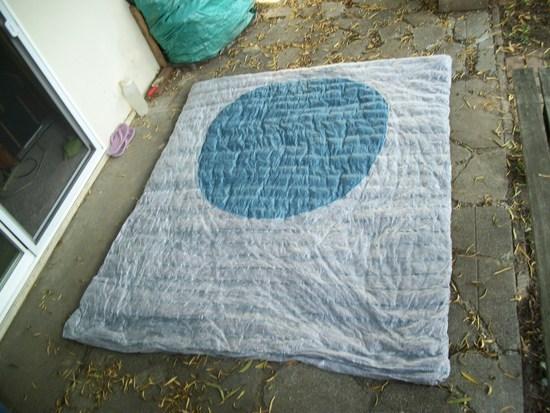
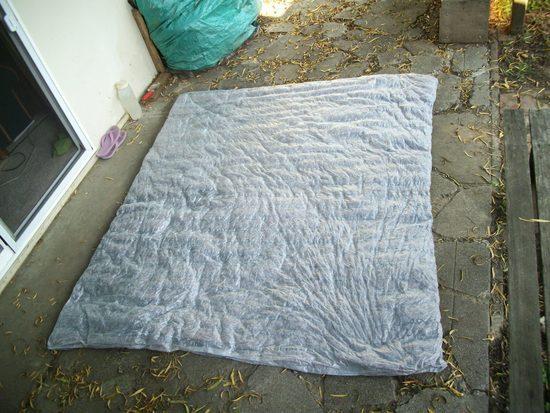
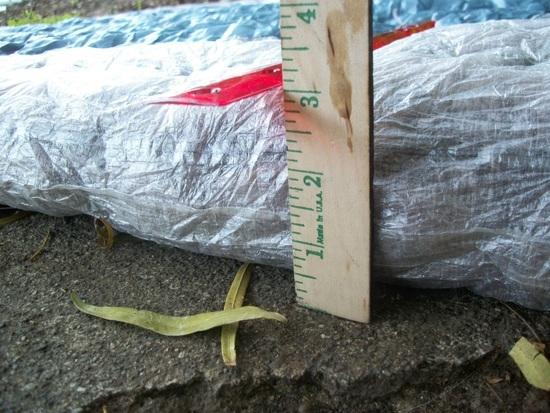
Given that my girlfriend and I are both slender and not particularly tall, this double quilt is huge (74” wide x 80” long). I chose these dimensions because I plan to attach tabs to the top that can be used to suspend it a little under the tarp (like a low net-tent), to make a little quilt-tent for warm nights. In total it weighs 29.6 oz, of which 23 oz is a mixture of 750 and 800 fill power down, some of which I dyed brown as an experiment a while ago. The total weight of the shell is about 6.6 ounces, which makes the down/shell material weight ratio 3.48. The loft averages about three inches. The baffle walls are 2.75” high and spaced three inches apart. It packs down to about the size of a gallon jug.
The shell is mostly 0.33 oz cuben. It is completely bonded, so, insofar as the cuben itself is waterproof (not strictly true), the quilt is waterproof. In the center of the quilt, though, on the top side only, is a fabric patch analogous to the “skunk stripe” on the historic cuben quilt made by Tim Marshall for Steve Evans. The fabric patch is an oval 3 ½ feet wide and 4 feet long.
The fabric I used for the patch is polyester ripstop kite fabric. It originally weighed 0.98 oz/yard on my scale. It had a melamine coating and is pretty heavily calendared. I used a chemical bath to strip off the coating and dissolve the surface of the fibers a tiny bit. It now weighs about 0.71 oz/yard, and it still seems very strong and down-proof. I don’t recommend trying this. The M50 fabric, from Thruhiker, would be a much simpler alternative if it still existed (and it has a DWR for the same weight).
I think a fabric patch for drying out the down is a good idea for sewn cuben quilts, but for a bonded cuben quilt like this one I guess one could argue it either way, because the patch itself is really the only way for water to get in. I decided to try the patch idea more or less arbitrarily. I chose the dimensions and placement of the fabric patch to minimize the risk of the fabric being wetted by rain splatter or contact with condensation on the tarp.
The baffle walls are made of 0.29 oz/yard nonwoven nylon. This material is very similar to nonwoven polypropylene (like agricultural “floating row cover”), but it’s nylon 6,6 (which has about twice the tensile strength of PP). This was sewn to 1/2” wide strips of 0.33 oz cuben, and the cuben strips were bonded with 3M 4693H plastic-bonding contact cement to the shell material (but sewn to the fabric patch). I tried Hysol U09lv at first, but using the two-part adhesive was far too time consuming for fifty-six 76” bond lines (354 feet of glueing). I’m glad I used the contact cement instead. I used an irrigation syringe with a very fine tip to put a hair-like thread of glue on the shell material and then immediately pressed down the strips sewn to the baffle gauze. When I tested the bonds later, I actually found that the bonds made with the contact cement have better peel strength than the early bonds I made with the Hysol, and I popped a couple of stitches in the nylon/cuben strip seam without causing the cuben/cuben contact cement bond to budge. I think others have also reported finding that contact cements have good peel strength on cuben (maybe Steve or Lawson?).
Anyway, I’m glad that I was able to establish for myself that a cuben quilt shell can be made by bonding alone without any weight penalty or apparent loss in strength compared to sewing. I always wondered about that. I’ll post updates when I get around to adding under-pad cordage loops and suspension tethers for making a little quilt-tent. Any feedback is welcome.