Topic

golite jam modifications

  • This topic is empty.
Viewing 14 posts - 1 through 14 (of 14 total)
Zack Karas BPL Member
PostedNov 22, 2006 at 8:26 pm

Hi all,

I am looking forward to the new Jam to come out. I have the old one and have always wondered if I should remove the foam back panel and cut out the bladder sleeve (never found it that useful or comfortable when in use). Has anyone done this and what were the weight savings? Pros, cons?

PostedNov 22, 2006 at 9:17 pm

I’ve modified my Jam as follows:

1. Cut out the foam backpanel and hydration bladder sleeve (and removed the foam backpanel).

-No real disadvantage as I didn’t use a hydration bladder in the sleeve since it caused a bulge along my back that was uncomfortable. I’ve used a 2L bladder in one of the side pockets and it works fine. Padding in the back was also unecessary since I put my sleeping pad along the back anyways.

2. Trimmed extra lengths of straps down on waistbelt, shoulder straps, etc.

-No disadvantages

3. Removed all the daisy chains except one, and also the ice axe loop and top holder on one side.

-No disadvantages, as I rarely used these at all. I kept the ice axe loop and top holder on one side in case I want to strap some trekking poles to the pack.

I can’t recall how much the pack weighed before, but after the mods my size M pack weighs 18 oz.

Dan

Nathan V BPL Member
PostedNov 23, 2006 at 6:52 am

I did about the same as Daniel did, size M 17.4 oz. No cons, Pros: lighter, gets rid of unused features.

Dondo . BPL Member
PostedNov 23, 2006 at 9:46 am

Zack, I considered removing the bladder sleeve and foam back panel but decided not to for these reasons: The hang tag on my size medium Jam says 1lb.5 oz. but mine actully weighs 1lb, 3.1`oz. Saved 1.9 oz. without doing anything. :-) I prefer bottles to hydration systems so don’t use the sleeve for a bladder. But I cut up an old Mt. Washington pad that was no longer comfortable for sleeping and made a triple-duty sit pad, leg pad(while sleeping), and pack frame (in the Gossamer Gear/Six Moon Designs tradtion). Each piece of the two-section pad is 7″x20″ and they are hinged together with tape. Slid into the hydration sleeve it increases the comfort of the Jam for me with heavier loads. The foam back panel weighs 0.7 oz. and was a canditate for removal. But I decided to keep it in when I discovered what a great pillowcase the Jam is. Since I wear most of my clothes to bed, the only extra padding I usually have is my raingear. The raingear + inflatable pillow + Jam with foam back panel = a really comfortable pillow. Combined with a self-inflating torso pad and the Mt. Washington leg pad, you get luxury sleeping accomodations at not too much weight.

Zack Karas BPL Member
PostedNov 23, 2006 at 1:33 pm

Thanks for the replies. The only reason that I can see for not removing the foam panel is that I use this pack under my legs at night, so the added insulation is nice. I imagine that the new Jam with modifications will be hard to beat. I’ve already gone on 10 day trips with the current Jam with no problems–incredible for a pack this size and weight.

Mark BPL Member
PostedNov 24, 2006 at 8:39 am

You can definitely do some good trimming with the Jam. My modifications:

-Trimmed 6″ from each hipbelt adjustment strap. I’m kind of skinny.
-Trimmed 6″ from each shoulder adjustment strap.
-Trimmed about 3″ from the drawstring cord, so it has just enough to open completely.
-Trimmed about 3-4″ from the top compression strap–just enough to arc over a completely full, but completely cinched extension collar.
-Cut out the hydration pocket that I never used.
-Cut off the hydration tube spandexy-loop-guide things.
-Cut out the pad pocket & pad–most of my gear is squishy, and typically use a sleeping pad inside. Something like a Gossamer Gear Thinlight serves well here as cushion and supplementary night insulation.
-Chopped off the ice axe loops. I live in the southeast.

The medium-sized pack went from 20.1 to 16.7oz. And I think I could lose a bit more from the straps.
-Mark

PostedFeb 6, 2008 at 8:50 am

I haven't made permanent mods to my Jam2 yet, so maybe this isn't an issue. But I would think after cutting and trimming fabric and straps you would have loose ends that will fray. I assume on the straps you can just burn them. Do you then sew it double backed like they had it so that it doesn't slip out of the buckles?

What do you do to keep the fabric inside from fraying (i.e. when you cut out the hydration sleeve)?

EndoftheTrail BPL Member
PostedFeb 6, 2008 at 9:31 am

Ryan:

Three methods that you can use to prevent the edge of newly-trimmed straps / fabrics from fraying:

1. singe with a BIC lighter
2. coat with seam sealant
3. fold over and sew

The fastest and easiest is #1 — just be careful. I would use #2 for hard-to-reach interior places where the risk of burning is too great.

PostedFeb 6, 2008 at 9:34 am

If you want the ends to be a little stiff and fray-proof another way to finish them is to SuperGlue them. This is useful if you want a little stiff section at the end to make it easier to poke through buckles while at the same time tending to not slip out of a buckle accidentally.

PostedFeb 6, 2008 at 3:33 pm

Zack, I use my Jam2 as insulation under my feet too. But try and remove the foam insert before you bed down and find out if there's any negative impact. Replace it if there is. Personally, there's always a few items left in my bag which I scrunch around to flatten the bag out. They give me just enough extra height for insulation above the ground and this system works well. In fact, I have used it recently down below 20degrees. You'll carve out quite a few ounces once the insert, sleeves and their hardware are gone.

-Michael

PostedFeb 7, 2008 at 4:34 pm

Mark (or others),

When you remove the ice axe loops, there is a hole left over from the rivet that I would assume rain would get in. Any thoughts on the best way to fix that? (If it's not pouring, I don't bother putting a pack cover on).

Update: SWEET! I got my size large pack down to 15.1 oz!

PostedFeb 8, 2008 at 1:50 pm

I dropped the weight of my Jam2 by 35%! Total weight (size L) with the ice axe loops in is 15.1 oz.

1) Cut off excess webbing on hip belt and front shoulder strap adjusters.
2) Remove sternum strap and hip belt buckles (reversable). I don't use the hip belt if I'm under 20 lbs.
3) Remove foam back panel and cut out everything inside (foam back panel sleeve and bladder sleeve).
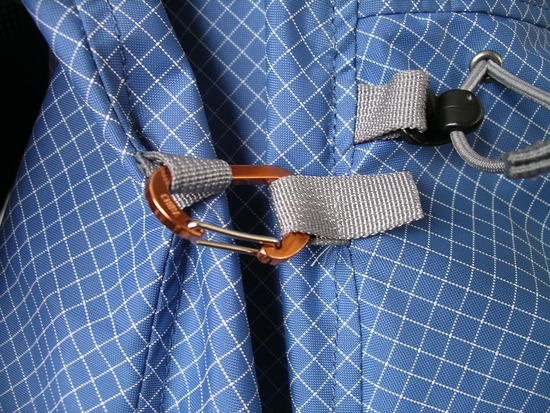
4) Cut off side straps and buckles. Hand-stitch loops in the straps you cut off. If you anticipate needing the "Compactor" system, bring 4 MLD Biners (0.1 oz each) and connect when needed.
5) Replace the top drawcord with Kelty Triptease (reversable).

For me, functionality has not been impaired at all. (This all depends on how you personally use the pack of course). It is 7.4 oz lighter and there is less fuss, less webbing to get in the way, less things to go wrong. Volume to weight ratio went from 142 cu.i per ounce to 212 cu.i per ounce! I am stoked to get this thing out on the trail!

MLD Biners
Side straps gone

PostedFeb 8, 2008 at 2:16 pm

ryan, it looks like it has jesus' seal of approval also. good job!

PostedFeb 10, 2008 at 1:11 am

I've done some mods and tracked the weights in g for cutting thigns off

Side straps and buckles: 20
Inner Foam pouch: 28
Inner Foam: 20
40mm buckle and strap: 64g

I've done the same thing with compression as the above poster – cut off the side straps and formed it into small loops that are sewn back onto the seams as he's done.

The side buckles were cut off with a pair of snips so that their fabric loops remained intact.

To compress I now use a bit of nylon cord and a cord-lock. The two together are a little less than the straps cut off but allow me to compress the pack more how I want it. I've also sewn another couple of small loops onto the front seam of the pack so that I can make a standard front X- compression system if I want.

If you are completely removing webbing from a pack the simplest thing to do is to cut the webbing close to and parallel to the seam and sear it with a BIC lighter – being careful not to torch the pack.

Although the Jam is a lightish pack there is weight hidden in strange places – the webbing is heavier than it needs to be. The side pockets are quite heavy and so on.

Viewing 14 posts - 1 through 14 (of 14 total)
Loading...