Topic

MLD Trailstar Question

  • This topic is empty.
Viewing 15 posts - 1 through 15 (of 15 total)
PostedApr 28, 2011 at 12:25 am

I was wondering if someone who owns one could provide the exact dimensions of each edge (the MLD site says they're 7' but is this exact?). I'm also wondering if each side is a perfect equilateral triangle (ie are the "ridge lines" the same length as the ground edges?). Thanks!

PS: Is condensation a problem in the tent? I wonder why MLD doesn't sell it with peak vents like the 'mids have.

Travis L BPL Member
PostedApr 28, 2011 at 4:42 am

If nobody answers about the measurements, I'll try to get them to you later tonight. From memory, the edges are indeed 7', and the ridgelines are around 78". I'd have to confirm that though.

Regarding condensation, yes, it can happen. However, the Trailstar is large enough so that it's easy to avoid touching the walls. It can also be pitched much higher off the ground than the mids can, which greatly increases ventilation, which in turn reduces condensation. Peak vents are simply not needed as condensation really is a non-issue for me in the Trailstar. Plus, they would take away from the absolute simplicity of the shelter.

David Chenault BPL Member
PostedApr 28, 2011 at 6:24 am

Just sauntered to the basement while coffee brews.

Stretched tight the panels are indeed 7', and are indeed equilateral triangles. Bear in mind that the edges are cat cut.

I've hand condensation, especially on damp nights with two guys in a low pitch, but not what I would consider problematic or especially voluminous condensation. With a higher pitch it just hasn't been an issue for me.

Though bear in mind I'm not using this in Georgia in July.

PostedApr 28, 2011 at 11:48 am

There's second hand info floating around that the Trailstar isn't available in cuben because it doesn't pitch right without a little stretch in the fabric. This fact just doesn't make sense to me (though I'm sure Ron would know best). It seems that if you made one with cuben, and a very slight cat cut on all seams/edges, it would pitch just fine…

The only problem I have with the Trailstar is that it ways 16 oz, not including stakes and seam sealing, so I speculate that when all is said and done it's checking in at 20 oz. Cuben would certainly solve that…

Travis L BPL Member
PostedApr 28, 2011 at 11:56 am

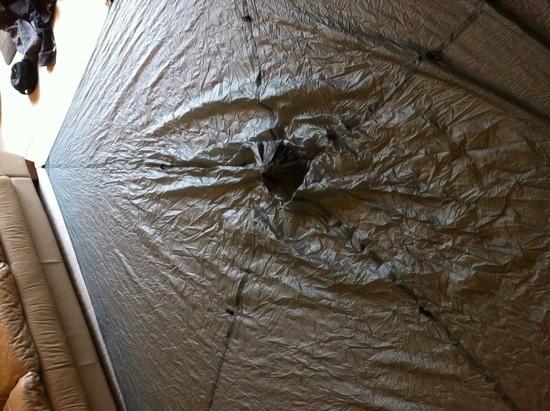
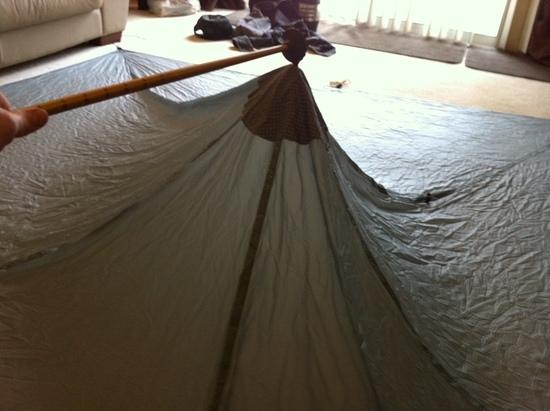
If laid flat on the ground, the Trailstar does not, um, lay flat. The center bulges up a little, like there is a built in cone shape to the shelter. Maybe this has something to do with it.

PostedApr 28, 2011 at 12:01 pm

The cone-shape is obvious based on the design. Five equilateral triangles (are they indeed equilateral?) sewn together would form a "cone" (it would take six for it to lie flat, forming a hexagon). This doesn't explain why cuben couldn't be used. Cuben is used for MLD's large mid designs (as well as the solo Trailstar) and they are experiencing the same tensions and long ridge lines as a Trailstar… The only issue I see is one of labor: Cuben is only available in 54" rolls and would require seams.

PostedApr 28, 2011 at 12:28 pm

I can only tell you what Ron told me when I specifically asked if he'd make one in cuben. He said no, the design needed the give/stretch/whatever to provide optimum results.

PostedApr 28, 2011 at 12:34 pm

Cuben doesn't stretch and the Trail Star is set up drum tight. Given the use in high winds, I believe that Ron is more concerned with potential tearing than anything.

Edit – Doug beat me (What's new)

PostedApr 28, 2011 at 1:15 pm

Huh. Even with cuben's superior strength/weight? Go figure. I wonder if that's why there are no vents in the top (the holes would weaken the panels too much)…

Travis L BPL Member
PostedApr 28, 2011 at 2:57 pm

My Trailstar has 7-foot sides, and 78" ridges. I just measured.

It would appear that they are not equilateral triangles (at least mine isn't)

Although not stretched incredibly tight, the slack in the material near the center is visible, as is the cone shape in these pictures. Sorry for the sideways photos. Stupid iPhone camera technology.

ulo
iykl

I think that in order to get a nice tight pitch, this shelter's success hinges on the stretchyness and give of silnylon. When tightening the linelocs, you really can see the material stretch. I'd question the usefulness of cuben in this design as well. But until someone makes one, we'll never know for sure! Regardless of actual dimensions, this shelter works, and works well.

PostedApr 30, 2011 at 1:01 am

…it's just deceiving because of the catenary cut. When you measured the ridge lines, did you measure when it was laid out flat (as in that first photo) from one of the stake out points to the center, or did you measure with it pitched relatively taught from a stake out point to the apex? If the former, then it would make sense that your measurements were shy of 84" (7') due to the cat cut.

Travis L BPL Member
PostedApr 30, 2011 at 4:11 am

I laid it flat, but pulled the ridge lines taut, though it wasn't pitch-tight.

Edit: Are you referring to the measurement taken when the shelter is pitched right from the tieout to the apex, on a level plane, and not directly along the fabric?

Jim Colten BPL Member
PostedApr 30, 2011 at 11:05 am

I don't have a trailstar so I can't measure this, but geometry tends to argue against the trailstar being made of equilateral triangles with 84" sides.

* If it were built that way then the "height" of the triangle (distance from the peak to the base line) would be 84*sine(60 degrees) = 72.75 inches. That requires fabric at least that wide if the sides are not pieced together and I've never seen a trailstar photo with a hint of a seam in the panels. 72" wide silnylon is not unheard of but is very unusual.

* In MLD's own words: "A tight ground pitch on all sides has a center height of about 36". Pitched tight to the ground it will cover a pentagon that is 84" on a side. The distance from the center of that pentagon to the midpoint of any side is 57.8 inches. Pythagoras says the distance from the midpoint of any side to a peak 36" above the center is sqrt(36^2+57.8^2) = 68.1 inches, which is about the widest commonly available width of silnylon.

PostedApr 30, 2011 at 1:10 pm

I figured that if silnylon only comes in at a maximum of 65" widths (as on suppliers' websites), then you end up having each triangular panel being a maximum of 65" tall. If the base (or edge) of these triangles is indeed 84" (point to point), then the sides (or ridge lines) could only be at a maximum 77.4 inches. This figure doesn't take into account seam allowances, but it is darn close to the 78" ridges that Travis measured.

So, assuming 65" wide bolts of silnylon, the panels on the Trailstar would be triangles that are 84" at their base and 77.4" along their edges (which form the ridge lines of the shelter). Jim, your math says that the height of the triangular panels should be 68" not 65", but perhaps the panels are just being stretched tight – 6% stretch doesn't seem too unreasonable. There could be even more leeway here if the "36 inch" height figure is not taken too literally (for example, if the actual height was 34", then there would only need to be 3% stretch to account for the difference. The added length of tie-outs and where the measurements are actually taken further complicates the matter.

At this point though, it seems safe to assume that 65" silnylon is used to make the largest possible triangular panels (84"x77"x77"). It would just suck to try to make one of these, either out of silnylon or cuben, and find out the geometry just doesn't work when pitched. Making one out of cuben… seems to me that eliminating most of the cat cut on the ridges would be a good starting point.

Travis, the ideal way to measure it would not be along the actual seam. Because of the catenary curve, that seam is going to be longer than the actual side of the triangle. The best way would be to pitch the tarp (taut but trying avoid stretching it too much), and then take a piece of string and stretch it from a corner tie-out up to the apex of the tarp and measure the length of that string.

Although… now I'm questioning whether there is a cat cut at all between each of the side panels.

Viewing 15 posts - 1 through 15 (of 15 total)
Loading...