Topic

Re-thinking the Big 3….

  • This topic is empty.
Viewing 25 posts - 1 through 25 (of 27 total)
Nick Gatel BPL Member
PostedApr 14, 2011 at 11:09 am

Some people are always working to get to a certain base weight. Maybe sub 15lbs, 10lbs or 5lbs. With a little money and skill, sub 5lbs can be easy. I have done many trips with sub 4lb base weight. Base weights are a good method of comparing gear items and maximizing our kits. To me the more important number is total pack weight, including consumables; along with the hard to measure comfort factor.

Comfort on a trip is dependent on two factors, your shoes and your pack. We wear both the majority of the time on every trip. So what makes a pack comfortable? To me it is hiking all day, never thinking about your pack or adjusting how it carries. All my UL packs force me to think about them, because I have to adjust things while hiking. It might be placing my thumbs under the shoulder straps at times to move some weight off my shoulders for a while. With my GG Murmur I often take it off, and carry it single strap on either shoulder, alternating as I walk. Then putting it on with both straps. And at the end of the day, my shoulders “know” I have been wearing a pack all day. Not saying it is painful, but not totally comfortable.
So what is the penalty of a heavier pack that you put on in the morning, adjust the straps, and then hike all day without any adjustments, slippage, or other fiddling around? A pack you never have to ‘think’ about?

There are 3 things I look at as most important:

– Base weight without the pack (how light is all the other gear)

– Total pack weight with consumables

– FSO weight

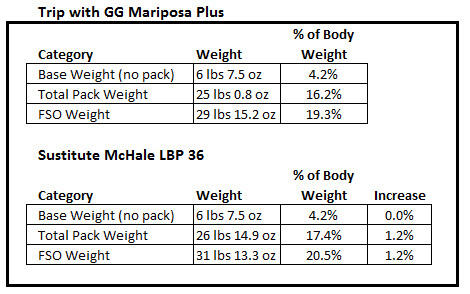
I did a few calculations for a couple trips I took. One was with a GG Murmur and the other with a GG Mariposa. I compared these with what the difference would have been using my McHale LBP 36. I also calculated weights as a percentage of my body weight (155lbs), which I think is important because we all are different, and there are some minor differences in some gear based on size.

I am not saying there is anything wrong with the GG products. I will keep the Murmur for some trips. But I am not sure how the Mariposa Plus will fit into my gear closet inventory right now. The other thing is that many UL packs are not sturdy. I replaced my Murmur once already due to damage while traveling cross country. Not the fault of the pack, but I don’t like to limit my trip based on what the gear can handle. And I don’t like the idea of owning many packs to handle different tips. Also many lightweight packs are not going to last a long time, due to the weight savings needed by construction materials and methods.

Thoughts?
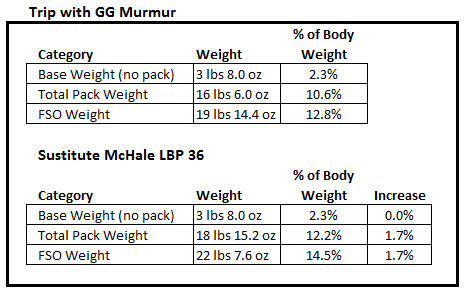
mumur vs lbp36

mariposa vs lbp36

PostedApr 14, 2011 at 11:30 am

Ive been reading your sub 4/sub 5 lists and am totally amazed, yet i totally agree that a framed pack makes a difference at some point.

I switched from a 5 pound North Face pack to my Jam on my AT thru hike and was so much more comfortable without the frame BUT it wasn't because of the weights I was carrying.

The NF pack had a big burly frame that didnt fit my body and caused lots of discomfort while the frameless Jam molded to the contours of my back. I find now that although the Jam is better fitted to me, I would like something of a frame even with low weights.

Travis L BPL Member
PostedApr 14, 2011 at 11:32 am

This is a debate that pops up once in a while, and I think you'll always have the two sides. Some enjoy their frameless packs, while others like/need the support a framed pack offers.

I'm of the camp that thinks a well-fitting lightweight framed pack will easily offset its weight with a more comfortable carry, even with a total pack weight below 20 lbs.

Yes, the framed packs add weight to the overall package, and that simply means more pounds on your back. No qualms with that argument.

BUT….a fully supported load will always carry better than an unsupported one. Even if you tightly pack your gear into a frameless pack and use a sleeping pad as a "frame," that pack is still a lump hanging on your shoulders. Obviously the lighter your total pack weight is (like for overnights or the super-ultralighers), the nicer a frameless pack will carry. But for multiple-night trips where you have more food weight and you'll have to carry your pack day after day, framed, IMHO, is the way to go.

Travis L BPL Member
PostedApr 14, 2011 at 11:34 am

Tyler,
Check out the Osprey Talon 44. It has a semi-rigid back panel that easily contours to your back, but it also has a light frame. The hipbelt is slightly stretchy and snugs around your hips very nicely. It's also adjustable to your torso size, so you can really dial in a good fit.

William Zila BPL Member
PostedApr 14, 2011 at 11:42 am

I use a talon 44 and that's the one place I don't want to do anything else with I love this pack light weight if you remove the top compartment it's 2lbs 2lbs 6 ounces with it. Its ventilated well and carries AMAZING.plus there's enough volume for longer trips over all great pack and surprisingly light for what it does

Travis L BPL Member
PostedApr 14, 2011 at 11:44 am

I agree with William's non-punctuated iPhone post.

All in good fun, William! :)

Ike Jutkowitz BPL Member
PostedApr 14, 2011 at 12:10 pm

Note the happy smile on the face of the MLD Burn user.

burn

Most of the time, I don't even notice I'm wearing it. Whatever pack you have, framed or frameless, I hope you get to experience the freedom I feel when wearing this pack.

PostedApr 14, 2011 at 12:27 pm

MLD Love Posted 04/14/2011 13:10:37 MDT by Ike Jutkowitz (Ike)
Note the happy smile on the face of the MLD Burn user.

Most of the time, I don't even notice I'm wearing it. Whatever pack you have, framed or frameless, I hope you get to experience the freedom I feel when wearing this pack.

I wonder if that guy would have the same smile, if he was hiking in the desert with 6 or 8 litres of water in his burn? I hope so, because I have one ordered. I'll let you know, when I get mine.:) I wish there was a one pack does everything, but I've never come across it. Maybe it is the Mc Hale. They look pretty interesting.

Ike Jutkowitz BPL Member
PostedApr 14, 2011 at 12:33 pm

"I wonder if that guy would have the same smile, if he was hiking in the desert with 6 or 8 litres of water in the burn? I'll let you know, when I get mine.:)"

Close to 18 lb of water? Unless your gear and food weight is 0, I'm thinking that might be a job that calls for a different tool. Good luck, my friend.

PostedApr 14, 2011 at 1:01 pm

I find a framed pack with good load transfer WAY more comfortable than a pack carried all on the shoulders, even with a pack weight of 15 lbs.

Mary D BPL Member
PostedApr 14, 2011 at 1:16 pm

I have the same issue. My shoulders are super-sensitive to pressure, making load lifters, and therefore some kind of frame, mandatory.

That being said, my SMD Comet (2005 model) with the stays works just fine. 27 oz. after a little judicious trimming. I have all the frame support I need, with more weight than a frameless pack but not unbearably so, and far less than standard brand packs. On one trip I even carried 35 lbs. My back, shoulders and hips were fine, although my knees and feet were screaming.

PostedApr 14, 2011 at 1:28 pm

Regarding:
"I find a framed pack with good load transfer WAY more comfortable than a pack carried all on the shoulders, even with a pack weight of 15 lbs."

I do agree, but I also find that a non-framed pack, with good hip belt, packed tight, with the sleeping pad acting as a frame, can be as comfortable.

I do notice the difference if I'm not careful with how I pack though.
One advantage of a framed pack is that you don't have to be so careful with how you load the pack.

John Vance BPL Member
PostedApr 14, 2011 at 1:32 pm

I too had this same thought process as I have whittled my weight down. Until last year I just couldn't take the leap to frame-less and was perfectly content carrying my SMD Starlight with the stays. While just under 2 lbs and very comfortable, I kept looking at the weights of other packs. What tipped the scale for me (pun intended), was the fact that the volume of my gear had been reduced to the point that I wanted a smaller volume pack. I narrowed it down the the SMD Swift '10 and the ULA CDT. After playing with both packs for a couple of weeks, loading and unloading, and carrying them around the local park, I decided on the Swift. It just handled my load and packing style better and I liked the full pad pocket even though I only have a piece of 1/2" foam in it. More specifically, the Swift let me place my sleeping bag/quilt horizontally in the bottom of the pack without having to really compress it. This essentially becomes the platform that all my gear sits on and the shoulder straps just keep my pack from falling backwards.

I don't like very much weight on my shoulders at all and found that when I switched to the large size, placing the top of the shoulder straps above my shoulders, I was able to get great weight transfer to the hips. This also had me rethinking my packing methods to accommodate having no structure to the empty pack. I really love the fact that I don't even think about the pack now and there isn't anything to adjust or fiddle with – a simple, elegant solution. The only thing I adjust during the day is the sternum strap. I pull it tighter on rougher terrain to keep the pack against my back more, and loosen it up to get a little airspace between the pack and my back on less technical terrain.

At 19.5 oz with my piece of foam in it, I know that for some it would be just too heavy, but coming from a full framed Jansport D5 to an Dana Design Astralplane, 19.5 oz is less than the hipbelt of either pack. The bottom line is that I have found a relatively lightweight, rugged, simple, and comfortable pack that is worth the weight because I feel better. With a typical week long trip with temps below freezing, I have a base weight of 9-12lbs and start the trip with another 8-12lbs of consumables – including water. Even if I dropped my total starting pack weight down 20-30%, if that hung from my shoulders all day I wouldn't be a happy camper.

The same thing holds true for my sleep system and shelter. I have found that a little extra weight adds up to a big difference in the quality of sleep I receive. I have a cold weather quilt for sub freezing temps that is 23.5 oz and a warmer weather quilt that works well to freezing and below at 17 oz, both of which fit the bill for very light. However, after buying and trying pretty much every pad, I am sold on a down filled air mattress. 24" wide, 60" long, and R6 at 21.5oz (Kookabay), and I would still carry it if it weighed 32 oz. When I was a back sleeper I carried a short piece of 1/2" closed cell foam and it worked great other than not being quite warm enough at times. Sometime in my late 30's or early 40's, I became a tossing and turning side sleeper and I about gave up spending more than a few nights outdoors at a time until I found something that worked.

I have found that for me the extra weight of the big 3 or 4 that I use, provides more me with more comfort during the day and better sleep at night, and as a result I have more energy and enjoy being outdoors more than if I was tired, sore, and cranky, but had a lighter pack. And this echo's the sentiment that, "you will know when you are too light when you are wet, cold, hungry, and sore".

Evan McCarthy BPL Member
PostedApr 14, 2011 at 1:41 pm

I've used many a pack but nothing feels as good (in that classic, I've made what's on my back negligible kind of way) as the Burn, even when packed to the gills. It might be the narrowness of the pack but I can't imagine a more comfortable design and weight.

Greg F BPL Member
PostedApr 14, 2011 at 2:29 pm

I have to agree with the orginal post that lighter does not always mean more comfortable. I really don't think it is about frame vs. no frame or sub pound packs vs 3 pound packs. It comes down to much more basic questions:

What is the heaviest, stiffest pack you can carry without it affecting the feeling of freedom you get from being unencumbered?

or from the other perspective

What is the lightest pack that you can use without the weight you are carrying becoming a burden?

Where these to ideas intersect is the pack that you should use.

If you look at a pack anything used to add comfort is functional weight. Extras that don't add comfort like thick fabrics, large buckles lids, are features that add dead weight. As with most gear if there is a functional purpose to the weight than it is good weight to put on your pack.

PostedApr 14, 2011 at 8:05 pm

Nick, you have a point that I think about, at least subliminally, allot. As a gear lover, I want to get to those lower base weights. But like you, I live in SoCal and many of the trails I hike require bear canisters. So, there a big strike against me cause I can't use a bear bag. But, as someone else pointed out on this site, using a bear canister sure has its convience factor. Anyway, it's nice to get down to a low base weight, but what really matters is your pack weight. And of course, your FSO weight. I just dropped about 1.5 lbs. on my FSO by going to Trail Runners and to 1/4 socks from full socks. I hope to get out in them this weekend.

I agree that your footwear and pack are the two big factors in comfort while on the trail. Some don't mind weight hanging on their shoulders. For me, I like to get it off of them. I recently went to a three-pound pack, the GoLite Quest. I hope that it's light rails and plastic sheet frame will be enough to carry a bear canister and tent. We'll find out soon.

I have never worn a UL or SUL pack. But I am a beleiver in some type of frame to support the weight you are carrying. Even if my pack weight were 15-20 lbs all out, I still don't want it all on my shoulders. But, as I am intimating, I'm never actually tried it. I just don't want to go there. I've had my eye on the ULA Ohm because it has a light weight frame. Not sure if it can carry a bear canister, but it looks big enough. Hopefully the GoLite works out though. I used an Osprey Aether last year and though it was over 5.5 lbs, it was very comfortable even mostly empty and carrying water on a very strenuous hike/climb. I've dropped my base weight considerably since then and hope to find similar comfort in my new lighter pack with lighter base weight.

Nick, great topic. Hopefully more will chime in.

Jeffs Eleven BPL Member
PostedApr 14, 2011 at 9:32 pm

Here's an old thread I started pondering the same things.

Personally I go with a beefier frame. Recently I mated my SMD hipbelt to my Dana Shadow Peak. If I would have never lost the original hipbelt I wouldn't have been buying all the packs I have now. I am totally sold on this pack. I can hook anything to it, tough, super comfy… I digress

Yes I go bigger frame.

Thread:
http://www.backpackinglight.com/cgi-bin/backpackinglight/forums/thread_display.html?forum_thread_id=33110

James Marco BPL Member
PostedApr 15, 2011 at 6:41 am

Yes. I agree with most of these posts.
A lot is how much you intend to travel with to start. And how much you intend to travel with when you finish.
My heaviest weight for the last 10-15 years was with a canoe, vest, paddle, pack and cloths. I had a 29# pack and 25# of canoe. when I weighed them when I left (at the trail head.) A total of 54# for a trip length of about 3 weeks. I used an older GoLite Trek (2lb.) My lightest was about 6.5# pounds. I used a Miniposa at about 14oz.

I don't like weight much more than 4-5# hanging off my shoulders. A hip belt and some structure to the pack is required. How that structure is obtained is another matter. Internally, or externally, doesn't seem to make a heck of a lot of difference. Mostly I use the Miniposa (no longer offered by Gossamer Gear.) It has removable stays. My tent poles, tightly rolled tarp or pad, offer other ways to support the load to the hip belt.

Mostly, the shoulder harness and torso belt keep things from shifting. This is in addition to the hip belt. The hip belt carries most of the load…about 70-80% in most cases. This takes the weight off my spine, clavicle, and chest. It puts the weight on my hips and legs. No matter what, this is where the weight ends up anyway. So, I do not agree with those that say a hip belt is not needed. For loads less than 10#, sure. But, for more it starts to become a chore. The more weight you carry, the more you want it on your hips, leading to needing better pack structure.

Weight on your shoulders can restrict breathing. It will cause you to breath shallower than normal or with more effort. This is about the same for a high hip belt restricting your diaphragm. Or the same for a too tight torso strap. I have tried front pouches but they also require a stay of some sort to carry the weight to the hip belt. With UL packs, they don't help a lot. Carrying a lot of water, sure. Water weighs a lot, you must have it. Soo, you don't have a lot of choice. Wherever you carry it, it's going to be heavy.

Anyway, I tend to go with the lightest packs that will hold about 2500-3000ci. This will do for all but the longest trips in deserts or dry mountains. 8oz-1lb packs would be my maximum for a week out, generally. Use what you bring in a packing system to create the pack structure for carrying.

(spelling)

Nick Gatel BPL Member
PostedApr 15, 2011 at 11:55 am

In my example, I replaced two of the more common UL packs with a 3 lb 6 oz internal frame pack, increasing the load-to-total body weight by less than 2% in both examples.

Your legs are not going to notice this incremental increase in weight. Due to improved balance, agility, and overall body comfort, it may actually allow you to perform better with greater enjoyment. The only potential downside could be the tendency to add extra stuff you do not really need because the pack can handle it. If we stay focused on all the other UL equipment and techniques, maybe the pack can just be removed from our Big 3 or even base wight considerations.

Just food for thought.

PostedApr 15, 2011 at 12:17 pm

I agree that comfort is king. I wear trail shoes, so my feet are happy. I'll never go back to a framed pack though. I much prefer a frameless pack that has no rigid areas to dig into your back after a few hours. I find it amusing that after 30 years backpacking, i've come full circle from 'fussy' packs, back to a simple bag on my back that i 'wear', rather than carry.

PostedApr 15, 2011 at 12:38 pm

I've got a GoLite Jam (24.3 oz) and a Gregory Z55 (53.5 oz), and I agree about the framed packs sometimes being worth it.

In VA, some hikes that are mostly ridgeline and have virtually zero water, requiring packing it all in, can get really heavy. If the pack weight is going to top 25 lbs, I'm better off with the Gregory for overall comfort at the end of the day.

It's a valid discussion. But I think most hikers have at least two packs, suitable for different situations.

PostedApr 15, 2011 at 4:14 pm

"But for multiple-night trips where you have more food weight and you'll have to carry your pack day after day, framed, IMHO, is the way to go."

+1

I seldom take trips less than 6-7 days, so a frameless pack is out of the question, for me at least. I've found the OHM to be just about ideal in this regard in that it will carry up to 30-32# in relative comfort, and 25# very comfortably, which is where I end up on 10-11 day trips. If I ever end up doing overnighters or 2-3 day trips I'll have to reevaluate, but I suspect there won't be enough of a savings in a frameless pack to make enough of a difference to offset the comfort of my OHM. So I'll probably just stick with it. I also like the simplicity and economy of having only one pack for all trip lengths and conditions. It has also been very durable in some fairly rough terrain over the last 2 years.

PostedApr 15, 2011 at 4:33 pm

"I've had my eye on the ULA Ohm because it has a light weight frame. Not sure if it can carry a bear canister, but it looks big enough."

Warren,

It is big enough to hold an Ursack stacked vertically, which means it should hold any canister 8" in diameter.

Ross Bleakney BPL Member
PostedApr 15, 2011 at 4:46 pm

I think the one thing that this shows is that it is really hard to summarize how much weight we carry. It is easy to just say "skin out" but that doesn't really tell the story. The pack plays a huge part in the overall comfort, regardless of its weight. One of the great things about the new, really light frameless packs is that they are fairly comfortable (as well as being really light). I could make a backpack that is lighter by grabbing a garbage bag and attaching a couple of nylon shoe laces, but you wouldn't want to do that. Likewise, the framed packs that exist out there are much lighter than the standard ones found ten years ago (and still commonly found). They provide just as much comfort, but a weigh a lot less. Unlike most of what you use (sleeping bag, sleeping pad, tent, cooking supplies) a pack is actually a critical component to your comfort when you hike. The other things are just dead weight. There are trade-offs with every item, but any ounce (or square inch, for that matter) you save in those "dead weight" items make the hiking part of the trip more comfortable (even if the camping part is less so). That isn't necessarily true of the pack, or the shoes.

Likewise, the "skin out" measurement seems silly with things like a T-Shirt. I wear my T-Shirt all of the time. For the most part, I could care less what it weighs. But if you don't count "skin out" weight, and only count "weight of items in the pack" then things can get silly on the other end. I can "save" four ounces by just taking my camera out of my pack and slipping it into my pack. That's why, in general, it makes sense to just look at rough numbers. I use pack weight (including the weight of the pack) when I talk to my hiking buddies. It is really easy to calculate (using a fish scale) and it is impressive enough to get those guys to consider going ultralight.

Ike Jutkowitz BPL Member
PostedApr 15, 2011 at 4:50 pm

Interesting thread, Nick, all the more so because you are accomplished at hiking with SUL loads. I'm glad you're enjoying the new McHale so much.

I did disagree with the heading some posters used, lightweight vs comfort, implying you couldn't have both. For me, lighter is more comfortable, and I sure don't miss the way padded hipbelts shackle my gait. However, most of my trips involve total pack weights less than 12 lb, and by day 2 or 3, that drops to well under 10. By the final days, I feel like I can fly.

Were I carrying 8 liters of water like one poster, or going on trips longer than 1 week with no option for resupply like Tom, I'd probably opt for a light frame too.

Viewing 25 posts - 1 through 25 (of 27 total)
Loading...