Topic

PCT / summer backpacking list — input appreciated

  • This topic is empty.
Viewing 21 posts - 26 through 46 (of 46 total)
PostedFeb 2, 2011 at 3:19 pm

I'm with Mike, all of it is sound advise. In addition to other advise, I'd like to reiterate that crampons will almost certainly be unnecessary.

Even if you keep most, or all, of your gear listed, it seems to me that the Circuit is more pack than you are gonna need, unless you are doing really long food carries.

Additionally, The Driducks and wind jacket are redundant, I'd just stick with one, probably the Driducks as it is more versatile.

PostedFeb 2, 2011 at 6:00 pm

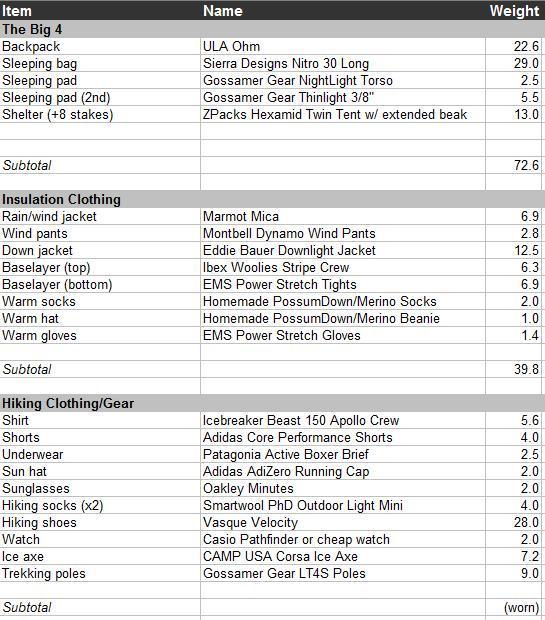
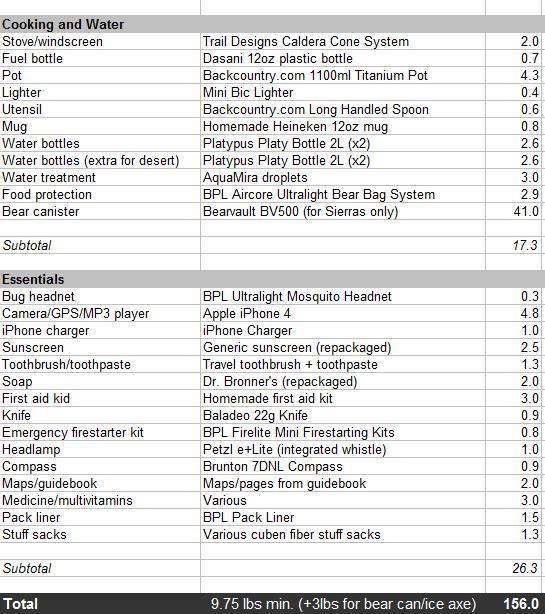
I took most of Mike’s gear recommendations and made some big reductions in my pack weight. Right now, my gear list is at 9.75lbs exactly–4lbs down from before. I didn’t come up with 7 lbs of savings, although it’s close to that if you count the weight of the bear canister (which I was only going to carry in the Sierras regardless, otherwise I will hang my food). One thing I did not change was the sleeping bag, mostly due to budget. I recently bought the sleeping bag I listed here, and I can’t find a decent quilt for any sort of reasonable cost. However, I’m going to attempt to make my own quilt after some sewing practice, so if that works out I could cut an additional half pound off of my base weight. It’s the same story with my down jacket — a bit heavier than I’d like, but getting the top of the line stuff is prohibitively expensive for me. Anyways, here’s the list.

pctlist1
pctgear2

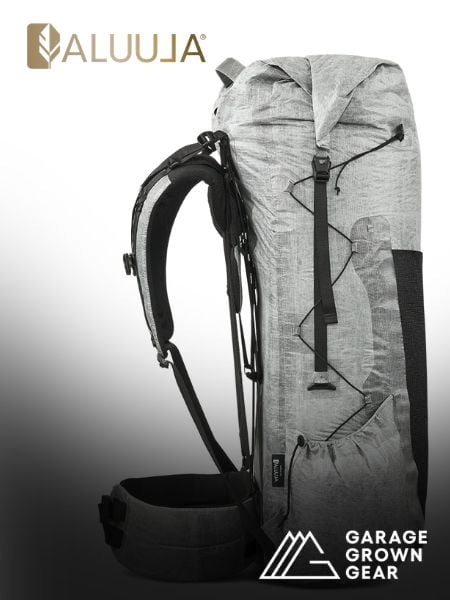
The two big cuts are the pack and the tent. From the research I’ve done on resupply along the PCT, as well as on the ULA Ohm, it seems like the ULA Ohm could be the perfect pack with this trimmed down list. It looks as though I could do an average of 4-5 day resupply periods (possibly less), with a max of about 6 or 7 days. I’m basing this off of resupply strategies found here and here. I’d estimate that my average “fresh” food supply weight would be about 10lbs at 2lbs per day, with an absolute max of probably 15lbs. So, I would have to think that my total max weight would never go above 33-35lbs (12.75lbs for Sierras gear + 15lbs of food + 5lbs (~2.5L) of water). According to this recent post about the ULA Ohm, the “sweet spot” is less than 30lbs, with optimal being 20-25lbs. One guy even said that he did 40lbs, which wouldn’t be ideal but certainly OK for short stretches. Unless there are any major objections, I think I want to go with the ULA Ohm at a savings of about 22oz.

Does anyone have experience with the ZPacks Hexamid? I think that it should be ideal for the PCT, and the added bug protection is nice. Am I correct in saying that a bivy is unnecessary for this shelter? The downside is that it costs about twice as much as the Tarptent, but I think that the weight savings (21oz) are probably big enough to justify that. It also pretty much requires that I carry trekking poles, which I’m not accustomed to. They seem like more trouble and cost than they’re worth, but maybe my knees will disagree.

If I succeed in making some homemade down gear, I may be able to get to about 9lbs of baseweight. I’ll start with the quilt, and if that isn’t a disaster I’ll try making a down jacket (using Thru-Hiker’s patterns).

I will trust Mike on the crampons issue, since I wasn’t too sold on them to begin with. I will need some place to find training for an ice axe, though.

Let me know your thoughts on the snazzy new list.

PostedFeb 2, 2011 at 6:20 pm

Hi, Brendan,

Re the question of how many days' food you'll need to carry, that's going to depend a lot on how fast you guys like to hike, and also on what style of hike you want to do. Some people want to get up in the morning, hike all day, and not stop until it gets dark. Others want to fish, bag peaks, or just spend a lazy afternoon by a beautiful lake. I've only hiked the JMT, not the PCT, but I believe the JMT section is where there are the most difficulties with resupply. The long section in the Sierra without easy resupply is between MTR and Whitney. That part *can* be done in 5 days, or even less — the question is whether you *want* to do it that fast.

Carrying two bearvault BV500's for two people is going to be pretty inefficient. The bearvault doesn't hold very much in relation to its weight, which is why it's cheap. Depending on how fast you want to cover the Sierra, a single bearikade expedition might be enough for both of you, and that would be a huge saving in weight. Bearikades are expensive, but you can rent them from the manufacturer, or maybe borrow one from a trail angel.

3 oz seems like a lot for aqua mira drops — do they really weigh that much? If you want to dedicate 3 oz to water treatment, you might want to consider a steripen, which will kill protozoan cysts very quickly. The batteries will last for longer than the time between resupplies. Water treatment is not necessary for the Sierra section, especially if you're selective about where you collect water from. A steripen is about $90, but that might be cheaper than the amount of aqua mira you'd need.

-Ben

PostedFeb 2, 2011 at 10:18 pm

UNDER 10 POUNDS od BASE-WEIGHT!

That's ULTRA-LIGHT!

Did you buy the ZPACK HEXAMID TWIN yet? If you don't use trekking poles, don't take 'em.

The GG SPIN TWIN doesn't require any trekking poles. 8.6 oz!!!
LINK:
http://gossamergear.com/shelters/shelters/spinntwinn-tarp.html

And you'll be fine with just a tarp and no bug netting. Andy Skurka doesn't take a tent on the PCT! You'll be so light that you can find bug free environments (ridge lines with a slight breeze, hi elevations, etc)

– This GG shelter is big enough so you won't need a bivy or a floor. Take a scrap of tyvec (cheap and 2 oz) for a ground cloth if you really want one.

– A heavy sleeping bag is fine. You'll spend 1/3 of your time in it, so it's nice to be warm.

– A nice down coat is awesome, keep what you have. You'll spend a lot of money upgrading, and you'll save the weight of two CLIF bars.

Steven Paris BPL Member
PostedFeb 2, 2011 at 11:16 pm

Brendan, if you are interested, send me a PM about my SpinnTwinn, which I keep intending to put up for sale, but go back and forth about various shelter options. Btw, I think your list looks really good. I don't know when most SoBo'ers start, but just a general warning about the amount of snow that can be in the PNW forests, even up to early July — I live here and I always get surprised when forest roads are still closed. That said, most of it will be walkable. Finally, I saw that you have friends who live in Portland, but if you needed a place to mail things to that could be brought to the Columbia Gorge, I'd be happy to help.

PostedFeb 3, 2011 at 1:12 am

A couple of things..Cascades snowpack is currently 74 percent of normal – that bodes well for a southbound trip. But do monitor the weather.

Don't worry about spending money on "Delicious Mexican Food" on the PCT – as far as I remember, there wasn't much of that. But what there was seemed much more delicious at the time due to constant hunger.

PostedFeb 3, 2011 at 1:16 am

If you want Mexican food, then definitely eat at Arribas in Idyllwild. It may not be the greatest Mexican food, but it's great to me, and the serving sizes are sized for thru hikers…especially if you get there on Tuesday for the $1 taco special.

PostedFeb 3, 2011 at 3:01 am

I'm not a big fan of base layers. I assume they're for sleeping in? I find that I'm not willing to get in or out of them when it's cold. I just go to sleep in my hiking clothes, and if that makes my quilt stink, I don't care. So I don't carry that. Same with sleeping socks.

I'm still searching for the right set of rain gear. Zpacks CloudCape and CloudKilt are intriguing.

Like you, I also want to try making down gear from a thru-hiker kit. I have a New Balance Fugu jacket that is great, but I want to try a down vest…although that may not be the best thing to combine with the short sleeves of a CloudCape.

I don't see long pants on your list. Wow, I could not hike like that.

PostedFeb 3, 2011 at 10:33 pm

Eugene wrote:
_______________

"I just go to sleep in my hiking clothes, and if that makes my quilt stink, I don't care."

Right on for you!

This is an lightweight camping forum and you are my new hero!

PostedFeb 3, 2011 at 10:47 pm

I agree w/Brian up above, since you're low on funds and you already own it, run with it! It's a solid tent.

The only other thing I'd recommend, which I'm actually new to but really like, is a tarp. Alpinlite, MLD, Mountainfitters, the list goes on…all have tarps, very light, spacious models, and an option would be a bug tent that attaches to the inside of the tarp. Both Alpinlite and MLD, for starters, have lightweight two person bug tents fir tarps. Gives you the option of being just tarpy, or bug tent tarpy. :). I'll be doing a review on my tarp/bug tent set up this week on my YouTube channel.

PostedFeb 4, 2011 at 11:38 am

"And you'll be fine with just a tarp and no bug netting. Andy Skurka doesn't take a tent on the PCT!"

Yes but he does take a bivy with bug netting. No?

PostedFeb 5, 2011 at 8:52 am

Ok, if you are wearing clothes full of sweat, doesn't that make it harder to sleep warm? Hey, I have slept in clothes plenty of times, but after a while, it's nice to let the clothes dry out on a long trip and sleep in something else, like long underwear. In areas with low humidity, my clothes dried out fast, but anywhere with moisture, I found it almost imperative to get out of the wet/damp stuff of else my down bag/quilt would be gain extra moisture, making it far less effective.

Dirk

James holden BPL Member
PostedFeb 5, 2011 at 12:03 pm

dirk…

thats when you pray there's going to be sun so that you can dry yr bag … for weekenders it isnt usually a concern

you can also try a hawt nalgene inside so the extra heat pushed out the moisture … which of courses costs you weight in fuel unless yr burning wood

PostedFeb 5, 2011 at 1:54 pm

Reply to sleeping in clothes.

Obviously, you'll need to take off any wet clothes before climbing into the quilt. But, I think that the term "extra" clothes or "sleeping" clothes is a bit of a distraction for me. You should take the clothes you need to deal with the expected (or possible) weather. You need to be warm and comfortable, no need to suffer.

Taking a set of long underwear is fine, because those might be put to good use in the event of cold (or wet) weather. But, those are your layers, nothing "extra" about them. And potentially -ALL your layers are "sleeping" layers.

If it's been raining and I'm camping under a tarp, here's what I do.

If it's raining, it's usually pretty warm. It is a lot colder at night in clear weather.

I strip off my outermost layers. The layers next to my skin should be (mostly) dry.

I take off my socks and trade them out fro a dry pair.

I keep the wet stuff I took off in a pile under the tarp. I know from experience it won't dry out over night, and I just put them back on (cold and wet) in the AM.

If my down sleeping bag gets damp, I will ANY the opportunity to dry it off during the next day. THat might mean strapping it to my pack if it gets sunny (and breezy) while hiking.

=

Also – sweaty clothes are different than rain soaked clothes. If you are sweaty during the day, and you have synthetic fabric, these should be totally dry within a few minutes after you finish hiking. If you hike VERY slowly and at a relaxed pace for the last 1/2 hour of the day, you should dry out just fine. If it's so hot that you are sweaty at night, being cold won't be an issue.

Dale Wambaugh BPL Member
PostedFeb 5, 2011 at 2:09 pm

"I keep the wet stuff I took off in a pile under the tarp. I know from experience it won't dry out over night, and I just put them back on (cold and wet) in the AM."

I think some reports of Yeti screams were just me putting cold socks and boots on in the morning :)

Makes you walk at a good clip!

PostedFeb 5, 2011 at 3:31 pm

Thank you everyone for your all of your help and replies. Planning for the PCT is obviously a lengthy recursive process. I won't bore you all with my constant waffling on the ULA Ohm vs. ULA Circuit vs. GG Mariposa Plus issue.

Ben — You make some good points about food resupply. I guess I have been looking at things from the perspective of what is possible, rather than what is desirable. That is likely a mistake. There is definitely merit to staying out on the trail for long stretches of time. I suppose I should be prepared for either possibility (10 day stretches or shorter ones) since it's probably one of those "see how I feel" kind of things. That's also a good tip about the Bearikade Expedition, although the price (even with rental at $6/day) is kind of tough to swallow. As far as the water purification method, I've only ever used Aquamira for purifying water–and I love the stuff, it's liquefied peace of mind. It is a fair point about the cost though, I will have to try to calculate that difference out.

Mike — Thanks again for all of your tips. I haven't yet ordered the Hexamid Twin, that's going to require a pretty big investment. I am looking into cheap tarp options to gain some experience with before making a decision on shelter options. Bug protection would be nice (I have to make some compromises due to hiking with my girlfriend), but I'm not at all opposed to sleeping with just a bug net on over my face. Especially if I'm going southbound (likely scenario), bugs should not be as much of an annoyance.

Dirk — Thanks for the tip on the snowpack in Washington. As far as Mexican food–ah well. I guess the demographic is different in trail towns than other places I've visited/lived in California. Authentic Mexican food is something of an anomaly in Michigan but I will survive.

Eugene — As far as the baselayers go, that is something that will probably require some testing. They are mostly for the purposes of staying warm when I sleep. I eschewed carrying a 20 degree bag with the understanding that I might need slightly warmer clothes for sleeping, since I tend to sleep cold. It also adds to versatility, since I can use them for hiking (at least the top baselayer) in slightly colder conditions. To be honest, based on the temperature data I've looked at, I could do without them–particularly the pants baselayer. It's not so much the smelling issue–I personally take it as a point of pride when I see the disgusted look on peoples' faces when you come back into town (favorite quote: "mommy what's that smell?" — little girl at the snack shop on top of Mt. Washington). I do have an interest in keeping my sleeping bag relatively free of body oils and sweat/moisture in addition to an extra amount of warmth while sleeping (which I need). I considered carrying lighter and cheaper silk baselayers for this purpose, but I could really use those for hiking and thus they aren't as versatile. You do make a good point about not wanting to get out of hiking clothes and into baselayers at night. That was a problem when I owned these insanely constrictive Marmot tights that were impossible to get on.

Dug — I actually haven't purchased the Tarptent Rainbow yet, I think I must have posted that by mistake. I was strongly considering it though (in addition to the Tarptent Squall). I do however have a SMD Wild Oasis which I own for solo use.

Bryan — I would bring a small iPhone wall charger for use in towns. I'm not exactly sure how good the battery life will hold up, so I will use it sparingly. I only plan to use it as a GPS if I get in a bind or for making sure I'm still on the trail periodically in snowy Northern Washington. I don't need, or always like, music when I'm hiking but it's kind of a nice luxury sometimes.

Thanks for the replies everyone, all of the fresh viewpoints help me keep the gears constantly turning.

PostedFeb 5, 2011 at 7:32 pm

Eugene, you also mentioned a lack of long pants for hiking. I do have a light pair of wind pants for chilly conditions or to shed rain. Additionally, I am bringing the Polartec Power Stretch tights, which would also help repel a bit of water if worn under the wind pants.

As far as some sort of long hiking pants to wear on a daily basis — I don't see the value in this. It would be clammy and uncomfortable for me, and at extra weight. It's easy to ignore the weight that is carried on your body itself, but I would still expend energy carrying those extra ounces. In this case, it's about a half pound extra for pants (if I got something like those convertible cargo hiking pants that people seem to like).

Also, I can't support this with any sort of substantive physiological theory, but reasoning by analogy tells me that the extra weight held in the pants fabric located below the thigh would actually feel relatively heavier than an object weighing the same amount that you carry in your pack. I'm basing this off the rule of thumb that one pound on your feet = five pounds in your pack (I think it's actually closer to six pounds, the figure comes from US Army research). The logic, I suppose, is that you would expend more energy moving a weight that is further from the force that is acting on it. The way I think of it is like a donut weight on a baseball bat. If you were to place the weight on the handle of the bat, it would feel lighter when you swing it than if it were located at the end of the bat. Disclaimer: I have no formal knowledge at all about physics, physiology, kinesiology, or anything of that nature (I study math and economics, we don't look at the real world). Translation: I'm basically making this up, although it sounds true. Can anyone back me up?

It's pretty shocking if you actually work out the numbers. A 2oz pair of gaiters would, in effect, weigh 10-12oz (again, reasoning by analogy). That's as much as my tent! I'm glad I ditched those.

PostedFeb 5, 2011 at 7:58 pm

If temperature was the only reason for wearing pants, I'd go without it. My main reasons are for sun, tick, poison oak and scratch protection, pretty much in that order of importance. Tick protection is somewhat provided by the fabric, but also by a coating of permithrin. I also wear a long sleeve shirt for the first two reasons. If you aren't worried about those things, then good for you. As far as the base layers go, that's not a big deal because you can always send them home or drop them in a hiker box.

PostedFeb 6, 2011 at 12:21 am

Dale, I completely agree…nothing like waking up on an exceptionally chilly and dewy morning to wet pants and cold socks.

Mike – I understand better, I could have foregone long underwear for most of the PCT but found it nice to have in the northern reaches and in the Sierra when it got chilly. I felt it was tough enough when it got down the single digits and low teens in northern Washingnton – but as you said, it is at least clear and low humidity under those conditions .

The worst was the constant steady rain that hovered above freezing only to snow at night. The humidity pretty much makes you thankful for any warm layers you have.

And in regards to pants, I had never hiked in them before the PCT, but for the reasons already cited (particular the issue with sun and the brushy conditions), was glad I hiked in them.

Dirk

PostedFeb 6, 2011 at 3:03 am

You might consider a pair of long pants for the first part of the trip — IMO the best way to handle the hotter, sunnier parts in the south are to wear light, loose high SPF long sleeved clothing (pants and shirt). Plus sungloves (and of course a good hat).

I personally just always wear such clothing on trail; the pant legs are long enough that I don't bother with gaiters unless perhaps in a lot of snow. And indeed they have kept me from getting my legs scratched up a few times.

The shorts approach is generally fine too, I just suggest you think about the so-called "desert" part. Of course, hikers tan (dirty legs) will help augment any sunscreen you apply, so who knows.

You mentioned snow in northern WA — depending on your personal time table, of course you might encounter this, but FWIW I did not. The only times I used the GPS on my smartphone were a couple of times in the Sierras, plus very infrequently for fun ("where exactly am I?"), or to note an unambiguous end-of-day camp location for my journal. Of the two times I recall using the GPS in the Sierras, one was because I found the trails out of Reds Meadow confusing, and so followed the wrong one for a short bit …

Viewing 21 posts - 26 through 46 (of 46 total)
Loading...