


Franco,
You can also leverage Google's calculator in the search engine and save yourself a step:
Type "3000 cu in to liter" and the first search result will be the Google Calculator result.
"49l to cu in" will convert the other way.
Topic
Become a member to post in the forums.
Franco,
You can also leverage Google's calculator in the search engine and save yourself a step:
Type "3000 cu in to liter" and the first search result will be the Google Calculator result.
"49l to cu in" will convert the other way.
Google's calculator is great. I often type "X gm/m^2 to oz/yd^2" to convert fabric weights, pops up a solution in the firefox google search box immediately.
I've also found the following quite helpful for converting the weights of fabrics. You can use the conversion factor 33.906 to convert oz/sqyd to gr/sqm.
"I am still searching for the short lived ultra light backpacking company or manufacture that tried to start a ultra light backpacking craze in the early or late 80's before Ray Jardine. Manufactured ultra light weight packs made out of 1.9 0z rip stop packs, clothing,sleeping bags in light blue colored ripstop. But it did not last because people were destroying the packs on one outing basically because they used the same heavy weight equipment they used for normal backpacking."
Nancy,
>>The Wavelocks do work<<
I obtained my 20 mm / 3/4″ Waveloc ladderlocks from ITW Nexus. I obtained the 3/4″ grosgrain from Quest Outfitters that I tried using with these waveloc/ladderlocks.
After completing my MYOG pack , loading it with my normal gear and adjusting the shoulder straps everything seemed fine. I tried it out on a practice “walk” and the grosgrain slipped allowing the shoulder straps to go slack and the pack to swing from side to side.
Maybe the 1″ waveloc with 1″ grosgrain would supply more “grip” and less slip.
I’ll continue to look for the lightest useable combination but I went back to standard ladderlocks and 3/4″ nylon medium weight webbing on my pack as I do not want any surprises or unnecessary problems in the field.
FWIW I carry a light load and I don’t use a hip belt with my pack.
Party On,
Newton
When trying to make something completely new, it becomes a completely new pain in the neck that consumes three times more man hours than doing something you know or have done already.
Aaron,
Amen! Brother Amen!
Party On,
Newton

"[Y]ou won't know how to make something perfect, until you've made it once, and most likely many more times than that."
Javan,
If you're referring to categories of things, like say, tents, then as painful as it is, guess you are right. Experience counts.
If you're referring to a specific project, am hoping you are wrong. Except for the "perfect" part. Nothing is ever perfect, IMO.
But if you are right … OUCH! All that time planning, for nothing? Well, winter time is the time for projects, and we'll will see what develops. By late spring, I'll know if you were right!
– Yes, you can make it. Whatever it is, you can make it. It may take you 4 tries and end up costing twice what you could have bought it for (or not, fortunately, sometimes), but you certainly can. Sometimes, though, maybe you shouldn't. There's something to be said for the division of labor.
– Tell your sewing machine it's beautiful. Take it out to dinner. Make it feel special. Sing sweet songs to it. Never badmouth it (at least where it can hear you). Do this long enough and those little hangups it always has may become less frequent…
– Get a rotary cutter and mat. Cutting is so much faster than with scissors!
i glue the stuff down first with rubber cement. sometimes i use heat sealed fabric glue. you can always get glued tulle off of silnylon or teflon impregnated fiberglass. wine helps. make an order of operations list (ops list) if the thing is a complex pain (like a tent window or a front bag). a walking foot is a fun toy. but in the end, sewing is not really all that fun. and unlike the wine, it's just a means to and end. a roller foot can help keeps things going straighter. some annoying people sew better than others. that sort can probably spell too.
@ Aaron: “When trying to make something completely new, it becomes a completely new pain in the neck that consumes three times more man hours than doing something you know or have done already.”
I’m not so sure. I made my first backpack (external frame, modular) a few years ago (with materials I had readily available at home) and it turned out really nice, versatile, strong, completely waterproof and comfortable -obviously, I’m biased because I made it myself :)-, but far too heavy (1.403 gr / just over 3 lbs). Over the years I’ve altered some things and have been able to bring the weight down to 856 gr (30.19 oz). Now, I’m trying to make a whole new version, based on my experience with my first trial, with materials bought specifically for the occasion and I’m aiming at a very light weight (less than 1 lbs) without losing comfort, strength, waterproofness, etc. Well…… I’m spending more time on research and finding the right material, than it took me to make the whole backpack in the first place. Maybe it’s because I want it to be perfect and that might not be feasible.
Sierra West was founded by Dick Kelty's son in Santa Barbara, CA and made some neat lightweight packs and tents. They stumbled on the "Big Dogs" T-Shirts and got out of the outdoor business. Their packs were made in a light blue.
Could it be Stephenson Warmlite? I guess they are still around, but I hadn't heard their name in a long time. Also, Jaand was in Santa Barbara. Their thing was durability, not so much being ultralight. I've still got a lot of Jaand stuff.
I've learned that making my own gear doesn't save money. It's usually not all that light. And when it comes to making shoes (which is the gear I like to make) it is almost an advantage to not quite know what you are doing. You don't get stuck having to do things based on 1000 years of craft that has gotten way more complicated than necessary.
It was alpine light I remember the advertising and the wire imbedded in to foam frame.
The reason I can't find anything on the internet is it was short lived company.
People were blowing the seams out of the pack using traditional heavy gear in ultra light weight packs.
Stepenson warm light is still in business making expensive quality cool tents and sleeping bags.
To bad they don't make the nudist theme catalogs any more.I was going to buy a tent back from them back in 1993.
One talk on the phone with Todd Bibler sold me on his Bibler GLT tent I have to this day.
Here's a google book archive of Sierra West article that appeared in backpacker, I have found the google book archive a good history book and tool on backpacker magazine.
I am sorry this thread morphed in to something new because I made one comment about things I have not learned.
I am trying to learn the roots of modern ultra light backpacking. Ray Jardine is great guy with great ideas. But I think he should not get full credit for the ultra light backpacking and it roots their is many people who practiced this type of backpacking before for him.
Backpackers in a whole have always been ounce counter trying to lighten their load some how some way. When I first read Colin Fletcher book about backpacking with a fanny pack could be the first modern ultra light backpacker.
Ultra light backpacking has been around for years in in rucksacks from europe to american hobo's with all their gear in tied up bandanas on the end of a stick. Modern day homeless people have all their belongings in cheap day packs . Or kids going over night camping in the local wilderness with day packs.
We did not start getting heavy backpacks till people in world war 2 , korean conflict came back and bought army surplus backpacks. Their was also the wooden frame trapper back packs. I am sorry I am a strange history buff . But I feel History we can learn from because it repeats it's self every so often.
Terry

You can start simple and work you way up too. Make a stuff sack or a fanny pack, or your own take on a Flash 18 pack.

Javan, thanks for the info on the size of the needle hole in the throat plate (big oval or small round).
I've been sewing on my wife's Bernina for 35 years. Prior to your post I hadn't noticed that the throat plate is reversible. One position has the oval and the other has the small hole.
What else is right before my eyes that I don't see? I have much to learn.
My pleasure Daryl. Hope it helps. =)
Just wanted to mention. A friend sent me a handful of the 3/4 Waveloc ladder locks, and they held the grosgrain I had on hand extremely well. So I dunno, maybe there're different models?
I'll definitely be using them on my next pack build or mod regardless.
As with anything though, YMMV.
I just did a gear shakedown 24 hour camping / hiking trip in 32 degree weather.
I learned that my MYOG top quilt made with 3.7 Climashield Combat and a drawstring footbox didn't keep me warm enough. ;-)
@ Javan,
Did you use the wavelocs on a piece of gear or did you just thread some grosgrain through and test the performance by pulling on the webbing with your free hand while holding the waveloc in your other hand?
Are yours the single or double bar type?
Do you know where you got the grosgrain from? Who was the manufacturer or distributor?
>>As with anything though, YMMV.<<
Mine varied and I'd still like to find out why so that I could use the ones that I have on hand successfully. :-)
Party On,
Newton
How much weight would be saved by using grossgrain over webbing on a typical ultralight pack?
Jack,
More than likely it would only be a gram weenie scale that would find the difference in the weight. :-)
I had constructed a pack using the grosgrain and standard ladderlocks that did not work well at all. I got some wavelocs and installed those on my pack straps and unfortunately they slipped also. I then had to bite the bullet and endure the ordeal of changing the grosgrain and the wavelocs out on my pack to install webbing and standard ladderlocks.
Bummer!
Party On,
Newton
Party on!
Excellent!
Jack,
As a rough guide, nylon grossgrain is about half the weight of the nylon webbing that most buckles work well with. So, for example, 1" wide grossgrain weighs roughly the same as 1/2" regular nylon webbing.
I have found, by the way, that 1/2" nylon regular webbing works well with 5/8" buckles. Adjustment is easier with the 5/8" buckles than with 1/2" buckles, in my experience.
John,
I admit, I only tested it by hand. Although I prodded and pulled in weird ways. It was regardless a much much firmer connection than using regular ladder locs.
It was just some generic grosgrain from hancock or something on a small spool. I have some of the owf "light" webbing in the shop, which isn't ribbed like grosgrain, I can check it. I think it's even lighter.
As to the wavelocs, they look like these as far as I can tell. I left them at the shop though, so I'm not looking at them right now: http://global.itwnexus.com/content/apex-waveloc-ll-dual
Become a member to post in the forums.
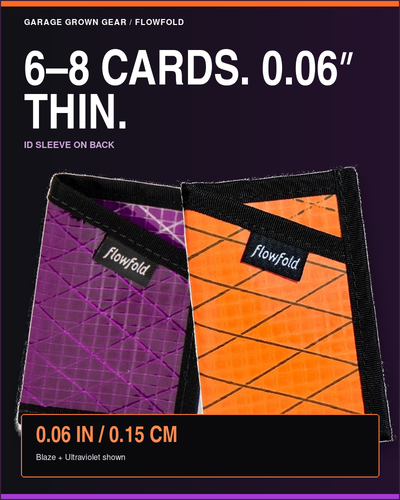 Minimalist Card HolderSlim card holder made from recycled sailcloth. Weighs just 0.5 oz.
 © Beartooth Media Group Inc.
 Loading...