I appreciate the comments and questions :-) I’ll try to explain what I’m trying to achieve and the research I’ve done so far.
My body is through with 20″ wide sleeping pads. It is very disappointing to have a great day in the woods and wake up the next morning feeling like somebody dragged me through a corn field due to a narrow pad. I sleep on my side with a leg kicked-out so I should have realized ahead of time that a 20″ wide pad would not be adequate for me, Therm-a-Rest nor closed-cell. I recently measured the width of my usual sleeping position and it is approximately 30″.
So, I thought I would try to build a 30″ wide sleeping pad comfortable in temperatures from ~0-32* F.
Climashield XP/Combat
My original idea was to spray adhesive on both sides of a piece of Climashield XP or Combat and sandwich it between two layers of heat sealable fabric. This appears to be the simplest construction method. However, Bender at Kookabay.com said “I find that XP is not tough enough to be used like a self inflating mat uses foam bonded to the nylon”. That led me to seek foam instead, similar to the Therm-A-Rest approach.
Open Cell Foam
In an email communication with James Atherton at Foamorder.com (see below), he recommended an open cell conventional foam and explains why in his email. He recommends their Y33 or EconoFlex C33 and explains why. However, the exact R values are unknown and their weight values for a 72″ x 30 x 2″ piece are:
Y33: about 1 lb per cubic foot = about 2.5 lbs for that piece
EconoFlex: about 2 lbs per cubic foot = about 5 lbs. for that piece
Two pieces of 72 x 30 4.4 oz sq yd heat sealable fabric weighs 14.66 oz or 0.915 lbs.
2.5 lbs + 0.915 lbs = 3.415 lb sleeping pad, at the very least.
Cost:
$56.70 foam
$19.14 foam shipping
$27.16 4 yards of 4.4 oz heat sealable fabric
$103 total (not including fabric shipping)
+ spray adhesive
+ ~$8 valve
An unknown R-value, approximate weight of a Therm-a-Rest Base Camp XL (4 lbs.), and higher cost of a Therm-a-Rest Base Camp XL are all discouraging reasons not to pursue this option. This might be an option, though, if foam could be purchased locally therefore eliminating shipping costs.
Therm-a-Rest Base Camp XL
The Therm-a-Rest Base Camp XL is the lightest 30″ wide insulated sleeping pad I have found so far… oh, and it weighs 4 lbs.
R-value: 5
Weight: 4 lbs.
Price: $100 (~$80 on sale)
Blue closed-cell foam
Each roll is 20″ wide and three rolls could be used to create two 30″ wide layers.
Pro’s
– easy construction
– lightweight
– inexpensive
Con’s
– 3 rolls are very bulky
Unknowns
– R value
KookaBay.com Method
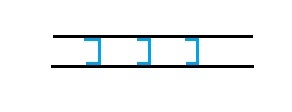
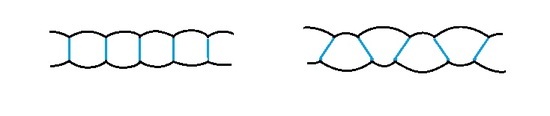
Heat sealable fabric is used and Bender mentioned that “the best design, although very time consuming, is to cut strips of nylon and use them as internal I beams.” I am considering this method but several questions come to mind:
Can Climashield XP/Combat be used ?
If so, should it be adhered in spots (spray adhesive) ?
If using down, amount needed to be comfortable in 0-32* F ?
Time for a mental health break…
Advice is appreciated!
Nick
Email communication with James Atherton at Foamorder.com
— first email —
Thank you for contacting us at foamorder.com. If you are looking for a foam that will perform similarly to the Therma-A-Rest mats, this would need to be made from an open cell conventional foam. The advantage of this type of foam is that you can squeeze the air out of the foam so that it can be compacted very small and it is a light weight foam. The weakness is that you will need to use an impenetrable covering that is air tight and moisture proof. Open cell foams well absorb moisture like sponge and retain it as well. If the covering becomes punctured at all, the foam will not handle moisture well, won’t compact as easily and will not do a good job of supporting a person by itself. Freezing temperatures should not affect conventional open cell foams, but they are not as insulating as closed cell foams due to the open cell nature of the material.
You can find this type of foam in the conventional foam section of our site, I would recommend you consider the EconoFlex, DuraFlex and EverFlex types: http://www.foamorder.com/cushions.html.
Closed cell foams are commonly used for camping mats. Closed cell foams have a closed cell structure that is impenetrable. Closed cell foams don’t absorb moisture, don’t need to be covered, are very insulating and roll up easily. However, while you can roll up a closed cell foam, you will not be able to compress/deflate it do to the closed cell nature of the material. Closed cell foams are very durable, it doesn’t matter if it gets scratched or punctured, and freezing temperatures will not affect the material. Closed cell foams offer a high insulation value.
The following link will take you to our closed cell foam section, I would recommend you consider the FloTex and EVA foams: http://www.foamorder.com/closedcell.html.
— second email —
Thank you for your reply and for the positive feedback. While I would normally think the EconoFlex C55 would be a good choice for a 2″ mat, I’m not sure how it will function for your particular application. With the design of this style mat, you will be receiving a lot of your support from the air that is trapped in the cover when it is inflated. My guess is that with the air also supporting you, this foam may feel hard although you could slightly adjust the firmness of your mat by letting air out.
I don’t know the specs of the foam used in the Therma-A-Rest mats, but I would guess it is a very light weight and soft foam from my experience with this mat in the past. I double checked the weight of one of the mats for you. Based on the specs of the Base Camp 2″ thick Therma-A-Rest mat, it uses a foam that is about 1.3 lbs per cubic foot. I would normally consider this a very cheap grade of foam. I would also guess the foam is oversized to help fill and maintain the shape of this mat. Rather than a 2” foam and cover being used to fill this mat, they probably used 1.75” cover with 2.0” or 2.25” of foam that is squeezed down into the covering.
Our Y33 would be closer to the weight and feel of the type of foam used in the Therma-A-Rest brand mats, although I don’t normally like recommending it because it is a very cheap grade of foam. If you are concerned about how firm the EconoFlex C55 feels, I would guess the EconoFlex C33 would be nearer the firmness of the foam used by Therma-A-Rest, perhaps even softer.
While these foams should do well for temporarily being compressed while hiking/traveling, they should not be stored for long periods of time in their compressed state. We vacuum pack these foams for shipping purposes and they can shrink up to 20% of their size when they remain in a compressed state for a prolonged period of time. I would suggest oversizing your foam a little in the thickness to help compensate for this and I think it will function better or you as well. To create a 2” thick pad, you could use a 1.75” covering with a 2.0” or 2.25” foam on the inside. If you are concerned about how the foam recovers from being compressed, you could consider better quality foams like our EverFlex V54, V44 and V34 that all recover better from compression, but the trade off is that they are heavier.
The Y33 foam weighs about 1 lb per cubic foot and your piece would weigh about 2.5 lbs.
The EconoFlex foams weigh about 2 lbs per cubic foot and your piece would weight about 5 lbs.
The EverFlex foams weigh about 3 lbs per cubic foot and would weigh about 7.5 lbs for a mat in your size.
While the foam will offer insulation value, we don’t have R values nor other technical data on the insulating properties these foams. I would guess that the Y33 would be similar to the R value of the foam used in the Therma-A-Rest mat. They may increase the insulation value with the fabrics used in the covering, impermeable fabrics will help with insulation. The heavier foams would have a higher insulation value due to the greater density of the material and smaller cell structure, but I don’t have a reference to offer you.
Your cost for shipping will depend on the foam you end up selecting. The EconoFlex C55 will be about $19.14 via UPS ground. I’m not sure if this item will need to be vacuum packed at $8 handling or simply tightly packed for a $3 handling fee. Our packing department will make the determination of the least expensive method of packing and shipping when they pack your item(s) so you do not incur any oversized shipping fees.
Our site is set up to quote this custom sized foam for you, offer you a shipping estimate and process your order. Here is how to use our site for the item you are considering.
1. Go to the conventional foam section: http://www.foamorder.com/cushions.html
2. Scroll down to the custom shapes and click on the one of your choice, the square/rectangle will be the first shape offered.
3. Enter your dimensions in the appropriate spaces, enter fractions as decimals.
4. Click on the price quote button.
This will generate prices in many different types of foam along with detailed descriptions (scroll down the web site quote page to read them). The site may recommend dacron wrap for your item, but this is not something I would normally recommend for the mat you are wanting to construct.
For a shipping estimate, simply enter a quantity and then place the item into the shopping cart. The site will then take you to the shopping cart feature and you will see a box for UPS, if you enter your zip code the site will give you a shipping estimate based on everything that is in your cart.
I hope you have found this information helpful. Please let me know if you have further questions.
Best Regards,
James Atherton
Product Consultant
Foamorder.com
Hours: Mon – Fri, 6 am – 2 pm (Pacific Time)
Email: Product-Info@foamorder.com
Phone: 415.503.9314
Fax: 415.349.5035