


Welcoming any thoughts/tips for bonding cuben to make a air and water tight seal. Tape ?
Many thanks !
Topic
Become a member to post in the forums.
Welcoming any thoughts/tips for bonding cuben to make a air and water tight seal. Tape ?
Many thanks !
Not sure about air tight like for a mattress, but you can glue it with aquaseal Urethane repair adhesive and sealant.
Other companies make the same glue. I think Locktight for one, but not 100% on that.
Really sticky stuff waterproof and pretty nasty.
Will glue anything to anything, IE cuben to cuben, cuben to sil, or sil to sil, or to regular nylon, or to tyvek etc.
The material will fail before the glued joint on those materials.
Only thing I found that it would peel away from so far was Polycro but it took some force.
There was a guy here about a year or so ago that built a square Cuben tepee sort of shelter that glued the entire thing. If I remember right he diluted it with a thinner and brushed it on.

There’s a lot of good info contained in these threads:
http://www.backpackinglight.com/cgi-bin/backpackinglight/xdpy/forum_thread/37663/index.html
If I had to boil this down to a few tips it would be:
1) Tape where you can. It’s much faster, easier and less messy than glue.
2) The 3M & C3 tapes found here work well.
3) Design all seams in sheer, not peel (good discussion of this in 2nd link above)
4) For reinforcement patches and similar work, glue may be easier than laying a lot of tape.
5) Grommets work great for the tie outs etc.
6) 1″ tape is good for major seams, 1/2″ works well for finished edges and less stressed seams.
7) CT2K.08 (0.74oz) is bomber for tarps etc. CT1K.08 (0.51oz) works well with a good design and a bit more care/responsibility. The even lighter variants are a fairly radical fabric that requires flaw-free design and careful use. For floors, groundsheets etc you want to use heavier cuben like CT3.5K.18 (1.26oz) and CT5K.18 (1.5oz).
8) The product codes of cuben work like this: CT = Cubic Tech, 2K (the amount of spectra), .08 or .18 (thickness of mylar layers on either side).
Dan, that summary was the best post on cuben I've read yet.
You can make airtight seams using tape or adhesive but at the end of the day the material itself is not airtight.
As Dan said tape works the best for simple lap seams.

How do you put a zipper in a Cuben tarp?
Reinforce and then sew.
At a minimum, fold the edges of the cuben and bond them (ie. hem the edge) to make the cuben 2x thickness and then sew the zipper into that.
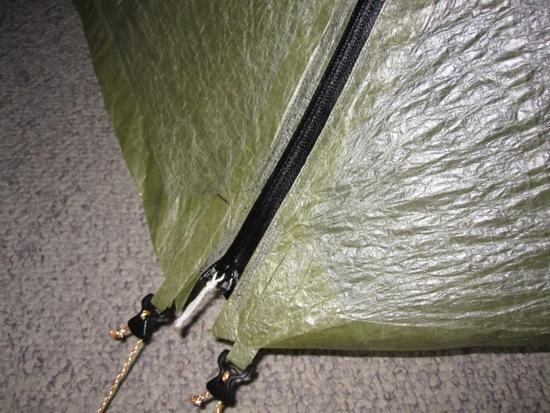
Thanks for zipper suggestion
That's just what I was thinking
Would you use a #5 or #3 zipper for a tarp?
It mentions above that there is a glue for bonding sinylon??
Can somebody post a link if so?
It's seems to say it wil be stronger than the material itself. So can I make a multi piece tarp without using a sewing machice and still end up with a super strong end product?
Above is a BPL article on silnylon laminating and it talks about glue.
> Would you use a #5 or #3 zipper for a tarp?
I use a good #3 zip on both my summer AND my winter tents. Lasted for many years with no sign of problems – but we do take care of them.
For novices and small Boy Scouts … #8 maybe? :-)
Cheers
Thanks
I've always used #5, but now I'm beginning to rethink.
The only problem is the local fabric store doesn't have #3 so I'll have to do mail order.
If you think there's going to be a fair bit of stress on the zipper then I would go #5…especially if it's fairly short zipper where the weight difference will be tiny. For most applications though a #3 will be fine. Use a waterproof (ie. uretek) zip rather than a regular zipper because it saves a lot of hassle/weight trying to make a storm flap over the zip.

Troy,
Interesting comment. Have been looking for something to seal a seam that is Epic or Sil joined to Cuben or Nylon with PU or DWR coat. Can use a more specialized sealant over the stitch lines, but also wanted to seal where one material meets the other. Sounds from your post that the Aquaseal Urethane Repair Adhesive and Sealant might do a decent job, maybe diluted. Will experiment. Thank you.
Did not want to leave my last post on this thead alone, given the results of the following:
Tried the McNett urethane sealant and found that it would not securely bond the back of a velcro pile square to the PU coated side of a scrap of 4 oz. Spectra Gridstop (peeled off fairly easily)(let it cure in a warm place). Then tried Elmer's ProBond urethane glue, and could not pull the velcro off. Have had good success with the Elmer's repairing the soles of Keen mids, and glueing velcro pile patches in them to improve fit.
Tried both the above sealants with silnylon strips on the Gridstop, and they both peeled off easily. Got me to wondering about how to seal the edge of a silnylon pole sleeve (chosen for strength and elasticity) with a Cuben canopy; so tried Permatex autoglass sealant on the Cuben, and voila', it worked even better than seamgrip, and being a silicone adhesive, adheres well to silnylon.
So tried bonding a strip of silnylon to 2K Cuben with the Permatex. It adhered well enough to pull (with only moderate effort) the mylar coat off the Cuben, exposing the fiber threads.
The posts on this site about the effectiveness of bonding Cuben with Hysol are very convincing, but does the Hysol penetrate into the Cuben threads to keep the mylar from delaminating as above under stress? If not, then stitching may be required for secure seams, with the bonding material being used to both reinforce and seal the seams.
At least I've found a good way to seal silnylon to Cuben seams, but am now concerned about just how rugged the Cuben really is. An even greater concern is about how well the mylar covering will hold up to repeated creasing of the Cuben material from folding and stuffing over time. As of now, I plan to go ahead and use it for the front half of a tent canopy, so time may tell.
Hi Samuel,
Do you have any photos (or could you take any)of the delamination of the cuben at the permatex bond? Did you pull toward an edge, and find that the mylar tore first and then delaminated toward the edge? Or did you pull away from the edge?
Samuel, good going with those glue tests, what colour is that permatex? Sounds a lot easier to buy than the Hysol, my last tube from Mcmaster Carr was a bit old , maybe shopworn ,not in a proper bag. As for durability, I noticed to that repeated folding does make it look poor but I have yet too make it leak by that means [ delamination does not seem to be in the cards]. As for glue getting past the mylar , I doubt it, sewing would help but then you would need to glue another strip over to seal.
As for tape, the basting one from sailrite it has its uses in non stressed areas , the C3 must require a rock solid technique to use. It all depends how much stress are you really going to put on it?
I find that the limit of glue [and cuben]is delamination, a fact that gives credibility to tape enthusiasts.
As to the original question here, water tight bonds, are quite easy with straight flat ones, glue or tape, but no wrinkles allowed![ easier said than done], but i have found that with complex curves that are not a perfect fit i have had to add addition layers to get a seal.
Ziff,
The Permatex has been discussed on a number of threads here, but only as an adhesive or sealant for silnylon. It is "Permatex Flowable Silicone Windshield and Glass Sealer." It is clear, and is available or quickly ordered at NAPA stores in the USA.
Thank you for the info about your experience with the Cuben. It is encouraging.
Plan to fold over the Cuben edges about 1/2" and bond them flat before introducing the edge into a seam. I believe Dan Durston has gone into some detail about this in recent posts. I will bond the seam also, and then use a very elastic nylon upholstery thread from Walmart at low tension to stitch the seam through the 2 bonded layers of Cuben and the other fabrics. The point of all this, besides strength, is to prevent the Cuben from puckering at the seam. Will seal the outside of the threads and seam edges also. Am not keen about using tape, as all my MYOG experience has been with sewing, so tend to stick with what I know. Am not sure how bonding with tape would be any less likely to rupture the mylar under stress than using adhesive.
Had planned to use the Hysol for bonding and sealing, but since the Permatex bond was strong enough to tear the mylar, and because the Permatex is much less expensive, easy to work with and bonds to silnylon, will probably use the Permatex, but will not dilute it, as I've found that this sharply reduces its adhesiveness to silnylon. Will use a small roller as suggested by Roger Caffin on another thread, and will apply the sealant as thinly as possible.
Colin,
Good point about where the tear started. Glued a two inch wide strip of silnylon perpendicular to a larger rectangle of 2K Cuben, with an overlap of about 2 sq". Attempted to peel it off the Cuben, and the tear began at edge of the Cuben. Quite possibly the tear might not have occured had I glued it differently, and attempted to peel the silnylon from the surface of the Cuben. The bond was so strong, and the Mylar so weak, I doubt it; however it might have taken a lot more force to delaminate the Mylar if I had not been pulling from the edge. Certainly hope so, as would like to use the Cuben for part of a canopy to save weight. Sorry about no pix – do not have a good camera for close up work, and am not much of a photographer. Hope the description is helpful.
Remain concerned about how readily the mylar tore away from the Cuben fibers. There was a recent post about a spot abrasion of mylar covering on a Cuben fly. The poster was not too concerned, but I am, because the mylar is what provides the waterproofness, and it doesn't take much of a breach to soak an occupant. Noted Ryan Jordan's recent discussion of some soaking just from not seam-sealing. (It may have been his account of a trek with his LHG Cuben awning tent) Have thought about what kind of natural conditions might abrade the mylar, and tend to think it is worth the risk to try the Cuben and treat it carefully; but would not use it for a floor – have concluded from experience that silnylon is best for that due to its elasticity and ease of repair. May try some Silnet on Cuben also, as Silnet comes in little repair kit tubes that are easier to take along.
I think the configuration of the test strips may not have been representative of the actual forces that you can expect to act on the material in your application. It is clear that the bond between the mylar and the underlying fibers is very weak. Cuben can easily be peeled apart with one's fingers or two pieces of duct tape (from an edge), but these kinds of forces should never play a role in the case of a finished cuben tarp or tent.
Try making a test strip, and experimentally loading it, using a configuration more like this, and see if you get the same delamination:
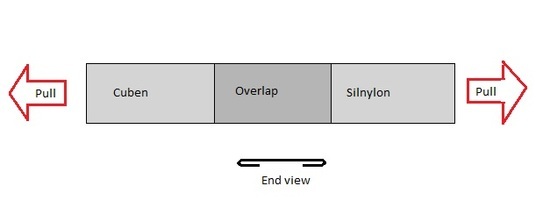
This should help to simulate a real application in which the only edges near the stressed area of material are those at the boundaries of the overlap.
Samuel, thanks for the info re peramtex i'l try some.
Colin,
Yes, some more experimentation is in order.
A couple elephants could probably not pull the strips apart as you have them illustrated. (slight exaggeration) Since the Cuben tent canopy seams will either involve Cuben to polyester fabric, or Cuben to Zipper tape, it should be possible to assemble the seams so that the peeling forces exerted by the pole sleeves are on the other fabrics, not on the Cuben; but what about wind whipping and snapping canopy fabric back and forth at the seams for hours. Or a hail storm? Or stuffing/folding a canopy covered with very fine grit (not easily brushed off) into a stuffsack. So you may be thinking me a "nervous nellie," but have learned from bitter experience to be as sure of materials as possible before spending many hours incorporating them into a tent. Probably have four or more failed tent projects stuffed into old boxes for every one that was successful enough to use and rely upon (not to mention look at). All those wasted hours (Well not entirely – did learn a bit). And the fabric in those old projects was way cheaper than Cuben.
Ziff,
The second run with the Permatex was not nearly so adhesive, yet a thin layer of the mylar did still peel off at some spots with the silnylon. ??? Did I bring the first bonded pieces upstairs into the warmer rooms a while before tearing?-don't remember. Maybe it will be the Hysol after all, for the bonding anyway, if not the sealing. More tests. Ugh.
Also wanted to mention that when I fold the Cuben edge a half inch over to bond to itself, the folded edge will be around 1/8 inch outside the closest stitch line. (There will be two stitch lines, resulting in what appears to be, but actually is not a lap fell seam). Will cut many small V's in the half inch to be folded over and bonded so that it will not overlap or wrinkle. The resulting edge will be a series of straight lines; but the stitch lines themselves will be the curve from the canopy pattern piece. Hope that is understandable. What it amounts to is that, since the Cuben is inflexible, I am thinking in terms of metal foil in imagining how to assemble it into a seam with fabric. Thought at one point about bonding strips of PU coated nylon with Hysol along the Cuben edges, and sewing the nylon into the seams; but decided that was overkill. Is it?
Tomorrow we celebrate the new year. More tests later. Got a Lumix TS2 from my brother for Christmas – will maybe work on some pix.
Often i just glue a strip of cuben along a seam for added strength or sealing..
Become a member to post in the forums.
 Vaer C4 Tactical Field SolarDurable timepiece for wilderness users - 20ATM (200m) water resistance, 120-click bezel, 316L SS casing, sapphire glass, solar-powered, Epson VS-42 Japanese movement, C3 Lume, USA assembly.
 © Beartooth Media Group Inc.
 Loading...