Topic

4 Way Stretch

Viewing 17 posts - 1 through 17 (of 17 total)
Kelly C BPL Member
PostedNov 4, 2020 at 4:18 pm

In fabrics, what exactly is “4 way stretch?” I can visualize stretch in 3 dimensions, length, width, and height (or various combined vectors of these),  but according to Einstein the 4th dimension is time.  Surely time is not a component of stretch.  Is it just a marketing ploy? Or is there a secret 4th dimension only fabric makers know about?

Roger Caffin BPL Member
PostedNov 4, 2020 at 7:14 pm

It is pure marketing rubbish. I think they justify it thus:
north
east
south
west
That’s why they are paid so much.

Cheers

PostedNov 4, 2020 at 9:21 pm

“It is pure marketing rubbish. ”

… and that is why we pay so much.                                       (well, not all of us)

PostedNov 5, 2020 at 7:43 am

How can you tell if a fabric is 4 way stretch?
2-way stretch fabrics stretch in one direction, usually from selvedge to selvedge (but can be in other directions depending on the knit). 4-way stretch fabrics, such as spandex, stretches in both directions, crosswise and lengthwise.Aug 1, 2018

https://www.google.com/search?q=what+is+4+way+stretch+fabric&rlz=1CAJCUZ_enUS831&oq=what+is+4+way+stretch&aqs=chrome.1.69i57j0l7.9853j0j7&sourceid=chrome&ie=UTF-8

Kelly C BPL Member
PostedNov 5, 2020 at 5:02 pm

So if I’m understanding this, if I imagined a point in the middle of the fabric, 4-way stretch would mean I could stretch the fabric “up,” “down,” “left,” and “right” (or north, south, east and west as mentioned above) from my imaginary point(?).  And if I stretched it in all of those directions simultaneously I could see how they get 4-way stretch out of that.


Roger Caffin BPL Member
PostedNov 5, 2020 at 5:53 pm

Well, yes, but calling that ‘4-way’ is very dishonest. It is TWO-way stretch: stretching on the X axis and stretching on the Y axis.

Cheers

PostedNov 5, 2020 at 6:19 pm

“Well, yes, but calling that ‘4-way’ is very dishonest.”

I disagree, at least from a consumer perspective. From an anal scientific perspective, perhaps. But most consumers aren’t anal scientist types. :-)

While most marketing may be ‘rubbish’, not all of it is. Sometimes marketing just ‘explains’ things in a way a ‘normal’ consumer can understand more easily. So using ‘4-way stretch’ to explain something to a consumer, so that the consumer quickly understands that it will stretch along both axes, is not (intentionally) dishonest, IMO.

[ Drew ] BPL Member
PostedNov 5, 2020 at 10:46 pm

Believe it or not, as the OP implied, it actually is 4-way [4-dimensional] stretch:

1 – up/down: as others indicated, up and down are really 1 dimension

2 – left/right: see above

3 – stretching through time: does the stretch exist through the life of the garment?

4 – stretching financial means:  does the garment, by virtue of marketing uplift, stretch the customers wallet?

Jerry Adams BPL Member
PostedNov 6, 2020 at 7:49 am

yeah, that’s what I was thinking Kelly, anal scientific

x, y, z, time

maybe it’s x, y, and then the 2 directions at 45 degree angles

if you had elastic threads running in the + and – 45 degree angle direction, that would give some noticeable difference in fabric properties

there are fabrics with rip-stop threads going in the + and – 45 degree angle directions.  I don’t know that that gives any useful differences in properties of the fabric

Matt Dirksen BPL Member
PostedNov 6, 2020 at 11:38 am

“While most marketing may be ‘rubbish’, not all of it is. Sometimes marketing just ‘explains’ things in a way a ‘normal’ consumer can understand more easily.”

Yeah, like saying an air mattress with a higher R value is “warmer” than a ccf pad with a lower R value, even though closed celled foam (as a material) is a significantly better insulator than an air mattress…

… especially if they were both measured at the same thickness (which is the traditional approach to evaluating R value in building construction.)

Mina Loomis BPL Member
PostedNov 6, 2020 at 11:52 am

Yeah, like saying an air mattress with a higher R value is “warmer” than a ccf pad with a lower R value, even though closed celled foam (as a material) is a significantly better insulator than an air mattress…

Matt, I didn’t know the R-values of CCF and air mattresses weren’t comparable.  (But I am not knowledgeable about physics or engineering.)  That would explain my personal experience observation that my Ridgerest (R 2.0 under the new system) feels a little warmer than my Flash 3-season (R 3.2 under the new system).

But since this thread is really about fabric….

Matt Dirksen BPL Member
PostedNov 6, 2020 at 2:25 pm

Hi Mina (and not to cause too much of a thread drift),

While my analogy was more indented to relate to the idea “useful marketing” to a sleeping pad with a higher R value being “warmer”, I guess I did raise the confusion between closed celled foam (R2.3 to R11.8 per inch) and inflatable air mattresses (R0.46 to R2.76 per inch.)

I will offer that your R 3.2 Flash is “supposed” to keep you warmer than your R 2.0 Ridgerest, since they are both being tested in the same way. Your observations are proving this to be the opposite, which I personally believe is an issue with the testing methodology. In fact, lots of folks over the years have expressed that their old ccf pads, generally speaking, seem to keep them warmer than all sorts of different air mattresses with “higher R values”.

(If this is something you’d like more attention given to, I’d suggest raising it as a new topic of discussion where it can be given its fullest attention by the collective BPL wisdom keepers.)

:)

Roger Caffin BPL Member
PostedNov 6, 2020 at 2:39 pm

There is a big difference between CCF and air mats. Our articles on mat testing:
https://backpackinglight.com/airmat_sotmr_part1_2011/
https://backpackinglight.com/airmat_sotmr_part2_2011/
go into this fairly thoroughly.

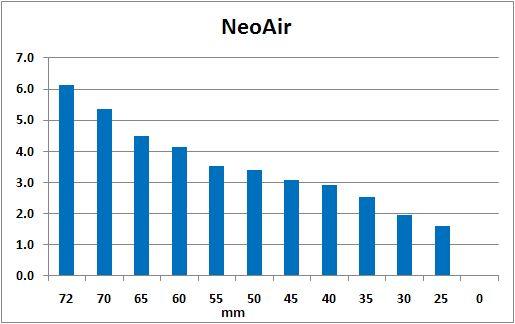
Basically, the difference between the two sorts of mats is that the CCF keeps its insulation when you lie on it, but a softly-inflated air mat can lose most of it by compression. You only get the claimed amount of insulation from an air mat when it is fully inflated, and I mean really fully, like rock hard. People just don’t inflate their air mats that much.

The cited articles give graphs showing this effect: as the air mat gets compressed down, so the insulation falls. A graph from the above articles illustrates this:

Believe me, a NeoAir mat which is 70 mm thick when you are lying on it is rock hard!

Cheers

Mina Loomis BPL Member
PostedNov 7, 2020 at 9:46 am

Thank you Matt and Roger!  I read the airmat articles way back when they were published, but had forgotten a lot of the details.  I will go re-read them.  I do keep the Flash inflated hard as my breath can go but it still doesn’t feel quite as warm as the RR.  Once upon a time I tried out a NeoAir xlite.  When fully inflated it kept popping out from under me during the night.  Had to deflate by about half to make it stay put.  I sold it on gearswap.

Viewing 17 posts - 1 through 17 (of 17 total)
Loading...