Hello there! This post has some length to it, hopefully it contains something useful.
Intro
3d printing is most known for solid plastic, however, I want to discuss a less used 3d printing material (flexible TPU) and how it can be used for MYOG projects.
Unique to TPU is that it is a thermoplastic that can be welded to fabrics with suitable but common coatings. This is how sleeping pads , tents, pack rafts and many jackets are sealed. Usually it is two coated fabrics getting stuck together, here I am talking about sticking a custom shape object to such a fabric.
Welding TPU solids to TPU fabrics industrially is not new. However, Today a 140 dollar 3d printer can create any custom shape object in great detail in TPU, and it can be welded to nylon/polyester fabrics covered with regular PU or TPU.
This brings MYOG a bit closer into an area that otherwise is only available to large scale industrial producers of gear, as injection molding is noutoriously hard to pull off at home!. Until now, my imagination has mainly revolved around replicating some industrially made solutions that previously was not really possible in home environments, Potentially, someone could create new applications that have not been done yet.
Applications:
Valve housings for low pressure inflatable structures. I have not tried to print a mouth valve, but a valve housing can be printed that accommodates commercially available sleeping pad valves (similar to the one on the picture below). Cascade designs for example sell spare valves for their thermarest pads for 8 dollars. The housing is not purchasable, but by printing it, the entire valve system on thermarest pads can be recreated at home and be added to any custom inflatable structure. The complexity of the structure that you can welded at home is off course still limiting, so you will not be making your own X-lite. However this is an example of how custom inflatables can get easier to make in MYOG conditions, with 3d printing expanding the list of good parts that are available.
Valve housings for high pressure applications. I have created parts that interface with silicone and PU air hoses that then attach a bicycle valve (dunlop/woods, shrader or presta all work). Tiny cheap bike pumps weighing 1 ounce exist, which I use for inflation. My application is to make a replica of the discontinued Klymit Airbeam frame sheet. It seems it was never a commercial success, however I like them. And I want anotherone for a backpack I am sewing. It seems to me that the proprietary valve that Klymit chose is the culprit for most of the leaks that occur, not the fabric getting pierced. What I like about airframes is that now when I can make them myself, I can make a framed backpack, from scratch, at home. This then slightly increases the motivation for making MYOG packs as in general, as there is a framed option.
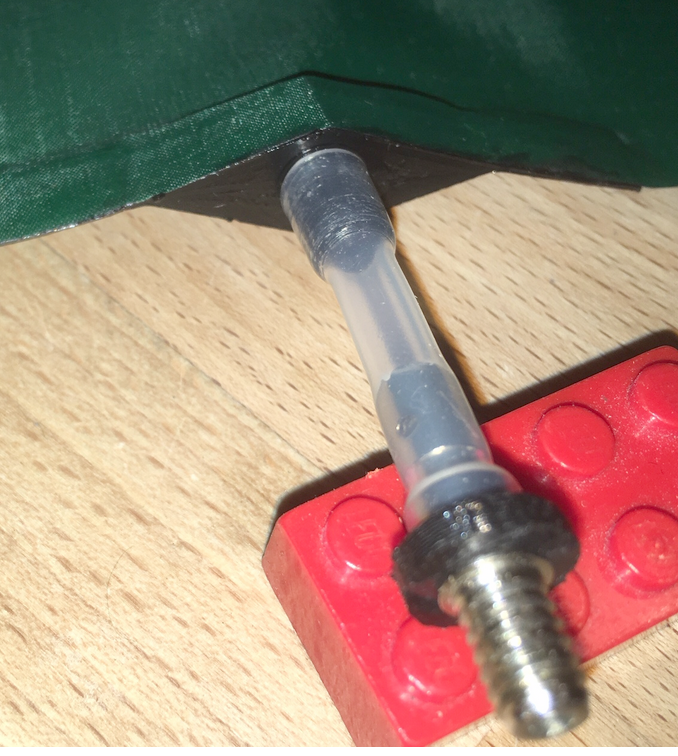
This is a 3d printed valve housing I welded to a TPU nylon fabric with a dunlop/woods valve attached through a silicone hose. (dont mind the lego). There is a hole in the housing with a diameter of 1.8mm allowing the air to go in. This design will go into my attempt to make a pack airbeam frame sheet. If the tube was given a bigger hole, a commercial replacement mouth blow up valve could be fitted to it, creating a lower pressure inflatable.
ideas for other applications – tarps, tents, packrafts, packs
Packrafts could benefit, as mounts for any item imaginable could be welded straight to the raft wall, even protruding into the raft itself. Say a gopro, GPS, fishing gear, I don’t know what pack rafters use really ;) I guess they could use somewhere to stick their paddles on the side. Clamps for paddles would be really easy to print and weld.
Tents and tarps have fewer applications I believe. Anchors, reinforcement and attachment points could be printed, but they can also be sewn in, or welded from fabrics.
This is about how far my imagination has reached so far. I would love to see others come up with other applications.
Process.
Only general TPU welding skills and tools are required. Sealing custom prints is really no different from welding seam sealing tape to a PU fabric. For general knowledge of welding I therefore refer to guides at diypackraft.com, this is where I learned a lot of it. This is just a short addition for what is specific to to 3d prints.
TPU 3d printed parts stick to both TPU and also to the PU fabrics I have tried.
TPU fabrics are usually made to be airtight with a thick layer, which means that the part can be directly welded with good strength. Because lightweight PU fabrics generally have a thin layer just to keep it watertight, a layer of TPU should be added in between to get good strength to the fabric. This can be a regular seal seaming tape for example. 3d printed parts are air and watertight. Welds to 3d prints reach max strength, meaning that if it is pulled off the fabric with force, the bond between the part and the TPU/PU layer is stronger than the bond between the laminated layer and its fabric.
Usefulness / Limitations.
3d printing of the flexible TPU likely holds different usability for MYOG than hard solid prints, as most useful hard solid parts are already injection molded and widely available. The applications of TPU in the industry is way fewer, but they are almost never freely availiable for purchase.
The usefulness of this technology is mainly determined by how it compares to sewing. A lot of solids can already be attached to fabrics by sewing, such as buckles and other hardware. I believe that anything that can be easily sewn, should be sewn and not welded. However welds are potentially much stronger than seams, as the adhesion is achieved over a two dimensional area. Also when welded, a solid becomes part of that fabric, not just attached to it.
For water and air tight solutions, the other competing means of adhesion is by glue. Welding is in most cases preferable to gluing, as it creates a more consistent and replicable bond, and does not introduce another material into the bond. Gluing TPU is messy and curing times range to up to 24 hours. Therefore I do see reasons for this avenue of MYOG to be explored.
Designs can be shared and reproduced anywhere by anyone. I recon probably up to 30 valve housings could be printed in a single go, although it would likely take something like 24 hours to do that. Material cost for the valve housing on the image is about half a US cent.
An obvious downside is that this does not work on anything silicone or cuben fiber.
Cheers!, I just want to share this as it likely holds usefulness for some select applications. If you come up with Ideas, please share them!