Topic

carbon frame pack experiment

  • This topic is empty.
Viewing 22 posts - 1 through 22 (of 22 total)
PostedDec 2, 2010 at 1:03 pm

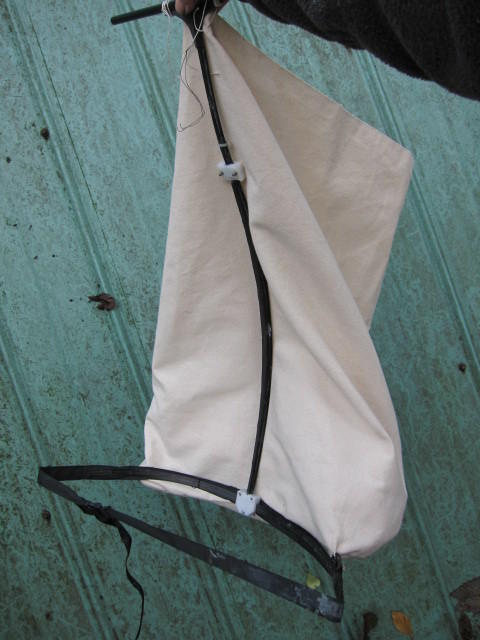
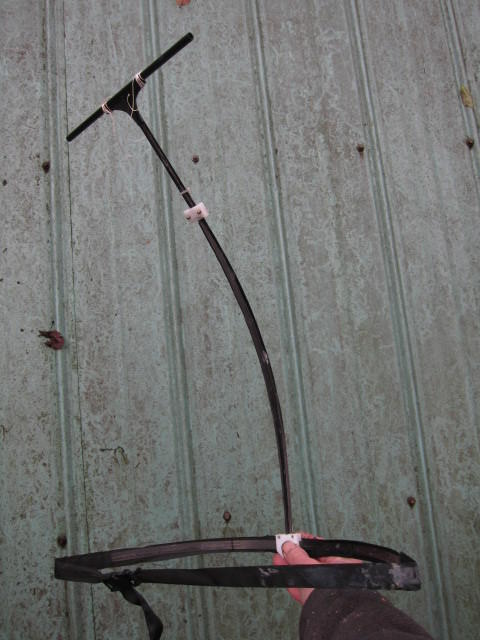
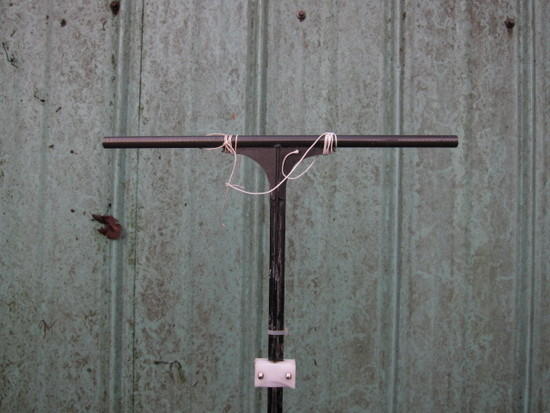
This will be about the size of the OR mid size pack/sack. all straps etc will be cuben, 2 around the hip [one pulling up slightly from the center rear]] 2 out over the back to support the bag thru to over the shoulder, another horizontal to control the bag laterally. So far i looks like the weight will be off my shoulders because of the t-bar at top, but transfered to just below the back of my neck, so lots of padding there plus i should have good control vs the hips. Since the bag will clip in [straps/frame separate] i can make another larger bag for longer trips.

456

PostedDec 10, 2010 at 8:41 pm

Did you mean "cuben" frame pack, or have you found a way to bend carbon rods and/or tubes? Please clarify.
Thanks.
Sam f.

PostedDec 11, 2010 at 7:46 pm

Well,what you see is the external carbon frame, all the rest, most of the straps, bag will be cuben. I wish i could bend carbon fiber , so i just cut a piece from a .1 " sheet left over from another project , then bonded some pultruded from the hobby store.

James Marco BPL Member
PostedDec 12, 2010 at 10:22 am

Actually it is easy…anything down to about 1/2-3/4"r that is.
Make the form, lay up the cloth, add epoxy, it will be dry in a few hours, full strength in about 7 days. I do this all the time on canoes.

They make carbon fiber tube material, also. I have wondered about making a casting of my back and doing a light laminate over that as a single pack frame. Not as light as yours, though. It might be too stiff for hiking, though. Just thinking about it.

jdm

PostedDec 12, 2010 at 12:36 pm

Yes i have to try that someday, making the form is the work part i think.

James Marco BPL Member
PostedDec 12, 2010 at 1:10 pm

Yeah, Mixing form material,taking a negative cast cast, coating it, adding releasant, making a positive cast, coating it, etc…
Lots a work…

jdm

Craig BPL Member
PostedDec 19, 2010 at 10:48 pm

Like you, I've a background here – built & designed kayaks and pioneered layup techniques with new materials. There's cheap ways to vacuum bag, but we tended to find it really labour intensive and worked out alternatives – you can get good resins which set much harder than standard polyesters and epoxies, and allow avoidance of bagging – results in stronger build for same weight without all the perparation time.
The hardest thing was to make tubes sucessfully – I was trying to get the perfect paddle shaft. Never did come up with an alternative to the full industrial investment for making tubes that worked, so if you ever work out how to make tubes successfully "cottage" wise, even 5 or 6mm diameter ones, please let me know, I'd be really interested.

For your frame, howza bout trying a foam cored strip instead of rods/tubes? Then you can use a shape moulded to your back. There's been some experimentation already on this elsewhere in this forum by similar minded types (refer article by Kevin Egelhoff "Lighter Carbon Back Stay – version 2") for ideas.

all the best

PostedDec 19, 2010 at 11:30 pm

Craig, wow! thats a clear case of parallel development, i got a few more wrinkles in mine. aiming/hoping for a sub 200gm weight. No idea how you did that layup.

James Marco BPL Member
PostedDec 20, 2010 at 1:50 am

Carbon tubing is generally larger in diameter. In the 1" range and often used for gunnel material (gunwales.) Here is one source:
http://www.fibreglast.com/category/Braided_Sleeves

Paddle shafts??? Easy. I used 1/4" cedar strips about 9' long. Lay them up in a hollow "square" box, ie left over right, at each corner. Lay a second strip centered over each surface. After the glue dries, plane all surfaces and route the edges. It should just barely clean with 1/2" router bit. If not, it will be real close. Sand it clean. Then slip a piece of carbon tubing over it all and epoxy it. It will be slightly out of round, easier to handle. I have made a couple of these.
EDIT: The first box was about 7/8"x7/8"…I had some "narrow" 5/8" wide strips left over from stripping a boat.

Foam core: Not generaly very strong for the weight.
Here is a non-technical address explaining that: http://www.oneoceankayaks.com/Sandcore.htm
Note that a core needs to be resistant to tension and compression. Styrofoam is neither. Balsa wood cores are considered best, but, cedar is near the top. Wood is about the best for structural cores, BTW. The weight comes mostly from the material and epoxy used, the total wood for a pack, I would guess is around a 1/2-1 ounce.

Curved surfaces are stronger than flat surfaces, generally. Soo, a three dimensional form of a back (taken from a negative/then positive casing)would act as a good form.
A single interior layer of carbon material, carefull arangement of 1/8" balsa core material, and a second layer of carbon material would weigh less than 6oz. With more conventional straps and belts, I would guess it would be possible to carry 100 pounds, though. Never really had a need for such a thing with UL packing. I would worry that it would not accept dynamic stresses, too well, though. Underloading, or overloading will change your posture…hence, the shape of the "shell". This is the real problem. Gregory and others often use a single pin in the lumbar region to provide fit and comfort for different people. Stiffness is easy. Flexibility and stiffness is difficult.

Flexibility is carrying comfort. Your torso, shoulders, and hips move. The pack wants to move with you (nothing about ventilation…hot is sweaty…)A full shell would sound ideal, but is really only a pipe dream.

Stiffness transfers the load to your hips where it belongs. This lets you involve the least number of muscles and confines the weight to those muscles that are best equiped to carry different loads. This removes the majority of weight from your spine and shoulders letting you use them for balance and breathing. Hence, you have better endurance and feel less tired at the end of a day.

Everything weighs something. The tradeoff this thread represents is a good one. I was trying to explaine that you can beef up the joints with carbon tubing. It is certainly possible to epoxy over an existing carbon tubing using standard composite methodologies…just a minor tweak. I am a poor wordsmith, I guess and it was not taken that way. My apologies.

jdm

James Marco BPL Member
PostedDec 20, 2010 at 9:39 am

Nice boat! 13# is a real good number. I am betting it doesn't see any Class I
or currented water, though. The skin would be a bit too light, I think.

I used UL building techniques to build a 12'6" canoe at 21# including the spray decks. I took it on the Northern Forest Canoe Trail this spring. 'Corse,
when I got back, the outer layer of fiberglass (3.1oz Satin Weave) was gone along with the skid plates (1/8"nylon paracord.) It took the trip just fine, though.
All repaired, now. It weighs a bit more, 21#6 now, days. It carried me (175#) and a
30# pack (2 weeks of food/fuel.) All UL gear, of course, 'cept for my old SVEA.

Anyway, the pack frame should transfer a good portoin of the load to your hips without colapsing. Looks good!

jdm

PostedDec 20, 2010 at 1:08 pm

The trouble with building experimental boats is you need someone brave enough to test them! Not me, i'm sticking to flat water. Actually i'm reskinning that boat this winter, always a better job 2nd time, broke a pole just behind the seat when i tried a self rescue exercise.

PostedDec 20, 2010 at 1:10 pm

PS you made good points about flex, never thought of that, but yeah that frame has lots except for the spine, project is going to be easy pickings.

PostedJan 22, 2011 at 2:55 pm

1
2
3
4
roller
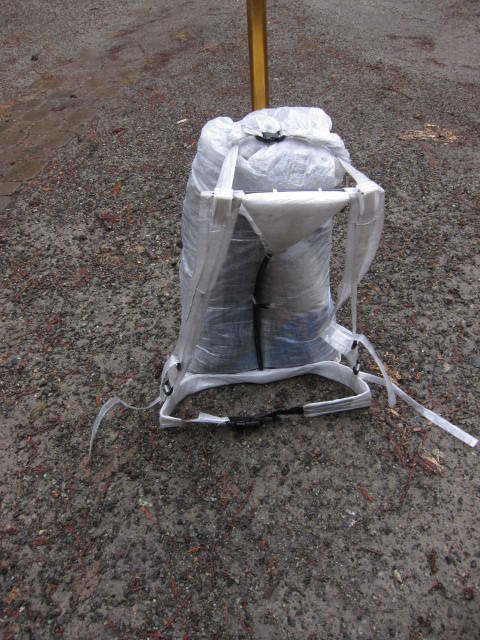
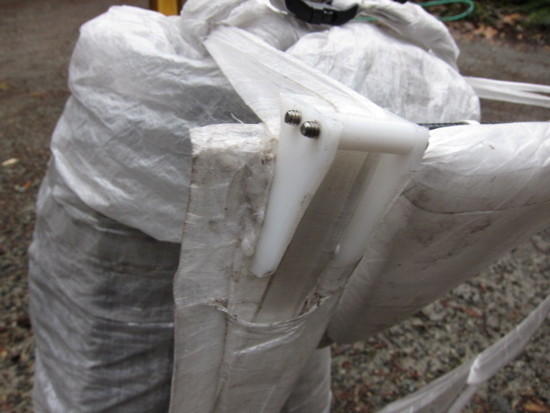
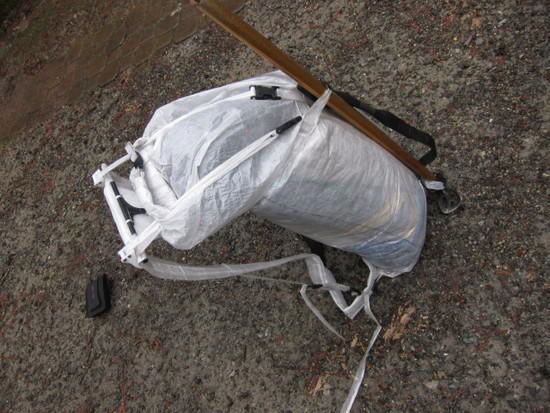
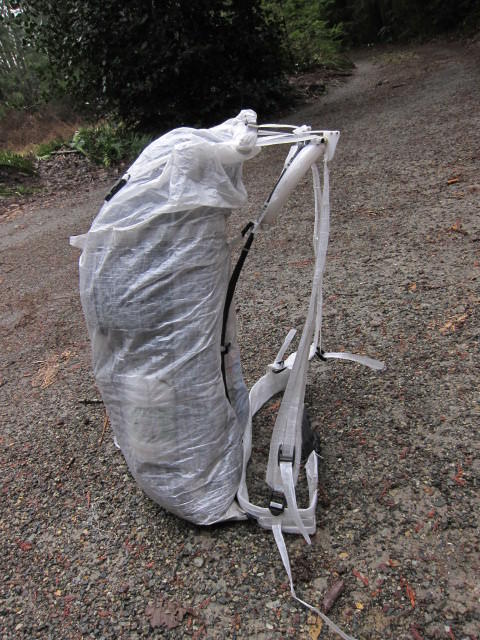
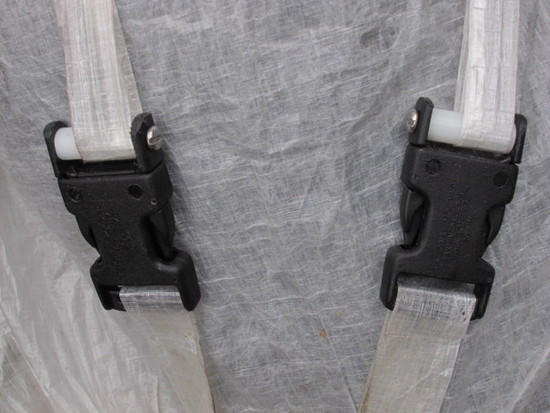
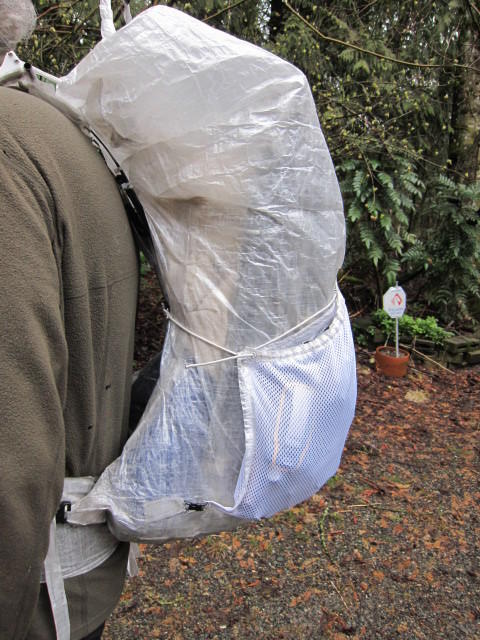
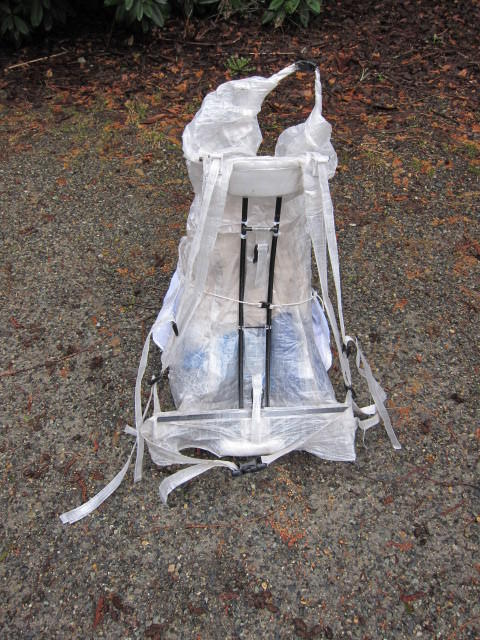
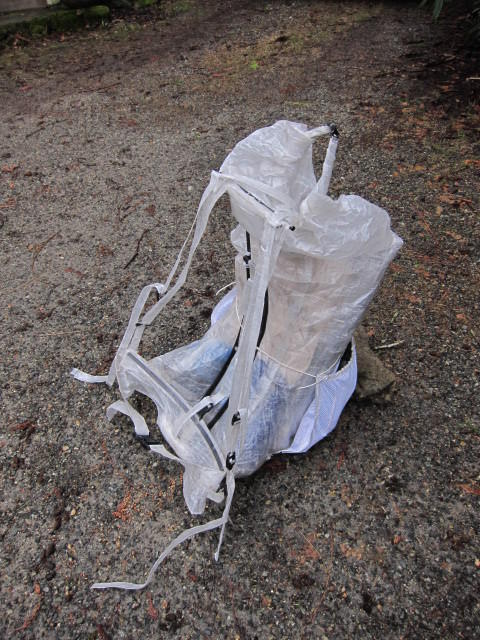
The frame consists of a rigid arc topped by a 'T' mounted on a carbon fiber spring. When the shoulder straps are tightened the arc is compressed [spring] so that the frame is adjustable to the length of the back OR the position of the hipbelt. The 'T' lifts the weight of the shoulder straps off the shoulders. Backpacks are about more than just containment, they are about the direction of forces. In this case, two straps originating center-back of the hip belt come, under ,around and over the pack itself and are tightened by pulling up at the front 2 rollers on each strap ease the friction issues. Using nylon straps might have eliminated the need for rollers, but then nylon WEIGHS.
In practice, transferring weight between the hip or a pad just below the back of the neck, is just a matter of tightening or loosening the hipbelt. Get the right balance and it feels weightless.
The pack is waterproof, good for 1 or 2 nights size wise. Final weight is 260 gms , luxury hipbelt was 50 gms.
Next one is a expedition sized pack with a double ladder frame and a bag that is CURVED! To fit the frame. Should weigh under a pound easy.

PostedJan 22, 2011 at 2:59 pm

I just need to add some mesh bags to the outside, Any weightless mesh suggestions? looked at garden net but it would snag on stuff.

John Nausieda BPL Member
PostedJan 22, 2011 at 3:08 pm

How about something like Remay used for floating row covers in gardens? Cheap enough to sacrifice ? Or something like the bags oranges, and onions come in=-once again disposable/replaceable. I really like your design work and am reading every bit.

James Marco BPL Member
PostedJan 22, 2011 at 3:21 pm

Looks good!

Yeah, I understand about redirecting forces. My shoulders are delicate from a few years (more than 20) spent as a carpenter. I have a couple bad disks in my upper back and neck area, soo, I cannot carry more than 50# for any length of time.

The frame looks like just the ticket. How does it carry on the trail? 'Corse at just over 11oz with an external frame pack it should carry like a dream.

PostedJan 23, 2011 at 6:57 pm

thanks for the suggestion, good ones i'll follow up.
Daryl, thanks, i've got a piece of cuben here about 6'' wide makes THE most comfortable hip belt, as is, no padding so the next frame will be hung off the back like yours.

PostedJan 23, 2011 at 9:20 pm

Ziff,

Thanks for the info on your cuben waist belt experience. Makes sense to me that it would work because it doesn't stretch much.

I've done a couple dozen experiments with waist belts and stretching is the kiss of death for them. When they stretch they lose their shape and pressure develops along thin lines of stress which is very uncomfortable.

For an extreme example visualize a womans nylon stocking foolishly used as a waist belt. As soon as the belt was tightened the stocking would stretch into a very thin, very uncomfortable band around the waist.

If a belt fits well (slightly conical shape helps) and doesn't stretch then very little if any padding is required for comfort.

PostedApr 2, 2011 at 9:58 am

New stuff, same princple, more room, bigger frame,new hipbelt [on both packs] pack is cut to fit frame. External pouches fit both packs. 345 gms [compare to other large external frame packs]. Weight sits just below tailbone [some padding needed] and just below the neck. Having all the weight in the center gives one a kind of centered feeling. Lots of volume, but i'm not sure this one would be good with big weight [don't have big weight so..] but with tweeking it should work.
Things to do still,
– this frame is a little to bowed , should have cut it a little straighter [tons of ventilation]
– all kinds of variations possible, all sorts of frames/bag cominations.
-could be done with injection molded parts [fortunes are lost to injection molders]

1
2
3

Viewing 22 posts - 1 through 22 (of 22 total)
Loading...