If money was no object, I'd check out New Zealand or Tanzania.
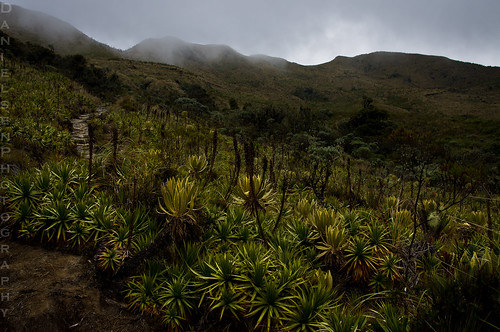
Otherwise I'd go back to South America, and specifically the Andes.
Some things to know about South America,
1. Microclimates! Terrain is rugged and highly variable, so wherever you find sweet warm and sunshine in February, 100 miles away you might find winter cold, or torrential rain. Personally if I were planning to revisit S.A. I'd pick a few treks I want to do and then find out which of those locations happens to have great weather in February.
The Lonely Planet online forum might be a place to ask which hiking locations might have great weather in February:
http://www.lonelyplanet.com/thorntree/index.jspa
Besides Patagonia, some of the epic/amazing treks of South America are
* Macchu Piccu
* Cordillera Blanca or Cordillera Huayhuash, in Peru
* Cordillera Real, in Bolivia
* Colombia (not sure where)
* The plateau around Angel Falls in Venezuela
However, I'm reluctant to recommend any one of these in particular because February may or may not work. Angel Falls, for instance, is said to be miserable when it's too rainy, but disappointing when it's too dry (water level is down so you can't boat close enough to the falls).
That said, Macchu Piccu and Bolivia's Cordillera Real are easy to combine in a month-long trip. They are fairly adjacent, and everything between them, nature and culture, is amazing.
2. Politics. Be sure you are up to date on which areas might be easygoing to travel to; versus which ones might have some political tension (and border-crossing hassles to go with that). North Americans tend to think Peru or Colombia are dangerous. That is very old information. Everything changes. Ecuador was extremely peaceful when I was there in 1995, but it probably wouldn't be my choice now. I'd love to go to Colombia – everybody raves about it. Sometimes, political problems in a country are confined to just one small region to avoid. Again, ask somewhere where people know what's going on locally.
3. Picking a trekking route. We've always gone alone, with no guide. (Sometimes we've had to hire someone with a jeep to get us to the trailhead, though.) We bought trekking guidebooks in advance and chose a route. Invariably, the experience on South American "trails" was exponentially more challenging than any North American trails. On routes claimed by the trekking books to be quite ordinary, we've: Encountered non-existent trails and ended up following mazes of livestock paths; gotten utterly lost; had comical conversations in bad Spanish with shepherds at 15,000 feet in our effort to get unlost; taken 7 days to do a "3-day" route; were required to do Class 3 and Class 4 climbing along the route. All that is not to mention altitude challenges (with some of our trails *starting* at 14,500 feet) and some very cold nights. Plus the challenge of finding a reasonable topo map before you head out.
So, if you are considering trekking without a guide, just be prepared for some big adventures and misadventures. Allow yourself a ton of time. Never trust a guidebook's ratings for the hike; I think a lot of the S.A. backpacking books are written by British expats who have gone so hard-core, they forget how hard these hikes are for an average or even a very well-trained person. Be a good orienteer, able to use a compass and read a topo map.
Personally my next trip will probably be to Cordilleras Blanca/Huayhuash. Joe Simpson, author of Touching the Void, writes in the epilogue that that particular mountain range, in his estimation, is the most beautiful in the world – and he has been mountaineering on nearly every continent. Plus, I love the Peruvians.
– Elizabeth