


between the listed "trail weight" and "packed weight" in specifications listed for some tents….see attached website for example.
Topic
Become a member to post in the forums.
between the listed "trail weight" and "packed weight" in specifications listed for some tents….see attached website for example.
Some manufacturers want their products to appear to be as lightweight as possible. So, they often list one weight that includes, for example, only the tent inner and fly, plus the pole system. A different weight might also include guylines and stakes, maybe a footprint, or maybe other items like a stuff sack. Every company seems to have a slightly different standard of what items go in which weight.
–B.G.–
the "packed" weight…still don't understand what they mean by 'trail weight'.
in your post.
THANKS
Further, some manufacturers will state that the nominal weight specification is +/-10% because of variations in the manufacturing process. I always found it interesting that mine always came out between the nominal weight and +10%, and none of them were ever below the nominal weight.
I was at a local REI store one time, and they had about eight or ten of one specific model of tent stacked up for sale. One customer had shown up with his own digital scale, and he was comparing them to try to select the lightest one of the bunch.
–B.G.–
buyer better be VERY aware!!
You will find that "boutique" gear makers are generally more honest with their weight specs — prolly because they know UL hikers will be weighing / verifying on their own.
Mainstream gear makers — OTOH — seem to fudge a lot more. Marmot, Mountain Hardwear, Sierra Designs, The North Face, etc., etc. are just some of the names that come to mind. Now, not saying that they lie on every piece of gear — but generally, the actual weight of the gear pieces you buy seem to always be higher (sometimes significantly higher) than the manufacturers' supposed "average" weight.
Specific to Big Agnes… their tent specs are pretty accurate (wasn't the case at all about 5-6 years ago). However, their bag warmth and weight ratings tend to be "optimistic".
Maybe picking the lightest of the bunch is not the best idea.
The difference in weight is usually related to the fabric coating.
A few years ago there were several reports of the floor of a popular double wall tent leaking.
Here it was interpreted as false advertising (re the floor water head,) my take was that the fabric of a particular batch simply did not have the correct amount of PU applied. So those tents (in my mind…) were probably lighter than average.
Franco
At the end of the day, you have to just weigh the pieces you're planning to buy or have bought. You just can't trust the specs.
I recently bought a new warm sleeping bag that came in 3oz UNDER the manufactures listed weight. I used a couple different scales and it turned out the company included the weight of the stuff sack in the total weight. In my mind, it's shocking that a company would make a sleeping bag sound heavier than it actually weighs. Weird, huh?
Usually “packed weight” is everything that comes with the tent. The body and stakes of course and stuff sacks, stake sacks, pole sacks, pole repair rod, etc
“Trail weight” is just the stuff needed to set the tent up for use. Tent body, fly (if double-wall) and poles. Manufacturers will often forgo stakes in this figure even though they are needed to properly use the tent. At BPL we list what is needed to use it correctly.
A “Fast Fly” or “tarp style” (as I just had it called on one) weight is the weight of the poles, fly and a footprint.
All of my Tarptents (5) have been right on with the weight.
What Ray said.
"Trail" or "minimum" is usually just body, poles, fly. Packed is literally everything. Note that many cottage makers will list "minimum," ie not w/stakes, not w/pole for a mid, etc.
For my own purposes, the stakes I carry weigh 3-4 ounces, and I don't use the stuff sacks/etc, use only a few feet of spectra guyline… so I add 3 or 4 ounces to the minimum/trail to get an idea of where I'll be if the manufacturer is on spec.
I've always liked the numbers REI provided:
Fly / footprint pitch weight: Fly, footprint, poles
Average minimum weight: Fly, body, poles
Average packaged weight: Fly, body, poles, included stakes, guiline, gear loft, manuals, heavy nylon stuff sacks, patch kit, whatever else is included
Avg Min Wt is often a 8-16 oz less than Avg Packed Wt. I usually look at the Avg Min Wt because I'll usually end up using my own stakes and guyline.
Become a member to post in the forums.
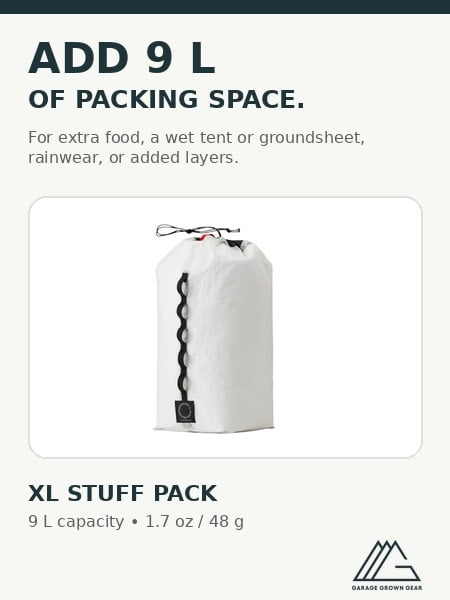 XL Stuff PackLightweight stuff pack designed to secure to the top of your backpack for carrying wet gear, extra food, rainwear, or layers.
 © Beartooth Media Group Inc.
 Loading...