Topic

Barska 10x40mm “close focus” monoulars

  • This topic is empty.
Viewing 25 posts - 1 through 25 (of 33 total)
Thomas Burns BPL Member
PostedAug 24, 2010 at 11:37 am

Would have put this in the review section, but there's no category for it.

For a stargazer, a telescope or binoculars be a necessity on the trail, maties. ;-D

I've been carrying the Barska 8(power)x42mm (diameter of lens) binoculars for years. They are the best (IMO) binos for general use, both for terrestrial and astronomical (my main interest) viewing. Many BPing stargazers carry 30mm binos, but you can't beat the extra 12mm extra aperture for those lovely OMG views of the Milky Way.

Lately, I managed to cut my base weight from 35 pounds to six pounds, but I was cheating a bit. I didn't count the binos, which weight 22 oz ( too much!) because I wear them around my neck.

A recent thread led me to finally put my lightweight money where my mouth is, and I ordered a 10×40 Barska "close focus" monocular from Amazon (about $40, which is very reasonable.

The Barska monocular focuses as close as 12 feet (I measured it) and works very well at infinity, which is what you need for stargazing. The slightly higher power makes for a slightly smaller exit pupil, making for a theoretically slightly dimmer image for astronomy, but as folks age, their pupilary opening shrinks anyway, so nothing is really lost unless you happen to be a seven-year-old.

And here's the kicker: The danged thing weighs but 8.2 oz if you nuke the case and cord. Can't wait to get it out under dark skies. The stars will, I suspect, look wonderful, but those flowers and bears will look even better given the slightly higher magnification.

My only concern: the smaller field of view caused by the slightly higher magnification. I'll let ya'll know how things pan out.

Cordially,

Stargazer

Bob Gross BPL Member
PostedAug 24, 2010 at 11:46 am

I always get a laugh out of it when I have some new piece of super optical gear, and some stranger sees me using it. They ask, "How far can you see with that thing?"

I answer, "I can see the Sun, and it is 93 million miles away."

–B.G.–

Thomas Burns BPL Member
PostedAug 24, 2010 at 12:25 pm

You are so right!

Don't look at the sun with an optical aid, though. The fluids in your eye will flash boil, exploding your eye right out of its socket. There is, of course, no fixing that.

I'd call the question in question (your question) the most commolyn asked about our observatory telescope at our public programs at Perkins Observatory. It reflects a common misunderstanding about optical instruments. The issue is light-gathering power — the wider the lens or telescope, the more light you can gather. In general, the farther away things are, the dimmer they are, but that's also problematic. Uranus is just visible to the naked eye at three billion miles away. The Andromeda Galaxy is also just visible to the unaided eye at 2.3 million light years away. (One light year is about 6 trillion miles. You multiply it out. I'm too tired.) ;-)

Distance/ magnification are practically meaningless. Brightness and aperture are the key points for astronomy. That's why I carry 42mm binos instead of the lighter 25mm varieties. The 25mm binos are great for terrestrial use. Daytime objects like bears are bright by nature. Magnification, not aperture (lens diameter) is all you need. For nighttime use, aperture, not magnification, is the key element.

I will gladly sleep in an 8.3 oz Hexamid tent and curl up in an 11 oz BPL sleeping bag, but there's no danged way I'm looking through anything smaller than a 40 mm monocular at the sky, even with a massive weight of 8.2 oz.

Cordially,

Stargazer

Bob Gross BPL Member
PostedAug 24, 2010 at 12:35 pm

I was high on Mauna Loa in 1991 to photograph the total solar eclipse, and I was using 1500mm of lens on a film camera. The sun was so intense that I had to use a solar filter over the front, and it knocked out 99% of the intensity. Unfortunately, it made the sun appear so dim that it was difficult to find in the sky. The experience was intense.

–B.G.–

PostedAug 24, 2010 at 1:11 pm

Oh cool I can't wait to hear how this performs in the field! I love looking at the night skies and it's one of my favorite reasons for getting into the backcountry. Based on the info in your other thread I was about ready to pick up the 8X42's, but if these will do the job for less $$$ and 1/3 the weight, I'm all in!

Thomas Burns BPL Member
PostedAug 24, 2010 at 1:13 pm

Yep. In fact, the only object you can see with a solar filter is the sun. Thus, the sun is difficult to find since you don't want to look at the sun, even with your unaided eye, to find it. Trial and error are the safest bet. Of course, the sun looks great through a solar filter, which is really the only safe way to look at the sun.

Look at the sun to your peril. The view through telescopes or binoculars will lead to instant, catastrophic blindness. Looking at the sun "naked eye," as stargazers like to say, for any length of time will produce in later years macular degeneration disease and the eventual degeneration of one's eyesight. Heck, I don't even like to go out on a sunny day without dark sunglasses. Even indirect sunlight bouncing off of the ground will eventually cause cataracts and macular disease.

Hence, use eclipse glasses, a solar filter (NOT sun glasses), or indirect projection to look at an image of the sun. Above all, don't look at the sun through a telescope, binos, a monocular, or even a camera without a bona fide solar filter. This will kill your eye(s) faster than a sharp stick.

Remember, your eyes are the windows you look through to see the wonder and majesty of the universe around you — both above and below the horizon.

Stargazer

PostedAug 24, 2010 at 1:17 pm

http://www.sungazer.net/

I had a chance to look through one of Greg's hydrogen-alpha setups with a long-tube Astro-Physics telescope… directly at the sun, LIVE, at 400x (no, that's not a typo — it was 400x) magnification.

Talk about an intense experience… surface texture, filigrees in the prominences… sigh. I miss observational astronomy. I should try to shoot some star trail images this weekend.

Thomas Burns BPL Member
PostedAug 24, 2010 at 1:29 pm

>Oh cool I can't wait to hear how this performs in the field! I love looking at the night skies and it's one of my favorite reasons for getting into the backcountry. Based on the info in your other thread I was about ready to pick up the 8X42's, but if these will do the job for less $$$ and 1/3 the weight, I'm all in!

Some argue that binos produce a better view because you are sending more light through two eyes. However, That's not been my experience. Binos tend to produce the "3D: effect, especially (and ironically) if the binos are slightly out of collimation (misalignment of the two sides of the binos).

Binos do not make the astronomical objects brighter. Only aperture (diameter of the lens(es) sending light into one eye) can do that, which is why I opt for the 40 or 42mm lens over the 30mm or smaller, despite the weight penalty.

Note: I used to lug the bigger aperture Edmund Astroscan into the woods, but at 12 pounds, this eventually seemed excessive. It is, IMO the best richest field (wide angle with a lot of light-gathering power) scope on the market, but at 12 pounds, it increased my base weight to 45 pounds.

Stargazer

P.S. I have owned for many years an 18-inch-diameter-mirror, home built Dobsonian. If I want aperture and dark skies, I can drive the telescope to rural Ohio or West Virginia. If I want to BP, I take a light pair of 22 oz binos or, next trip, a 9 oz monocular. Some day, when I get old and grey, I will live in a shack in the mountains and have my trusty 18-incher beside me.

Thomas Burns BPL Member
PostedAug 24, 2010 at 2:07 pm

>Talk about an intense experience… surface texture, filigrees in the prominences… sigh. I miss observational astronomy. I should try to shoot some star trail images this weekend.

Yes, indeed. Most of us carry a camera with us on BPing expeditions. Point the camera at the north star, for example. Open the aperture and keep it open for, say, an hour. You'll get a great view of star trails. If the sky is really dark, keep it open for increasing lengths — two, three, four, five hours, until the ambient light pollution spoils the view. The effect is stunning, and it's easy if you have even a light tripod with you.

(I'm too much of a gram weenie to carry a tripod.)

Stargazer

PostedAug 24, 2010 at 2:20 pm

"it's easy if you have even a light tripod with you."

I'm a professional photographer… I *always* have a tripod and a 4×5 with me. :)

No SLR's though. They're too bulky and heavy. ;)

Bob Gross BPL Member
PostedAug 24, 2010 at 2:48 pm

"Open the aperture and keep it open for, say, an hour."

I think you will get better results by keeping the shutter open for an hour.

By the way, some digital cameras will have problems trying to stay open that long. That gets into sensor problems and battery problems, and that is the sort of thing that an astronomer doesn't run into with traditional equipment.

–B.G.–

PostedAug 24, 2010 at 4:24 pm

I have commented in the past that monoculars are not for everyone. For example I have the Zeiss 8×20 but cannot use it..
The same was with most monoculars I used to sell, typically 6-10x , 20 to 25mm opening. An exception from the past was a Zeiss Jena (East German) 8x30mm.
Recently I was looking for a lightweight and somewhat cheap solution for a mate of mine and found a 10x42mm in the shop I used to work for.
This one I can use and it is about 10oz the weight of my beloved (but lost) Leica 8×20.
So , yes have a look through a "large" aperture monocular, it may work for you too.
The one I found is branded "Gerber" a local brand.
Franco

PostedAug 24, 2010 at 8:14 pm

Hi all,

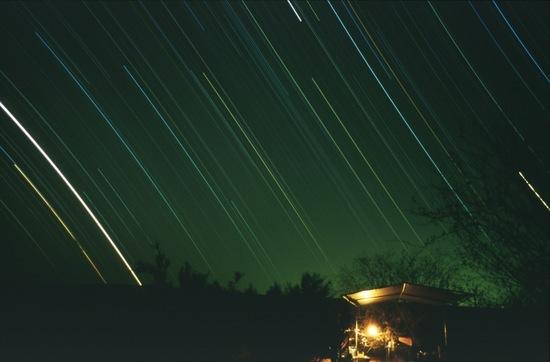
I thought I’d share my one successful star trail photo, since the topic came up. I took it about 12 years ago while doing field work at the Mohawk Dunes (somewhere between Phoenix and Yuma). It’s a 4+ hour long exposure using my old Olympus 35mm SLR. I let the coleman lantern in our shade structure burn for about 30 seconds at the beginning of the shot, then turned it off. Recently I was able to ID every single star in the photo with StarryNight Pro software, which was a lot of fun. The really bright one on the left is Jupiter.

Star Trails

I have to say, you guys are making me think pretty hard about dusting off the old telescope this weekend….

Thomas Burns BPL Member
PostedAug 25, 2010 at 5:48 am

>I let the coleman lantern in our shade structure burn for about 30 seconds at the beginning of the shot, then turned it off.

That's a beauty, you betcha! It shows what you can do with a long exposure from really dark skies.

Another trick: Step into the field of view with a little red LED flashlight and sign your name in a lower corner (backwards). I'm hoping to test out my new Barska monocular this weekend in the Wayne National Forest, but the forecast looks pretty grim.

Stargazer

PostedAug 25, 2010 at 8:29 am

Nice shot!

Hm… maybe I ought to consider risking a sheet of film for such a shot this weekend… the moon will be probably a quarter moon, which might light the landscape a bit, but not so bright as to wash out the night sky. And with the mechanical shutters on my Arca I can leave them open as long as necessary… provided that the weather's nice (the biggest down side to having a bellows — wind likes bellows).

PostedAug 26, 2010 at 6:55 pm

It just occurred to me – is there a moon filter available for this monocular? I didn't see any, it sure would be nice though…

PostedAug 26, 2010 at 6:59 pm

I *always* have a tripod and a 4×5 with me.
You may already be doing this, but in case you haven't – what I used to do was carry a lighter weight bogen tripod with me, and to stabilize it with that heavy view camera on it, I'd hang a sack from the center post, and fill it with rocks once I had it positioned. That keeps the load lighter but makes sure it's stable during shooting.

Thomas Burns BPL Member
PostedAug 26, 2010 at 7:12 pm

>It just occurred to me – is there a moon filter available for this monocular? I didn't see any, it sure would be nice though…

Since you can't remove the eyepiece, a moon filter wouldn't thread on anyway.

However, a standard-sized neutral density filter or polarizing filter will fit into the eyecup. a bit o' duct tape, and you're good to go.

However, with its 4mm exit pupil, IMO the image of the moon won't be too uncomfortable. In fact, I just took the thing out and looked at Luna. Saw a few larger craters with acceptable, not glaring, brightness.

However, the 5-degree field makes this mono best for starfields and other elements of the deep sky. Wow! Best views I've had for a nine oz weight penalty! A bit of blue/ purple fringing on the moon, as expected, but not unexpectedly so.

I'm happy at 40 bucks. Hotcha!

Stargazer

PostedAug 26, 2010 at 8:43 pm

Saw a few larger craters with acceptable, not glaring, brightness.
Awesome… I wasn't sure at what magnification "moon blindness" became an issue. But if you're not having an issue tonight, then I don't think it could ever be an issue.

Sounds like I'll have to pick one of these up. Thanks again for the info!

Thomas Burns BPL Member
PostedAug 27, 2010 at 3:16 am

Well, I had to be up anyway, so . . .

The Barska monocular did well last night. I could just see three of the four Galilean moons of Jupiter, but I never got that perfect focus that takes porro prisms and several hundred dollars to get out of a really fine set of astronomical binos.

However, the Pleiades were spectacular, typical of a 40 – 50mm bino view. Especially nice was the "sword" area of Orion, complete with M42, the Great Nebula.

For the price and weight, I'd say these are a real bargain for both terrestrial and astronomical use.

Stargazer

PostedAug 27, 2010 at 8:47 am

Kieran,
I use one of these:
http://www.feisol.com/english/CT3441S.htm

with one of these:
http://precisioncameraworks.com/Media/p0-eng-web.pdf

I've managed to lose the hook that was on the tripod though, I think it came off during a hike and I didn't realize until I got home. Same with the rubber feet, I need to replace them. Sigh.

Fortunately, my view camera isn't all that heavy (around 4.5 pounds) — and my 3 primary lenses are quite light. Collectively I think it weighs less than a full-frame digital SLR with comparable reach, but nowhere near the detail. :)

I stopped carrying my digital SLR (1.6x crop) once I realized that it with 3 lenses (all primes) and a teleconverter weighed as much as my 4×5 with my 3 lenses and 2 Quickload holders (one backup, because I've had them jam in the field before).

Now I carry 4 cut sheet holders which are a lot lighter than the Quickload holders are, so I think that if I add some extra film boxes and a film changing bag, it will still weigh less than my digital SLR. And go back to the rubberized silk darkcloth (3 oz) once I find a cold shoe that I can attach to the Arca, and I can drop the 18oz Black Jacket….

But star trails are probably not in the cards for this weekend, due to the forecast. :-/

Stephen Barber BPL Member
PostedAug 27, 2010 at 9:22 am

My Barska 10×40 monocular arrived yesterday, and I will be returning it.

The problem is that the view through the monocular is either in focus in the center of the lens and out of focus in the outside half, or vice versa. The focused area does not cover the entire field of view – only the center half.

Very disappointing.

Thomas Burns BPL Member
PostedAug 27, 2010 at 9:37 am

Mine doesn't have that problem. I've had similar problems with out-of-collimation binos before, though. On occasion, I've had to look at practically every pair in the store before I got a pair where the two sides were aligned and each side was internally aligned.

You might consider asking them to send you a second one before you give up on the instrument entirely.

Cordially,

Stargazer

PostedAug 27, 2010 at 9:42 am

OH that is a NICE ballhead! yowsa!

I agree that the weight penalties of DSLR's are pretty substantial. I shoulda kept my 4X5 *sigh*… I've been leaving behind the DSLR because of the weight. I think I'm gonna start carrying my Holga and/or Diana again though.

Viewing 25 posts - 1 through 25 (of 33 total)
Loading...