Topic

Getting used to tarps

  • This topic is empty.
Viewing 25 posts - 1 through 25 (of 40 total)
PostedAug 9, 2010 at 9:17 pm

In my quest toward ever lighter loads I've pared my pack down without feeling any loss of comfort. But one jump I haven't made yet is from single-walled tent to tarp. Every other luxury I've been able to give up without any adjustment period (my 1/4 inch foam pad is plenty comfy and my frameless pack feels just fine), but the few times I've tried sleeping in a tarp have been less than enjoyable.

My question is, how many people out there were initially hesitant about using a tarp and have since come to love it, or tried to use it for an extended period of time and switched back to a fully-screened-in option? Comfort you're willing to carry a few extra ounces for is a personal thing, but it's also matter of what you're used to, and I'm trying to figure out if it's worth getting used to a tarp or if most of the people who don't enjoy them still don't enjoy them after repeated use.

I'm especially interested in hearing from people who are particularly bothered by mosquitoes or mice. Certain people, myself included, attract mosquitoes more than others — can such people really sleep comfortably in a tarp, or is attempting to do so as bad an idea as it first seems? Keeping mice away is a more irrational and seemingly more curable desire, but currently I feel much better with a piece of screen or fabric between me and critters than I do with rodents scurrying near my face at night. How long does it take for people who really don't like mice to get used to sleeping with them?
PostedAug 9, 2010 at 9:37 pm

Do you consider the Hexamid a tarp or tent? I like mine, although I miss the easy entry of a dome tent.

I hate mice. I'm anxiously waiting for an ultralight mouse-zapping variation of the airborne laser.

John Donewar BPL Member
PostedAug 9, 2010 at 9:56 pm

Jeffrey,

Take a look at the Six Moon Designs Meteor Bivy.

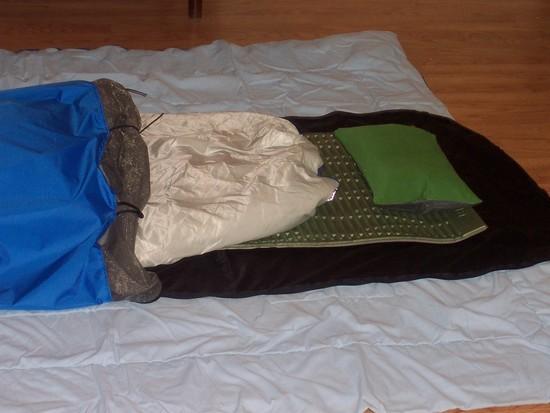
Homemade Meteor Bivy LS full length

It is light, roomy, airy and keeps away all manner of pests.

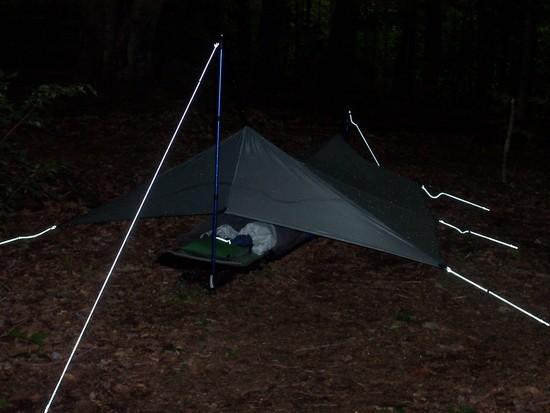
My tarp and bivy setup

I used it under my tarp and in shelters. You can make your own for around $50.00 in material. The plans and downloadable patterns are available at;

http://www.sixmoondesigns.com/community/myo_MeteorBivy.html

And if you are not into MYOG it can be purchased from Six Moon Designs for $130.00.

BTW yes I am hooked on tarping. :-)

Party On,

Newton

PostedAug 9, 2010 at 9:56 pm

A head net works for me when I sleep in the open in an area that has bugs. Once it gets cold they usually stop being active, and I can take the head net off. If they're so thick that the sound of them buzzing around the net is bothersome, I use earplugs (which are also handy to have when circumstances force me to sleep in crowded backpacker's campgrounds).

Never had a problem with mice where I hike, which is usually the Sierra. Do they actually bother you while you're in your bag? Are they trying to get your food? What are your nighttime food storage practices?

PostedAug 9, 2010 at 9:57 pm

I consider the screened version of the Hexamid a single-walled tent (and can't wait until mine finally ships later this month!) given that it's fully screened in to deal with the mice and mosquitoes. It's light enough (lighter than many tarps) that I don't feel bad about its weight. So really it's more of a philosophical issue of trying to decide whether avoiding tarps is just coddling temporary insecurities or whether trying to tolerate tarps is just needless suffering.

Bob Gross BPL Member
PostedAug 9, 2010 at 10:02 pm

Don't worry about the mice. The mountain lions will get them.

–B.G.–

PostedAug 9, 2010 at 10:22 pm

@Newton: Bivies and net tents were two of the options I investigated but never really understood the appeal of. Not to knock another man's gear, but what do you see as the advantage of a net bivy vs something like the Hexamid? The Hexamid is lighter and offers more area within the bug-free zone, although I can see how the tarp/bivy option offers more flexibility, since you only need the bivy if there are bugs, only need the tarp if there's rain, and it works with any type of tarp including poncho tarps.


@Ben
: Does sleeping with the head net take practice? Do you use a hat or some other device to keeping from falling against your face, and if not can the bugs bite through it? Does it stay on and does it take much getting used to from a comfort stand point? I've never slept with my food (or sunscreen or other smellable items) but more often than not I hear mice around the tent as I'm falling asleep (here in WA, but also when I visited Yosemite and the Grand Canyon).


@Bob
: See, that's the funny thing, and part of the irrationality; I don't worry about mountain lions, bears or any other creatures one bit, but the thought — and sound — of rodent claws skittering near my face is maddening.

PostedAug 9, 2010 at 10:24 pm

A tarp is my primary shelter, but I dont think I would hesitate to switch if mice were regular visitors into my personal space. Mice are icky.

David Chenault BPL Member
PostedAug 9, 2010 at 10:45 pm

I think the OP is getting at a good point, the tarp v. tent thing is primarily psychological. That being said, I've camped lots from an early age, which I think made it so that creepy-crawlies don't bug me at all. I also sleep very soundly. I've slept out under the stars at some of the pest prone sites in the grand canyon without issue, but if a mouse ran across my chest I'd almost certinaly not notice it.

As for sleeping with a headnet, provided the rest of you is tucked in the bag, the main issue is that while the bugs can't bite you, you can still here them buzzing. Light sleepers would I imagine struggle with this.

PostedAug 9, 2010 at 10:56 pm

I guess I can't really respond directly since I haven't used a "true" tarp, but I will say that I really enjoy the advantages I get with the Hexamid. That is, I can pull stuff out of my pack willy-nilly and not worry about it rolling away. I can push stuff up against one side to block the wind. It also retains a little heat. One disadvantage is that most of the guylines can't be adjusted from beneath the tarp, that is, if the guylines were swapped with adjustable guylines.

Bob Gross BPL Member
PostedAug 10, 2010 at 1:01 am

"…but the thought — and sound — of rodent claws skittering near my face is maddening."

Mice don't eat much. Besides, they go for your soft parts first.

–B.G.–

John Donewar BPL Member
PostedAug 10, 2010 at 3:23 am

Jeffrey,

Honestly I think that your Hexamid is a fine piece of gear and it does have more area within "the bug free zone".

>>although I can see how the tarp/bivy option offers more flexibility, since you only need the bivy if there are bugs, only need the tarp if there's rain, and it works with any type of tarp including poncho tarps.<<

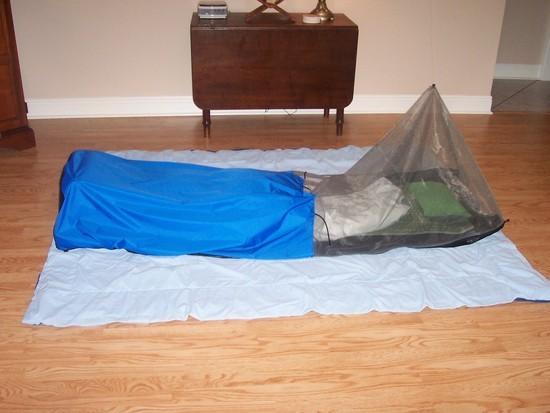
My bivy's bottom is 1.3 oz silnylon so that I do not need to carry or use a seperate ground sheet which I find to be hard to keep properly positioned on or under the tent floor.

Also I have the option to use it as only a groundsheet,unzip the netting and roll it back if there are no bugs or mice to worry about.

Half length LS view of bug net stowed

The tarp/bivy option offers more flexibility, since you only need the bivy if there are bugs, only need the tarp if there's rain, and it works with any type of tarp. Lastly I have invested in my tarp and bivy combination my time at the sewing machine and roughly $135.00 in materials. This puts me at approximately $140.00 below the cost of a Hexamid with the net floor. I am arguably "cheap" but this gives me more $ to play with.

>>Not to knock another man's gear<<

No offense taken and none offered. Your Hexamid will be a fine piece of gear and it will be ultimately lighter than my combination of tarp and bivy. I have often imagined and considered an extended triangle of a tarp, ala tube tent,with a sewn in floor. Each end would have a combination of sewn and zipped netting. But that removes some of my flexability. :-)

We all hike our own hike and choose our own gear. There are always tradeoffs in the gear choices that we make.

Are you going to carry your new Hexamid in one of Joe's cuben Zpacks? If so I will then be truly envious of someone whose base wieght is approaching our ultimate goal of negative pounds. :-)

Party On,

Newton

Hiking Malto BPL Member
PostedAug 10, 2010 at 6:26 am

On my last Sierra trip I was camped out next to evolution lake, hiding from the mossies in a tarptent when the biggest scariest mouse started scurrying about. It was sort of cool to watch him do his search.

I normally hike with a tarp bivy and this was the last and hardest move in my ultralight conversion. Frankly I'm not sure why because even with my tarptent I generally cowboy camp. But once i made that leap I doubt I would ever go back. My primary reason for staying with the tarp/bivy is simplicity. I generally only use my bivy so it takes seconds to pack and unpack my bivy/quilt. I like the thought of a modular setup that you use only the components required by the conditions.

At least in the Sierra the mossies are only a problem for the first hour after sunset. I have spent many nights with a headnet on for that first hour. Then it comes off and all is well. My bivy will eliminate the need for this but I would expect that I would use the headnet only for that first hour.

PostedAug 10, 2010 at 7:54 am

1. I love tarp camping, it is beautiful and elegant. You are communing with the environment, not walling yourself away.

2. For bugs – Wear a head-net to bed and camp at a high elevation.

3. Mice are usually only in impacted campsites. THe beauty of the lightweight format is that you can ignore the trappings of the "traditional" camper and ignore the established (and filthy) campsites. Camp where ever you want.

4. My advice, get a tarp, get a head-net. Go camping, and don't look back!

5. I have taught tarp camping for 16 years, and nobody has ever complained. It is less expensive, fast, simple and MUCH lighter than a tent. Tent's are nice when there are a LOT of bugs (only a few weeks each summer), or on an alaskan glacier. But in pretty much every other situation, a tarp is just fine.

6. Mostly, I will use my tarp as a pillow, because sleeping under the stars is always the best option if it's not raining.

I have a very roomy 2-person SpinTwin (highly recommended)

+ tarp with string: 9.8 oz
+ vapr bivy (with bug face netting) 5.8 oz
+ bug head-net: 0.7 oz
_________________________________________________
( + ) TOTAL weight: 16.3 oz

This is a lightweight forum. And the above totals are for a shelter that can handle bugs and severe weather with plenty of luxurious room for a solo camper, and it's not bad with two.

PostedAug 10, 2010 at 8:14 am

Jeffrey, I have also been curious about tarps but I can't quite come up with a compelling reason to change from my SMD Lunar Solo. I am a very light sleeper and a mosquito anywhere near my ear will keep me up all night. Wearing a head net will keep me up. A granddaddy long legs walking across my face will keep me up. A spider landing on my cheek will bother me. It's just such a beautiful thing to zip up that tent and separate me from all the critters of the night and have absolutely no worries about being bothered by insects, mice, etc. In a bug and critter free world I would have no reservations at all about using a tarp.

Nia Schmald BPL Member
PostedAug 10, 2010 at 8:37 am

I'm there with you. It took me 5 years of light weight backpacking to finally take the plunge in to tarp camping, which I did last year for a thru hike. I was nervous about being exposed to the elements and the talk about needing the necessary skills. Now I find that exposure to be the best part about tarping. I feel a part of my surroundings. It's fun to sit under the tarp and watch the rain coming down. Sure a few drops might make it inside, but so what. It's just a few drops and dries quickly enough.

I went through a rain storm that lasted 2 days and was perfectly fine. Two tenters and one hammocker got pretty soaked in the same storm. Good site selection (not to mention seam sealing) is important no matter what you shelter, so I don't see that the skill set needed is a whole lot different for tarping.

Mosquitoes are definitely a problem. I'm usually the first one they go for. I use a homemade version of the MLD serenity nettent to deal with them at peak season. Otherwise a headnet works just fine, unless ticks are a problem.. For the most part the mosquitoes go to bed about the same time I do, but that's at elevation. In the lower elevations of the cascades I would likely stick with the nettent. I prefer the nettent over a bivy as I hate crawling in and out of a bivy for late night trips. Most people I know who are happy with their bivies also use pee bottles. The weight difference of 1-2 oz is worth it for me.

Never had a problem with mice running over me. The little buggers love to chew on my trekking pole grips though.

The zpack hexamid looks like a nice option. I thought about trying one but decided to pass. I like the seperate nettent so on nice nights I can sleep under the stars and still have mosquito protection and outside of mosquito season I can leave it at home. I also think the side entry on the hexamid leaves a fairly large area exposed while at the same time having a lower entry point than a tarp in an a-frame pitch. Still the hexamid looks like a nice shelter, and Joe certainly proved it can work well on the CDT. So yeah, if you've devided to go the hexamid route great. I think the experience will be the same as tarp camping. To me that's more important the a few ounces.

I've never used any pitch besides an a-frame. The cat curve on my tarp makes it difficult. If I where to buy a tarp now, I would probably go with a flat tarp so I could experiment a bit more. The new mountafitter tarps with a flat center seam and curved egeds seems like a nice design.

PostedAug 10, 2010 at 8:53 am

Jeffrey Stylos wrote: "@Ben: Does sleeping with the head net take practice? Do you use a hat or some other device to keeping from falling against your face, and if not can the bugs bite through it? Does it stay on and does it take much getting used to from a comfort stand point?"

I've done it with a hat and I've done it without a hat. It works either way. I don't think I've ever been bitten through it, even when I used it without a hat. For me the main advantage of a hat is simply that when I'm sleeping on my back, the brim keeps the netting from drooping down and tickling my nose. But the netting is stiff enough that if you wear it without a hat you can just sort of pull it away from your nose and it will stay up.

The net won't stay on for eight hours without fiddling, but I don't wear it for eight hours; I wear it for an hour or two, until it gets cold enough for the bugs to stop. The one I have has an elastic band that keeps it in place.

Re all the comments about buzzing, the earplugs really do work. Usually where I hike the bugs aren't thick enough or numerous enough, even early in the evening, to make the earplugs necessary. When I do use the earplugs, I only use them for the first couple of hours.

I do need to find something that I can use to cover the velcro tab on my sleeping bag, because the headnet gets caught on it.

PostedAug 10, 2010 at 9:22 am

I have the same set-up as Mike Cleland above (Spinntwin and bivies). I think this shelter system is just about the perfect way to feel connected to the outdoors.

Probably my single best outdoor experience in the past few years was sitting out an explosive thunderstorm in the Wind Rivers with my tarp pitched in the lee of a giant boulder. I cooked my dinner, with a panorama view of lighting, sheeting rain and courses of storm water rushing down the cirque. My buddies in their tents missed it. This summer, a herd of mountain goats came through our camp one morning. I was able to roll over and watch them without getting out of bed or even opening a zipper. Nice.

If the bugs are expected to be heavy (such that I might want to hunker down in a shelter for a while), however, I take a Tarptent, which is okay, but nowhere near as immersive as a tarp. After dark, all that bug netting becomes opaque.

I have hiked a fair bit in both the east and the west, and I will say that the east is a lot buggier than the west. In the east, it seems to me many types of bugs "come out at night", such as those giant daddy long legs spiders, and the mosquitos will stay awake much longer. Plus, it's hotter at night. The tarp bivy combination works bc most of your body is covered by the sleeping bag. If I want to sleep uncovered b/c of the heat, sometimes even the bivy seems too much coverage (plus, I'm not sure whether the mosquitos can bite through it–I think they can). So, for the summer season in the east, I will take a tarp tent. I view this as SERIOUS drawback to backpacking in the east, and plan my trips in the west whenever possible.

PostedAug 10, 2010 at 9:31 am

I was really nervous at first, but Mike C! persuaded me via a pre-course email trail to give it a try, and with a borrowed tarp and bivy (on one of BPL's WTS courses), I went for it and had a groovy couple of nights in the Gallatins.

Since then I've been pushing and refining my sleep system and have spent a bunch of nights under tarps, starting with a GossamerGear SpinnTwinn which I bought as soon as I got back from the course. Late last summer I made a MYOG solo cuben fiber tarp (5.8oz) and have just finished work on a MYOG cuben- momentum bivy with a built in bug net over the face area (4oz), giving me a reliable solo shelter for <10ozs. I've used the tarp with a VAPR Quantum bivy around New England last fall and this summer with no issues whatsoever: the bugs can't get through the bivy, so even if they are buzzing around, they won't get'ya. I did wake up one morning with a couple of chipmunks sitting on my sneakers. I thought that was actually kinda cool – as soon as I moved they took off like the wind, of course!

Also, +1 to Mike C!'s comments: you are much more connected to the nature you are trying to visit when you use a tarp. If the weather is good, put the tarp up, but sleep next to it. That way, if it rains you can just slide under the tarp. If it stays clear, you're sleeping under the stars. It doesn't get much better than that, even in New England!

Anyway, HYOH of course, but I've become a big tarp fan thanks to Mike C! and BPL… ;-)

Happy trails, James.

PostedAug 10, 2010 at 10:41 am

I've slept in a tarp and MLD Serenity a few times this summer, and it's been pretty comfortable so far, but I haven't been out in harsh weather. I'm not worried about rain since the tarp I have is a duo tarp, so it has plenty of space, but I am a bit concerned about cold (planning ahead for autumn camping :)).

I'm planning on adding down layers to my kit (started with a down jacket, pants are on the list), and wondering whether I should be looking at bivies or a warmer sleeping quilt, or what have you — I'm currently using a Kookabay pad and a 30 degree MLD Spirit quilt.

Advice of course is welcome :)

Gregory Topf BPL Member
PostedAug 10, 2010 at 10:54 am

I did a very rainy solo seven-nighter in the Bob Marshall Wilderness last August. No worries with mice or skeeters, (I completely agree with Mike C's impacted campsite vs. wilderness comment), but flawed fearlogic or not, one consideration for my choice of ID Silwing tarp + GoLite Ultra 20 Quilt (no bivy) was how quickly I could jump out of bed in case someone or a large omnivore came into my hopefully scent-free camp in search of me. Maybe I saw too many videos of people trapped in their tents and sleeping bags being dragged away to who knows what, but I still believe that the ability to grab the bear spray, then roll or jump out of the way a few seconds more quickly than one could do so after extracting oneself from said tent and fully zipped sleeping bag could make a difference in such a situation.

I saw not a single bear on the packrafting trek down and around Youngs Creek, the White River, and the South Fork Flathead, but I slept soundly.

Delusion is sometimes a beautiful thing…

PostedAug 10, 2010 at 11:13 am

"started with a down jacket, pants are on the list"

Consider Rab vapor-rise pants instead of down. You can wear them hiking in cold weather all day without sweating out, and then sleep in them at night for a little extra warmth. Wonderful pants, highly recommended. It's all I hiked/slept in last late fall/winter. Well, on my lower body, anyway.

PostedAug 10, 2010 at 12:54 pm

"Consider Rab vapor-rise pants instead of down"

Thanks for the reference, I'll check them out. Is Rab the best place to get Rab stuff if you're in the US?

PostedAug 10, 2010 at 2:15 pm

"Is Rab the best place to get Rab stuff if you're in the US?"

I bought my vapor rise pants from a BPLer no gear swap, but I recently bought the new vapor rise lite jacket from some company in Colorado, I believe. There are places in the US where you can get RAB without having to order from RAB (I think Prolite Gear sells RAB).

Viewing 25 posts - 1 through 25 (of 40 total)
Loading...