


It looks like Marmot makes a lot of packs that I though belonged to Dana Designs. Did DD go out of business and sell their intellectual property to Marmot, or does Marmot just license from them?
Topic
Become a member to post in the forums.
It looks like Marmot makes a lot of packs that I though belonged to Dana Designs. Did DD go out of business and sell their intellectual property to Marmot, or does Marmot just license from them?
I noticed that Marmot had acquired DD in one way or another. That is too bad because DD had some pretty neat and innovative designs over the past. Hopefully their thinkers and creators were retained by Marmot.
More info at http://en.wikipedia.org/wiki/Dana_Design
Mystery Ranch has a store in Bozeman. Neat packs, but I still have my trusty DD T-1…
Thanks for the link… So is Marmot owned by K2? I thought they were based in California, not Washington. The web never ends. I wouldn’t be surprised if half the outdoor industry were owned by the Carlyle group or something.
K2 owns both Marmot and Dana Designs.
Dana Gleason sold DD to them a few years ago.
Now the big DD packs are relabled as Marmots and the rest of the line appears to have vanished.
If you want a real Dana Gleason pack see Mystery Ranch in Bozo MT.

Outdoor products is an ever-increasing and changing industry. K2 is a good example: go to their corporate web site and watch the product banner scroll http://www.k2inc.net/. You will will see Marmot, Dana, Stearns, Ex Officio, Rawlings, Shakespeare, as well as a dozen paintball, hunting, skating and ski/snowboard companies you might have thought were competitors. What was a ski manufacturer on a little island int he middle of Puget Sound has become a large international corporation. Columbia is another good example. Like many other industries, the large outdoor products manufacturers are taking turns buying up the smaller ones. The North Face was bought by VF Corporation, which also owns Jansport, Lee and Wrangler (jeans), and Eastpak (see http://www.mediawaveconsulting.com/san_francisco_chronicle.html).
Outdoor equipment sales are massive– I did some quik searches and saw figures like $18 billion a year in 2001! Keep in mind that even the small home-grown manufacturers are using materials from some of the largest companies on the planet:
W. L. Gore and Assoc., Inc.
Polartec®
Polarguard®
Primaloft
Easton
Dupont
Burlington Industries
Vibram®
In the bike industry, a lot of large companies are owned by private equity and investment firms that don’t really do much except put up opearating capital and distribute profits back to the company. People were scared when they first started swooping in, but for the most part, they’ve been relatively friendly and haven’t really done much to sour the core business (there are exceptions… anyone heard of Ibis?). Is this the same in the outdoor industry? When K2 buys Marmot, do they do things like fire a lot of Marmot staffers and send in their own people to run the show? Or do they tend to let their independent divisions function freely, more like a silent partner? I’m curious how this affects the diversity of the product. Next you’re going to tell me that Backpacking Light is owned by Rodale…
I think we should know where our dollars go and be mindful of the environmental impact, sustainability and social conditions we help create when we buy into a product. And that is not an easy or simple thing to do.
Your point on the diversity of products coming out of megacorporations is well taken. Just the advertizing budget for one product can be larger than a whole handful of home-grown UL manufacturers. Large budgets and distribution channels imply large risk and a string of approving committees to get a product to market. To me that also implies conservatism, so diversity takes a back seat.
I saw something this weekend that spells trouble for small pack manufacturing companies. I was looking at one of the new Arcteryx AC2 packs and it struck me that no backyard builder would be able to afford the computer controlled cutting equipment and more importantly, the seam welding equipment. Rumor has it that the new products were designed and built behind locked doors to protect the investment in new technologies. The seam welding techniques will be a boon to ultralight design as there isn’t a spare ounce of cloth used. Computer aided design and cutting equipment allows some advanced engineering and complex shapes like radial shoulder and hip straps to be built: more comfort, less weight. It’s like the difference between building a car with a frame vs. one with uni-body construction.
Gerber Legendary Blades Purchases Brunton
Posted: 07/07/2006 In Category: Outdoor Manufacturer/Supplier
FISKARS, the parent company of Gerber Legendary Blades, announced that it has signed a definitive agreement to purchase the Sweden based Silva Group including its US subsidiary, The Brunton Company. Brunton is recognized as a leading manufacturer of navigation equipment, personal lighting, sports optics, portable power and camping accessories.
“This acquisition is consistent with previous steps we’ve taken to provide the outdoor enthusiasts with the essential gear they need to fend for themselves as they pursue their activities.” said Jason Landmark, President of Gerber. “We’ve been impressed for some time by their quality and wide array of outdoor products and see it as a natural extension of the Gerber line” added Landmark.
Gerber Legendary Blades is a global manufacturer and marketer of high-grade innovative and branded essential outdoor gear including knives, tools, lights, accessories, packs and hydration. For more information, visit Gerber online at
http://www.gerbergear.com or contact Customer Service at 800.950.6161.
>I was looking at one of the new Arcteryx AC2 packs…
For all their c-c equipment and seam welding, the pack still weighs over 3.5 pounds. They’ve got a ways to go before they approach the pack weights from small builders with sewing machines. Maybe by then this specialized equipment will be available at a lower price point (or on the ‘used’ market).
Understood– I’ve never thought of Arcteryx as an UL builder, but the signs of the times are there. Vaude is making a summit bag that is all welded and you can imgine what someone like GoLite could turn out.
It may well be that someone will develop a seam welding machine that looks more like a sewing machine, or even a hand-held unit. If the seam welding technology goes that way, the teeter totter would tip back towards the small outfits. Consider that the first video tape recorders were the size of a dishwasher until the Japanese designers saw the opportunity for stereo component-sized units. The computer controlled cutting equipment is more of an efficiency issue: if I have some resonable hand-eye coordination, all I need is a good template to make a sophisticated pack. You could sculpt a shape in clay to get the templates developed for making a seam welded pack or other gear and bypass an expensive computer modeling application. That sounds like fun to me.
Dale and Douglas,
Seam welding gear has been around for at least 40 years and some types are no more demanding and little more expensive than sewing machines. The appearance of seam welded backpacks is due entirely to the advent of fusible fabric. And, in fact, fusible polyurethane coated pack-weight nylon has been around for several years as well. Could it be that someone just decided to try a marketing gimick?
Yup, I’ve bought some heat sealable stuff in the past. The machines I was surfing on were ultrasonic gizmos. Take a look at one of the new packs– not like your old seam welding.
Could it be a marketing gimmick? Sure. Few have invented new wheels, but many have given the wheel a new paint job and renamed it :)
My point was the megabucks technologies could make headaches for our mom-pop builders. I’ll make this prediction: the big guns won’t go Uberlight, but they will swing towards “much lighter.” I don’t think we’ll ever see an overnight change, but each new marketing year will see a few more ounces knocked off– I guess bikes are a good example.
Dale,
I figure your predictions are about right about the big guns going ‘much lighter’ but not UL. Light is not in their genes.
The welded stuff is an interesting twist. It isn’t repairable to its original state – which makes it either disposable or makes the user dependent on the manufacturer. It uses polyurethane which has a limited lifespan and probably should be considered disposable anyway. How can it be attractive to an experienced user?
Yup, some gear makers don’t get it. Now that I’m “enlightened” it is weird to go to a large gear store like REI– 90% of the stuff there has lost interest to me.
Getting back to seam welding… yeah, it has it’s strengths and weaknesses. I’ve seen separations in UL fabric seams that didn’t leave much to work the– the UL fabric shreds to the point that the only option for repair is to sew a large patch over the tear. There’s more to seam welding than there used to be. Check out the Patagonia video at http://www.webcastgroup.com/client/start.asp?wid=0670217062135 .
“I saw something this weekend that spells trouble for small pack manufacturing companies. I was looking at one of the new Arcteryx AC2 packs and it struck me that no backyard builder would be able to afford the computer controlled cutting equipment and more importantly, the seam welding equipment. Rumor has it that the new products were designed and built behind locked doors to protect the investment in new technologies.”
That’s funny. I have a feeling you didn’t look at the seams of the pack. Did you notice the stitching? The packs are sewn together and then seam taped. As for the rest of their marketing spew and those ‘rumors’, well, as a small pack manufacturer, I’m not too worried. It’s pitifully easy to manufacture seam sealed packs, it’s just a tad expensive and if you don’t have the brand cachet of Arc’RobyouTex, you’re not going to get away with calling it revolutionary. For an example of what I’m saying, please consider the Berghaus Crux pack or any of the Ortlieb messenger bags. For another example, they did not develop those laminated buckles, Duraflex did…and for the military not for them.
Just to clarify a few things:
1) Seam welding machines and consumables (if any) are not particularily expensive. Examine your underwear: according to the industry, something like 60% of the knit underwear sold in the US has the waist bonded on…
2) The cost of manufacturing the cloth does demand scale; however, many textile manufacturers are moving to providing the appropriate finish out of their stock lines. For most of the technologies, you have NOT have a DWR on the fabric being bonded…
3)It’s cheaper to send your cloth out to a cutter than to cut in house. Computer aided cutting is not necessarily cheaper. In almost all cases, an experienced human cutter will have a lower amount of waste than a computer generated cut diagram.
4) There are plenty of good, easy to use laminar analysis and CAD programs available.
5) I personally believe that your analogy to automobile manufacturing is flawed.
No offense intended, I’m just expressing my viewpoint based on my knowledge of the business.
Graham, You may find this interesting:
“Ski and outdoor equipment outfit Salomon has acquired cutting edge Canadian clothing and pack company Arc’Teryx Equipment Inc. – though the two brands will remain separate.”
Arc’Teryx hasn’t been an ‘independent’ company for three or four years. None of the big manufacturers are.
Become a member to post in the forums.
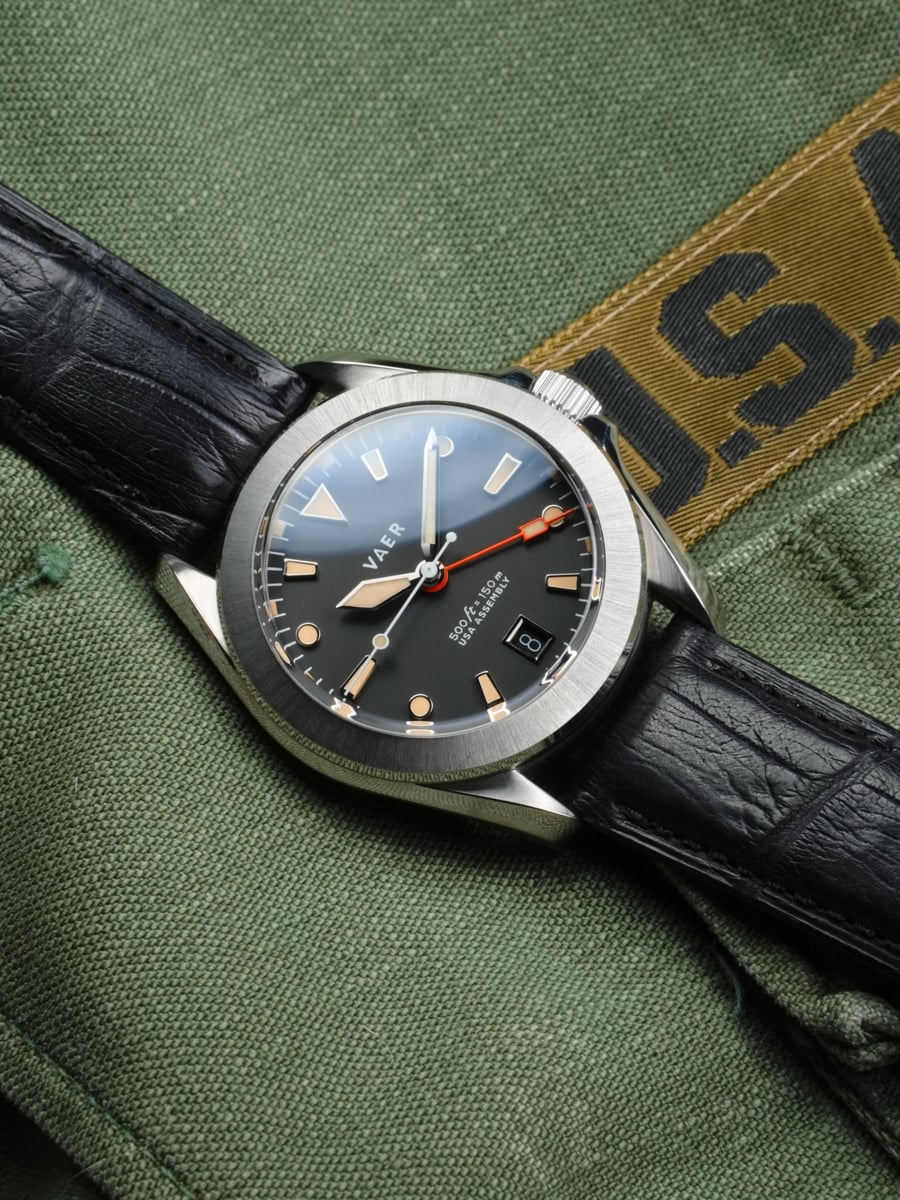 A Cult-Classic GMT Reimagined for Everyday WearInspired by the famously bezel-stripped Rolex GMT-Master worn by Marlon Brando in Apocalypse Now, the G2 Apocalypse turns a piece of 1970s film and watch history into a practical everyday GMT. Its restrained 39mm design pairs a Swiss Ronda quartz GMT movement with sapphire crystal, 150 meters of water resistance, strong BGW9 lume, and USA assembly. The result is an accurate, low-maintenance travel watch with a story collectors will immediately recognize.
 © Beartooth Media Group Inc.
 Loading...