


Hi folks,
I read a thread on here recently that mentioned that down does not loose too much warmth if worn compressed. unfortuntaley I cannot find the post and was wondering if anyone else could point me in the right direction.
Thanks,
Stephen
Topic
Become a member to post in the forums.
Hi folks,
I read a thread on here recently that mentioned that down does not loose too much warmth if worn compressed. unfortuntaley I cannot find the post and was wondering if anyone else could point me in the right direction.
Thanks,
Stephen

If down is completely compressed, like the bottom of a sleeping bag, It looses a great deal of its warmth, basically all of it. A different story if it is only partially compressed, like maybe a down jacket under a backpack? What is the specific application you are thinking of?
Will
Richard Nisley points it out at the end of this thread
and here as well
James
In order for down to be "Warm When Squashed", or anything to be "warm when squashed", the thermal conductivity must decrease by half when the thickness is halved (and under compression terms, this means that the density is doubled).
It is true that there is public access (published) data that shows that down thermal conductivity does decline when compressed (density raised), but the relative decrease in conductivity is less than the half required for "Warm When Squashed". However, this data does not identify the down for fillpower, just as "natural down clusters". This may or may not actually represent the highest quality down commercially used.
http://www.dtic.mil/cgi-bin/GetTRDoc?Location=U2&doc=GetTRDoc.pdf&AD=ADA481751
The published data does not support the conditions needed for "Warm When Squashed" conclusion – but rather supports the "Not So Warm When Squashed" common observation, such as expressed earlier in this thread..
In fact, as you look at the data, in virtually all of the cases presented you form the opinion that the general behavior is "Not So Warm When Squashed".
The data in the chart Nisely used specifically don't show a rapid enough loss of thermal conductivity with density gain to support the hypothesis.
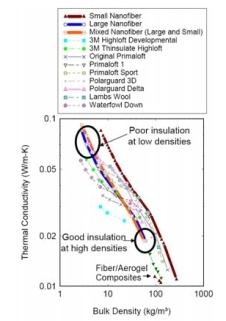
Natick Data
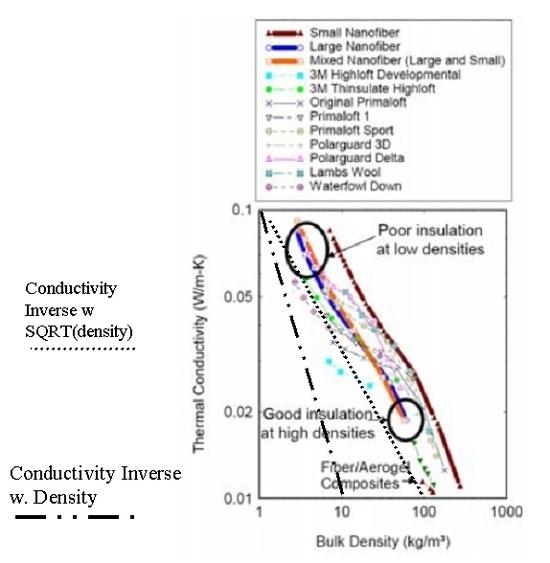 Natick Data Annotated To be fully "Warm when Squashed" the conductivity must scale inversely with density. The data are better approximated at low densities by an inverse square root scaling.
James,
My research and subsequent posting has focused on the thermal conductivity analysis of 800 fill down in the near linear range of commercial fully lofted (2.16 kg/m3 average) to a 2.5x density increase range.
You referenced one legitimate study that measured the average density versus thermal conductivity for 12 different types of insulations, including one unknown down fill power sample. That study started at the density of approximately 4 kg/m3 over a density increase of approximately 100x. Your analysis and conclusions were generally valid for the data samples you used but it was very different than what is relevant to UL backpackers.
You are a trained material’s scientist… you have the ability to easily measure what I primarily reported on (the thermal conductivity of 800 fill down in the range of being fully lofted to a 2.5x density increase) and then report your independent primary research results. That would be a valuable contribution to the forums.
Most commercial synthetic insulations are already being manufactured at their optimal thermal conductivity versus density inflection point. This phenomenon is shown clearly in the synthetic insulation’s respective patent applications. Look at each patent’s test data for density versus thermal conductivity. Next compare that data with the product’s density being manufactured. Increasing the density of most synthetic products will reduce their efficiency.
Richard Wrote:
You are a trained material’s scientist… you have the ability to easily measure what I primarily reported on (the thermal conductivity of 800 fill down in the range of being fully lofted to a 2.5x density increase) and then report your independent primary research results. That would be a valuable contribution to the forums.
You are making stuff up in your head that bear no relation to reality.
John,
Actually, I know that you missed the point and substituted your own instead.
The question Stephen asked was:
================================
Hi folks,
I read a thread on here recently that mentioned that down does not loose too much warmth if worn compressed. unfortuntaley I cannot find the post and was wondering if anyone else could point me in the right direction.
Thanks,
Stephen
================
I used a study on compressed down clusters (and other compressed insulations) to answer a question on compressed insulation — not to make an argument on optimal stuffing of down in manufacturing.
That is the point you made:
Richard Wrote:
Please stay on subject. This has virtually nothing to do with the question on compressed worn insulation and warmth.
Learning to get names right is a big plus, as well.
Hi Folks,
First of all thank you very much for your very intuitive replies.
To answer Wills question it is for using my Winter down jacket under a shell, I would say that the jacket is compresses by about 40% in the lower arms, 20% on the upper arms and the same on the body and hood.
Cheers,
Stephen
Stephen, the good news is that your jacket also partially traps some air between the down shell and the jacket, so you should get some more warmth than just the down alone.
–B.G.–
Many Thanks BG, thats good to know :-)
Mr. Rocketman, that was an interesting choice of tone for a forum discussion rebuttal. Its comical that you chastise someone for adding "virtually nothing" to a thread (when your chastising adds absolutely nothing to it).
Its seems that from Stephen's latest post, the information Richard has provided is very applicable.
James (but you can call me John)
Other than chastisement, there was nothing much to add.
The data presented explicitly give an indication of what happens when down is compressed 20% (and the density raised by 20%).
Phil Gibson of Natick labs stated the down used in that study (the one producing the graph) was mil spec 550 fill and 80/20 down/feather ratio.
From the data on this mil spec down, and relatively light compression, the inverse square root function is probably a good start for making a first order approximate calculation to tStephen's down compression question.
That would lead to roughly a 20% increase in thermal flow for a 40% compaction, and a 10% increase in conductive thermal flow for a 20% compaction.
Two components apply – the decrease in thermal conductivity of the material of about 20 %, and the 40% reduction in thickness for a net of 20% greater heat flow. For the 20% compression case, the changes are -10% conductivity and -20% thickness loss for a net gain of 10% in heat loss.
There appears to be no comparable public source data on down compaction and conductivity for fill powers of 600 cu.in./oz or 700 or 800 or 800+ fill down.
If there were such data available to you, you could answer a lot of your own questions on design and use of down in commercial and MYOG equipment. As it is, you are stuck with pretty old "rules of thumb" from books up to 40 years old, or gleaning the best that you can from manufacturer's catalogs or other published ratings of warmth, loft and weight. It seems to work out OK most of the time.
I find this interesting, this lack of data on basic behavior of materials used in substantial volumes in this specialty recreational area.
And customers just kind of putting up with it so readily.
> There appears to be no comparable public source data on down compaction and
> conductivity for fill powers of 600 cu.in./oz or 700 or 800 or 800+ fill down.
Apart from the fairly extensive publications in the BPL Forums of actual directly-relevant results by Richard Nisley based on his own in-house professional measurements …
Me, I wouldn't worry too much about the loss of insulation from the pack compression. Instead I would worry about the damage to the down from the continuous rubbing (grinding) under the pack straps all day.
Cheers

"Instead I would worry about the damage to the down from the continuous rubbing (grinding) under the pack straps all day."
+1
In a related vein, how anyone could hike with a down jacket on is a mystery to me. I'd be stewing in my own juices in a matter of minutes.
"In a related vein, how anyone could hike with a down jacket on is a mystery to me."
In the winter, I've been known to cross country ski in a down jacket, at least on a cold day. My metabolism just isn't as fast as it used to be.
–B.G.–
Hi Folks,
Thanks all for the very indepth replies.
It is for static use so I wont have to worry baout damaging the down with my pack starps.
Many thanks,
Stephen
Become a member to post in the forums.
 Brynje Mesh BaselayersBrynje baselayers use open mesh construction to move moisture away from the skin, create insulating air pockets, and help regulate body temperature across changing conditions and activity levels.
 © Beartooth Media Group Inc.
 Loading...