


For the scarp owners our there, does anyone use the solid inner for 3 season camping?
I am also curious if there is a weight difference between the solid and mesh inners?
Topic
Become a member to post in the forums.
For the scarp owners our there, does anyone use the solid inner for 3 season camping?
I am also curious if there is a weight difference between the solid and mesh inners?
The weight of the two inners is about the same. Sorry I cannot give you an exact answer right now.
Franco
That is going to be what I try as well. I have the Double Rainbow now but I get cold with all the ventilation in the 40s. Now I just have to sell the DR and buy the Scarp 2 with both inners :)
How is condensation with the solid inner?
From my understanding, the solid inner is made from the same material as the liner for the DR. I think most condensation would be on the outer fly and be blocked by this liner. The mesh liner would do much the same I think. The solid inner does have mesh windows which allow for ventilation to reduce the chances but not prevent condensation.
"I think most condensation would be on the outer fly and be blocked by this liner."
I could be wrong but as far as I know, condensation cannot be "blocked", as it is merely water in the air reforming on the walls of your tent when the temperature of the air inside the tent (which is of course high compared to outside temp. when body(s) are inside) clashes with the temperature of the air outside your tent. A "liner" becomes another wall for excess moisture to collect on, now how well is sheds/repels moisture is a diff. issue. Only way to mitigate condensation is to leave an air vent open, or stop breathing! Correct me if I'm wrong! :)
cheers
What I meant by that was the problem that some people have with single wall tents. That being condensation forming on the outer fly and "misting" when rain drops on it. I think the second wall of the inner would block most of this.
oh now I see! thanks, -Evan :)

"Only way to mitigate condensation is to leave an air vent open, or stop breathing! Correct me if I'm wrong! :)"
I believe condensation only occurs when there is a temperature differential, like when warm humid air (like your breath) contacts a tent wall that is cooler than the air. This cooling of the air caused by the colder wall causes the humid air to contract and thus expel the excess moisture it can no longer hold onto the cold wall.
So in regard to your post, I believe another way to mitigate condensation would be to warm the wall that the humid warm air contacts so it is not significantly colder than the air. This is essentially what a double wall tent does. The outer wall is cold because it's touching the presumably cold outside air, but the inner wall is warmer because there is a layer of air between the walls that insulates the inner wall. This decreases how much the air cools when it contacts the inner wall of the tent and thus reduces the amount of condensation on the inner wall. Of course the condensation still forms on the outer wall when the hot humid air vents to the outer wall and then cools.
I could be wrong but I think that in theory if your tent walls are as warm (or warmer) than the air inside then you will not get condensation. So one theoretical way to eliminate condensation in a single wall tent would be to heat the walls somehow….like impregnating tiny wires in the wall fabric and then using those to heat the walls a little bit much like an electric blanket. This is likely an impractical suggestion, but it is an interesting avenue to mull over. Besides using two walls, there may be other options to reduce/eliminate condensation like using thicker wall materials (ie. bubble wrap) that have some insulative value, so the inside of the material is warmer than the outside.
One of the regulars at Outdoor Magic (UK forum) yesterday labelled "condensation" talk a phobia. His point was that given the right circumstances all shelters will gather condensation. Some do it better than others.
Reading the Ray Estrella review of the TN Laser , as one example.., should have made it pretty clear that a double wall is not a cure for condensation, in fact that particular design will collect rather than dissipate condensation as a similar designed shelter did before a vent was put in place.
The main reason that some are convinced of the magic double wall solution is that they do not see the underside of the fly getting wet. However they do notice that when it starts dripping on them and the inner is mesh. Ever wondered why tents like the Hubbas have a piece of fabric on the top section of the mesh inner ?
Franco
It seems that there are a lot of talk about the issue of condensation.
Obsessing about condensation is like obsessing about snakes, bears, wolves, spiders,…
If you don't let it bother you and choose to ignore it, it won't bother you.
Of course you should practice condensation management and provide ventilation when it gets cold and damp.
I find that I don't sleep well in an oxygen deprived shelter so I always have enough ventilation to keep condensation at a minimum in the wettest environment.
I would never consider using a fabric wall inner, even with mesh windows. The all mesh inner blocks enough air flow and adds some warmth.
well i dont know why but a 100% mesh inner does a lot to mitigate condensation.
i am a big fan of single skin without floor shelter
with my wife we use mostly either a kifaru paratipi or an msr twins sisters, and we were used coping with condensation when we couldnt ventilate enough etc…
for bug (midges) protection i did a myog silnylon floor + nanoseeum inner , 350g / 12,3 oz.
it wasnt the purpose but it seems every time i bring it that i have much less condensation than when i dont because i dont expect bugs.
and its not beacuase the inner prevents me from touching the outer skin, when i pack the shelter in the morning its much drier with comparable weather / wind etc..
Hi Fred,
"well i dont know why but a 100% mesh inner does a lot to mitigate condensation."
Yes, I believe it is because the mesh holds some of the warmer moister air in while the dry/colder air circulates between the mesh and the outer wall. I have found that the air between the mesh and the outer wall is colder than the air inside the mesh.
This assumes good air circulation of course.
If there wasn't much ventilation, it probably wouldn't make that much difference.
I'd woken up many times in the past several years in a tent with some water / dampness here and there.. sometimes on the floor.. and just wiped it down. I've woken up once with the tent and esp. the sleeping bag near my face completely covered in ice crystals when it was 10 F outside.
I didn't even give it a name in my head and on reading about condensation here and in gear reviews around the web, I thought it must be some serious life-threatening problem I'd never experienced. I can see how it could be an annoyance in very small tents where you touch the walls a lot but I can think of a 100 other inconveniences in the backcountry.
I would understand this as a minor issue to consider in a purchase alongside color of the tent, height of the doorway etc but can this ever really grow beyond an annoyance to something dangerous?
The mesh inner is 12 oz, the solid fabric is 13 oz.
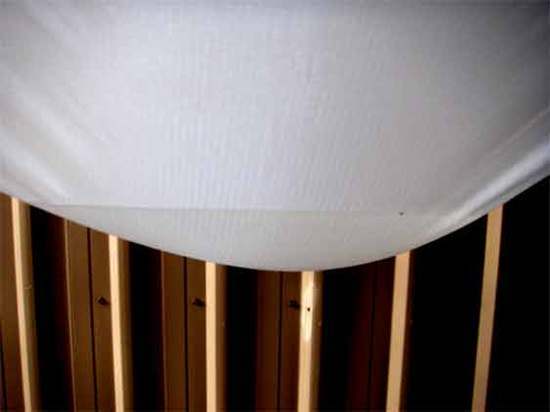
Did this test this morning , but I already had done similar tests last year…
The DR/Rainbow liner is the same fabric as the Scarp solid inner.
There is one liter of water in there, it has been up for more than two hours , not one drop escaped.
(I have a newspaper under it)
I left it up all day till 9PM, a total of about 12 hours.
No drips.
Franco

The Scarp fabric inner is about 2 oz. heavier than the mesh one. The fabric portions of the inner are 1.1 oz. ripstop nylon with a "breathable" DWR silicon coating (You can hold the fabric to your mouth and blow through it).
It will collect far less condensation than the outer fabric, which has a much more water resistant silicon coating (You cannot blow through the outer fabric).
For me, condensation is a serious problem when there is no barrier, either mesh or breathable fabric, between the occupant and the condensation. That is because I do not enjoy having myself and my gear soaked. For this reason, my single wall tents are designed with netting barriers and/or netting covered vents at head, foot, and sides. The Moment is an example of a tent that, to some extent, uses this approach. This approach is in addition to enough venting for ventilation to keep condensation from accumulating to the point where it actually drips on the occupant, or in a full double wall tent, on the inner wall or mesh.
Sam
Become a member to post in the forums.
 A Medical Problem in the Backcountry. What Next?When symptoms develop miles from help, deciding whether to rest, consult Medical Assist, self-evacuate, or use SOS takes judgment. See how two-way satellite messaging expands your options. Button: Watch the Video
 © Beartooth Media Group Inc.
 Loading...