Topic

New UL knife from Ka-Bar

  • This topic is empty.
Viewing 14 posts - 1 through 14 (of 14 total)
Dale Wambaugh BPL Member
PostedMay 5, 2010 at 9:41 pm

I ran across an ad for a tiny Ka-Bar knife designed by Nathan Becker called a Becker Remora and found one on eBay for $20.

Becker is known for designing some monster military-style knives, but he also created a smaller model known as the Becker Necker. That isn't a bad knife for hikers, but there are other fixed blade knives of the same weight that are probably more useful. The Necker is made of carbon steel, which makes it difficult to use around salt water and needs a little extra care to keep it from rusting. I do prefer stainless steel knives and eventually sold the Necker that I owned.

Ka-Bar has been manufacturing Becker's designs and recently released the Remora model. It is made of 440A stainless steel. 440A is not considered to be a premium knife steel, but it isn't terrible. Hardening and other manufacturing techniques can make a real difference in how a particular alloy works as a cutting tool. It is inexpensive and soft enough to be field sharpened. I use Swiss Army knives as a benchmark for inexpensive outdoor knives and my first impression is that this steel is at least as good as you will find in a Swiss Army knife.

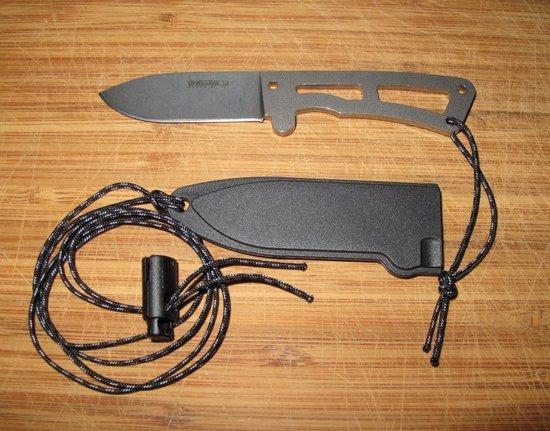
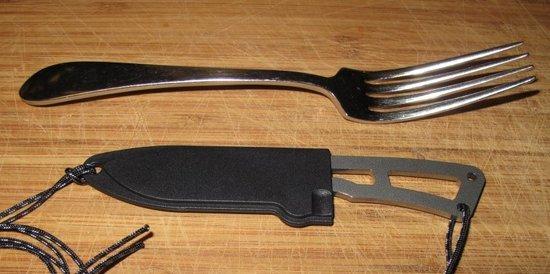
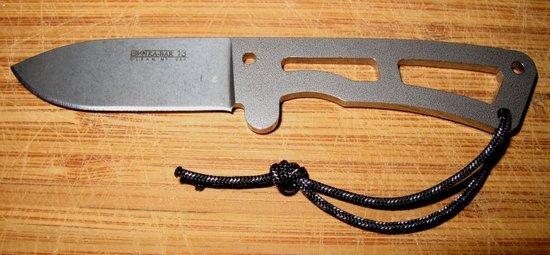
The knife is 5-1/2" long in the sheath, 5-3/16" long by itself, with a 2-1/4" blade. It is a skeleton style knive, with blade and handle being all one piece of steel, with no handles or scales. There are lightening holes in the handle and three round holes for lanyard and lashing as a spear head. The blade shape is a drop point design and the edge is hollow-ground, all the way to the spine. The handle has a bit of surface texturing.

Weight you ask? [drum roll] It is a mere 1.4oz/40g with the sheath and 1.1oz/30g without.

The lanyards are my addition.
Ka-Bar Becker Remora knife

Ka-Bar Becker Remora knife

Ka-Bar Becker Remora knife

Conclusion:

This is a small, lightweight, inexpensive knife. It provides a sharp edge, useful for fire-starting techniques like making fuzz sticks and scraping firesteels. It could be used for cleaning fish and small game and basic food prep, opening packaging,repairs, etc. With the 440A steel I would not expect long-term edge holding properties, but it is more than adequate and can be easily resharpened in the field with a small ceramic or diamond stone. It should be rust proof. Adding a line for a neck or belt lanyard will keep the knife close at hand and prevent loss. This knife is light enough for comfortable use as a "necker" or can be carried in a pocket. The molded plastic sheath does the job– simple, light, and secure. I like the overall design of the knife and I am satisfied with the purchase.

IMHO, the major drawback for this style of knife is the handle size. It is difficult to really bear down with a handle like this. Adding a small loop lanyard as shown in the photos helps stabilize the knife a bit, with the loop wrapped around the ring and little finger. Skeleton knife handles are commonly wrapped with cord, which improves handling and provides an a supply of line in an emergency. A handle this small should be wrapped using small diameter braided line like the 1.5" reflective cord I used for the lanyard.

PostedMay 5, 2010 at 10:41 pm

I'd love to see something like this made in S30V Stainless. By far my favourite knife steel for use in incliment weather when you don't necessarily have the time or materials to keep a high-carbon knife rust-free and oily.

Ethan A. BPL Member
PostedMay 5, 2010 at 11:11 pm

Peter and Bradley, the Hartsook is available in S30V. Great little design.

Dale, nice inexpensive find. Keep in mind that in June Ka-Bar is releasing a new Becker with the Becker Necker BK11 blade and the very comfortable Izula handle design, which is much more comfortable than the Becker Necker handle. Also, in practice, I've reconsidered handle wrapping – looks nice, but it isn't very functional, especially if you're dealing with wet weather – the cord will be hard to work with when wet and can tear up the skin of your palm.

You might also consider the Bark River Bravo Necker and Bark River Bravo Necker II (same knife with a slightly longer blade) for a non-carbon strong steel blade with convex grind. Not comfortable though without the featherweight scales, which adds to the cost, while the Izula is comfortable without scales. Both Bravo Neckers weigh under 2 ounces and the kydex sheaths are very light. You can find them used here and there.

Not long ago I researched light fixed blades with lightweight sheaths to replace my old heavier military tactical knife (which was still considered light back then) and mid-weight fixed blade (SOG Seal Pup) which I sold. My criteria was fixed blade knife 2.5 ounces or under, with lightweight kydex sheath and blade 2.5-3.5 in. These were some of the ones I've considered. As you can tell, I don't consider a fixed blade a luxury, but I do want it to be very light.

PostedMay 5, 2010 at 11:12 pm

Hi Bradley, check out the Buck Hartsook. It's little, but S30V steel and only .5 oz!

Dale Wambaugh BPL Member
PostedMay 5, 2010 at 11:16 pm

The Buck Smidgen is a great small knife design. See the Buck Hartsook for the same design as the Smidgen in S30V steel with BOS heat treatment. Both are excellent examples of what I call "sharp claw" knives — those knives that provide the claws that Nature left us without.

I've owned the Hartsook and it is a clever design and a great study in tool minimalism, but won't do much more than a single-edge razor blade.

As far as real utility in a small package, it is hard to beat a quality folding knife with a good handle. The Benchmade Griptilian is my favorite.

When it comes to knives in the woods, I like one "real" knife– one capable of some heavier cutting and another for backup, a tiny sharp claw to be carried with my pocket survival lanyard, with firesteel, whistle, tinder capsule and LED flashlight. I usually have a Victorinox Classic for that role. There are many perfectly usable knives for this. I use it for grooming, small repairs, and finer work where the larger knife is clumsy or can't handle the detail.

I know this makes some UL folk crazy, but I have these tools with me walking around a large city every day, let alone 5000' feet up a mountainside and solo. I want a little more than a single-edge razor blade or the scissors taken from a Swiss Army knife.

Ethan A. BPL Member
PostedMay 5, 2010 at 11:32 pm

Dale, I don't think that's crazy at all. I also use the Classic with scissors on my lanyard with whistle and Photon mini as part of my survival kit and for general utility. I don't consider it or other very small knives like the Hartsook a replacement for a capable light fixed blade.

For something compact for everyday use, I'd also go with a Griptilian or similar quality folder, but much prefer a fixed blade for backpacking.

Dale Wambaugh BPL Member
PostedMay 5, 2010 at 11:51 pm

I found the larger — 4" and larger fixed blades to be a little too much and too heavy. I had a Fallkniven F1 and a Benchmade Rant, are both excellent utility knives, biy hover around 8oz with a sheath. I've replaced them with a Mora Allround, which was $15 and capable of just about any bushcraft chore and only 4oz with the sheath.

I have that and several Swiss Army knives and I still head out with the Benchmade Griptilian the vast majority of the time. Next in line would be the Victorinox Trekker. It is a great food prep knife, with a long, flat (and sharp) blade, that is great peeler and slicer. The mora excels at food prep as well.

PostedMay 6, 2010 at 4:52 am

Crkt Ritter, slightly lighter, full tang fixed blade.To give the ka bar a better grip, attach paracord to back ofhandle and tie an overhand knot where the cord meets the back of your pinky. Will extend the handle and blade control.

PostedMay 6, 2010 at 6:42 am

Great review Dale. Thanks for taking the time to type it out. The review gave me a much better idea of how to examine the quality of a knife. Gonna take some time to learn about different steels and blade shapes now.

Right now I just use a razor blade and have not ever had the feeling that I need more. However, when I carried my bushbuddy on wetter trips I would carry a small knife. I was thinking of bringing my bushbuddy back out this season to mix up my routine a bit and this article gave me something new to shop for! Cheers for that!

Dale Wambaugh BPL Member
PostedMay 6, 2010 at 7:43 am

There is a great resource at the Spyderco web site, with a chart listing all the major knife alloys: http://www.spyderco.com/edge-u-cation/steelchart.html

I would say there are three major groups of steels used for knives:

High carbon steels. Less expensive, easier to machine, heat treats well (also known as tempering), takes a good edge, prone to rust.

Stainless steels. Many grades, some harder than others, more difficult to machine and sharpen than carbon steel, more expensive, variable edge retention, doesn't rust.

Tool steels. Very hard, most expensive, more difficult to machine and sharpen, excellent edge retention, variable rust resistance.

Look at the Victorinox Trekker one hand opening model for a companion to your Bushbuddy. It has a nice saw and is a very useful all-around knife with the usual selection of Swiss Army knife tools. It comes with serrated or plain-edge main blade, and I prefer the plain. If you climb or otherwise use ropes and lines, you might want the serrated model. You can find them on eBay for $30 or so.

The Wenger S18 models are smaller, still offering a locking main blade, a saw,and the addition of scissors. The Victorinox Fieldmaster is similar, less the blade lock. IMHO, the Trekker is much more useful for sawing with the larger saw and handle.

If you want a dedicated saw, the Gerber Sportsman is inexpensive and about as light as a folding saw gets– about 3oz. If you can handle a bit more weight, the Bahco Laplander is about 6oz and is much more robust. It is sold in the US by Kersaw knives. These folding saws are far more efficient wood cutters, able to cut 3" stuff in a single cut and larger with multiple cuts. Not exactly Leave No Trace conscious, and capable of real damage in the wrong hands.

If you want to carry a larger fixed blade knife to use for batoning wood, look for a thick blade with a straight spine and a convex or flat ground blade– steer clear of hollow ground blades. The Fallkniven F1 and Benchmade Rant are good examples. The Mora Allround will work for light stuff, but it wouldn't be my first choice for batoning as a primary duty.

PostedMay 6, 2010 at 11:48 am

I've posted about this one briefly before, and I need to do an in-depth review.

My new goto EDC and camp knife is the Bark River Bravo Necker 2.

This is way more knife than the aforementioned knives, but also comes at a price premium.

Fully convex grind in 12c27 steel (which is a highly stain resistant variety).

http://www.knivesshipfree.com/Bravo-Necker

The necker 2 is 3.5" blade length that weighs in at 1.75oz for the blade only, and adding scales weighs it @ ~.75 oz extra. The scales are very comfortable, although I don't find this knife as comfortable as the Izula with paracord, without modification. However with scales, it's much more comfy.

The regular necker is 2.5" blade at 1.5oz.

I've been beating my BN-2 to death and have done nothing more than strop it in the month and a half I've had it. It's alot more knife than the Izula or the Becker Necker.

PostedMay 6, 2010 at 11:52 am

btw, want to mention that convex blades are extremely easy to sharpen(shaving sharp) and maintain in the field using an UL setup of a piece of cut mousepad(I use the hipbelt padding from my Gorilla) and high grit silica sandpaper(I take two grits cut to the width of padding and about 5" long).

Dale Wambaugh BPL Member
PostedMay 6, 2010 at 1:32 pm

Bark River makes world class knives— excellent examples of good design and materials. Their Micro Canadian model is another that would appeal to UL hikers.

Viewing 14 posts - 1 through 14 (of 14 total)
Loading...