Topic

Arctic tent

  • This topic is empty.
Viewing 25 posts - 51 through 75 (of 102 total)
PostedApr 6, 2010 at 3:04 am

I prefer tunnel tents in a storm. Yes, they might move around a bit more, and are usually noisier, but i haven’t had one fail on me. I’ve seen so called ‘bombproof’ dome tents collapse.
Here in the UK, the 2 dome CRUX tents are popular for severe weather use.
Also, check out some of the Terra Nova offerings. They don’t only make UL tents.

Brad Groves BPL Member
PostedApr 6, 2010 at 8:26 am

Interesting discussion thus far.

FWIW, "It seems to me that, while the freestanding tent requires securing SOME of the time…" isn't really true. For any tent to work properly it always needs to be secured, bad weather or not. The point of a double-wall tent is better ventilation, less condensation, etc. If you don't stake a double wall tent, the fly will just hang against the inner tent; you lose all the advantages gained with a double-wall tent.

If you've had and used the 'mids, but want something smaller and lighter, I'd check out an MLD Duomid w/insert.

The biggest issues I've had w/staking have always been in winter. The toughest for me is when there's 6 inches of snow and frozen ground. Can still usually find rocks or trees to anchor, but if ever I were going to insist on a free-standing tent, that'd be the time. If I were looking at mass-market bomber-ish but light-ish free-standing tents, I'd consider the MSR Fury or perhaps the SD Omega, both ~6.5 pounds, or perhaps the ~4 pound MSR Hubba Hubba HP, in addition to the Hillebergs mentioned. (For the record, the Kaitum and Allak weigh about 6 pounds, the Soulo or Unna weigh about 4 pounds.)

Robert Blean BPL Member
PostedApr 6, 2010 at 10:29 am

If you don't stake a double wall tent, the fly will just hang against the inner tent;

I do not understand (for a freestanding tent). The freestanding tents that come to mind have the fly supported by the tent skeleton.

MSR Hubba Hubba HP — MSR explicitly considers this a 3-season tent. Is it really as strong as the rest of the tents we have been talking about?

SD Omega — does not look to me as if it is still being made.

MSR Fury: min weight 6#4oz max weight 7#5oz
Allak: min 5#7oz max 6#10oz
Soulo: min 3#12oz max 4#13oz
Is considering the Fury based on price, or does it have a compelling technical advantage?

–MV

Brad Groves BPL Member
PostedApr 6, 2010 at 10:57 am

Yes, the fly is somewhat supported by the frame. But it is not supported by the frame in considerable stretches. It is not supported by the frame on the sides or ends. This is true for most of the fs tents I've set up.

Yes, the HP is a 3-season tent… but it was designed "with increased foul weather performance" in mind and "holds its own in more extreme 3-season conditions." No, it's not as strong as a Fury. But I reckon it'd do fine if you're looking at lightweight options, aka 2-3 pounds lighter and not a mid.

I own a Fury; mine weighs about 6.5 pounds with stakes, and I just stuff it into my pack. The Fury is also ~$250 cheaper than the Hilleberg, and at least as strong if not stronger. I feel like I could just about lay down on top of it with no problems.

I spaced on the Omega, but it was still current as of fall, so if it appealed to you I'm sure you could easily find one at a dealer. Just trying to give you options that haven't been mentioned.

It's worth mentioning the Big Sky Convertible 2P; has a third crossing pole ala Allak/Soulo, and larger diameter poles than the stock tents. Also has snow/sod flaps on the fly. Weighs about 4 pounds.

PostedApr 6, 2010 at 11:01 am

one quick bit of advice is to add some cord on all the lines for tying around rocks, I also like to use those snow parachute-type anchors. They work great in sand and you can always fill them with rocks to keep your tent in one place.

Robert Blean BPL Member
PostedApr 6, 2010 at 11:34 am

I spaced on the Omega, but it was still current as of fall, so if it appealed to you I'm sure you could easily find one at a dealer.

I just looked, and Sierra Trading Post has it for $159.95

This customer review did not sound promising, though:

It performed well until a huge wind storm picked up. The door of the tent only has a screen and relies on the fly to keep out rain and/or sand. The description does not indicate this feature. By the end of the wind storm my tent was full of sand blowing up underneath the fly.

Brad Groves BPL Member
PostedApr 6, 2010 at 11:45 am

FWIW, if anything, the reviewer's comment "The door of the tent only has a screen" is wrong. The door has a zip-out full nylon door. If you zip out the nylon door to leave it at home during the summer, then the screen door is left. The ceiling has an open-able nylon piece, too, which is not removable. Not saying this tent's your answer, but you should at least have the right info at hand…

Hendrik Morkel BPL Member
PostedApr 7, 2010 at 12:34 am

Great discussion going on here!

Bob, to get back once more to the Scarp 1, which would be a lot cheaper and a tad lighter than the Soulo. I have used the Scarp 1 now for a few months on trips in different conditions, and would feel confident taking it to Lapland (what exactly is Northern Canada for you? Labrador? Nunavut?) into the Fjells. It sheds wind fine, has no problems with snow, is freestanding (though I always would peg out) and is very comfortable on the inside. It is easy to put up – not as easy and comfortable as a tunnel, though. If you will need such a tent just for this one trip, I believe Scarp 1 could be the better investment, as it is less costly and should get a good price if you decide to sell it again. Also, Chris Townsend has used it a lot in Scottish conditions, and recommends it in the "Tent for Iceland" thread.

Rog Tallbloke BPL Member
PostedApr 7, 2010 at 12:51 am

"But are you suggesting that you would not go find the same number of rocks to guy out a 'free-standing' tent? Surely not? Tumbleweed!"

There was a fatal accident in the UK a couple of years ago when a woman was rolled across a campsite and over a 20 foot drop into a stream bed. Such are the dangers of taking 'freestanding' too literally. And this was a freak gust on a relatively fine day, not a winter hoolie.

Roger Caffin BPL Member
PostedApr 7, 2010 at 1:26 am

Hi Bob

Good discussion. Thanks.

> You are saying that basic pitching the tunnel is all the guying it needs to ride
> out a gale.
Well, yes, although it helps if the wind is end on. This happened to me on Mt Anton in mid-winter, as described in When Things Go Wrong. By the time morning arrived (well, around 5 am?) the hammering of the wind and snow had put about 1″ of ice around every guy rope, and the constant fretting against the hard sharp edges of the titanium snow pegs frayed 7 out of 8 of the 150 lb Spectra guy ropes to the point of failure. I had not anticipated that! We knew something was amiss when the tent started to shake more than it had done for most of the night, so I dressed and got out and crawled around (take that literally) and inspected what was left of the guys.

Anyhow, what all this means is that the tunnel tent was taking the storm with 100 kph wind and gusts above that, with only the two windward end stakes (and the two at the other end) holding it down. That’s ‘basic pitching’. Granted, the end stakes were decent deadman anchors!

OK, OK, I have to admit I was seriously impressed with my new MYOG tent! We now have very high confidence in it!

Errr… yes, I have altered the Ti snow stakes so the fretting never happens again – see my article on the mods done.

We lost those Ti snow stakes – they were buried too deep with no trace visible, and conditions were not suited to archaeology that morning. I have recently been back to the approximate site to search for the stakes (our Autumn), but to no avail. Mind you, I reckon we were within 50 – 100 m of them!

Sounds as though we are close enough in thinking. Here’s to snow camping :-)

Cheers

Roger Caffin BPL Member
PostedApr 7, 2010 at 1:30 am

Hi Brad

> The biggest issues I've had w/staking have always been in winter. The toughest
> for me is when there's 6 inches of snow and frozen ground.

Have a look at our articles on MYOG Titanium Stakes. I have been amazed at how they slice into frozen ground when thin Aluminium ones just crumple.

Cheers

Robert Blean BPL Member
PostedApr 7, 2010 at 10:23 am

For those who have not noticed, there is a somewhat similar thread, based on hiking in Iceland, that started in 2009 and was recently revived.

By Northern Canada I meant Northwest Territories and Nunavut — the barren lands and the arctic.

Scarp 1 — I just took another look, and I must say there are appealing things about it (such as 2 vestibules). If it really is a suitable tent, the price is certainly better. I remain a bit concerned that it may not be as strong as the Hilleberg tents, though.

Scarp 2 — do you know anything about that? The available net inner tent is a nice touch. I note Will’s review and wonder whether some of his comments might not also apply to the Scarp 1.

Weather conditions — I’ve been meaning to post this quote from Cliff Jacobson’s “Expedition Canoeing” book:On our Hood River trip, we were once tentbound for sixty-two hours — pinned down by icy rain driven by an unrelenting wind that raged at 50 miles an hour. It is worth noting, in the context of this discussion, that from a pegging point of view his favored Aroostook tents are tunnel tents.

Hendrik — your tunnel remark — any particular tunnel in mind? Hilleberg, or do you now of a lighter/cheaper one that is still solidly 4-season?

Roger — are there conditions where you would prefer a freestanding tent to a tunnel tent? Or do you believe a tunnel is always a better idea?

–MV

Robert Blean BPL Member
PostedApr 7, 2010 at 11:01 am

Stephenson tents are very light, and they are tunnel tents. The price for many of their models is right up there in the Hilleberg atmosphere, too.

I know they are controversial — some say way over-rated, while others think they are wonderful. I have an older 2-man model myself, and have liked it a lot.

The very lightest one would be their 2CX 2-Person Climbers' Tent, with everything optioned out. That would be 2# 3oz and $445. Makes me wonder why it does not come up more in these forums — it is surely UL weight.

A roomier tent one might choose is the 3R with side windows and a large door. That is a 3-person tunnel tent, doors at both ends, roomy for two at 4# 8oz $684. (3# 12oz without those two options)

Anyone else with comments on those tents?

— MV

PostedApr 7, 2010 at 11:07 am

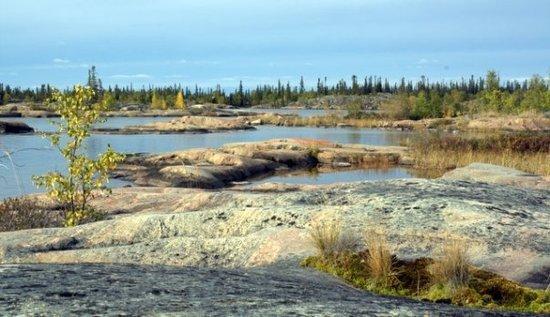
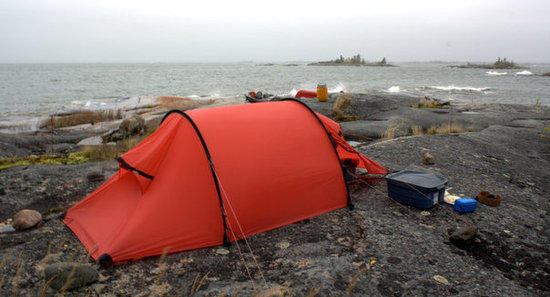
Just to clarify something. I only suggested a freestanding to make things easier. Last year the NWT experienced the worst bugs I have ever seen (believe me…. way worse than anything in the lower 48). For ones own sanity, a freestanding takes away the search for suitable rocks on the land. If you are camping anywhere in Nunavut, or the NWT, FOR THE MOST PART (not everywhere!), you will need to pitch with rocks. You will not be able to pitch with stakes. See photos of landscape examples.NWT landNWT land

Tunnel tents are by no means an impossible way to camp. I did it! But I would take a freesatnding if I had the choice.

And you cant go wrong with Hilleberg.

ALSO, land is very dependant on what river you are paddling. Check guidebooks and online for suitable info. If you are paddling lake systems, I can almost gaurantee everything will be rock.

ALSO, pt. 2, you would be suprised at how difficult it can be to find rocks soometimes…

Have a story from a friend in Iqaluit. People set up their wall tents just outside of town in the summer months for hanging out/hunting, and apparently ACTUAL battles ensue over the few rocks available to assist in pitching. Like… actual disputes.

Robert Blean BPL Member
PostedApr 7, 2010 at 11:38 am

Tunnel tents are by no means an impossible way to camp. I did it! But I would take a freestanding if I had the choice.

Nicholas,

What are your thoughts about Roger's assertion that your rock needs are about the same, whether you use a tunnel tent or a freestanding tent?

–MV

PostedApr 7, 2010 at 11:44 am

Throw some equipment into a freestadning and you should be good to go. Unless you're going so minimal that you dont have any equipment…

Either way, 2 rocks on the windward side of a freestanding is easier to find than the minimum 4 for a tunnel. You could also use a canoe to secure the windward side.

As said, tunnels are doable. I would take a freestanding if I had the choice though.

PostedApr 7, 2010 at 12:20 pm

I would sidestep Stephenson tents. Stephenson tents are not just tunnel tents but also require substantial tension for integrity and I can see where that would be a real problem on exposed granite and loose gravel. Having stated that my 2R and 3R work well in most conditions. Stephenson 3R
Stephenson 2R

Hendrik Morkel BPL Member
PostedApr 7, 2010 at 12:45 pm

Bob, Scarp 1 is like the little sister of the Scarp 2. I believe the majority of points in Will's review (it has been a while I read it) should apply, except that the Scarp 1 is smaller in all aspects (less surface to be attacked by wind, smaller footprint, etc.).

No particular tunnel in mind, just based on Roger's comment on how he pitches his ;).

Roger Caffin BPL Member
PostedApr 7, 2010 at 2:14 pm

Hi Bob

> Roger — are there conditions where you would prefer a freestanding tent to
> a tunnel tent? Or do you believe a tunnel is always a better idea?
OK, this is strictly a personal opinion now. Having tried many tents under different conditions, I find I sleep a lot more securely in one of my tunnel tents.
Domes and pop-ups (I have some) seemed to have very poor ventilation in comparison, which means more condensation.

Cheers

Roger Caffin BPL Member
PostedApr 7, 2010 at 2:16 pm

Hi Scott

> I would sidestep Stephenson tents.
> require substantial tension for integrity
Yes, that's where I have a problem with them too. Not enough poles to handle really bad weather.

Cheers

Robert Blean BPL Member
PostedApr 7, 2010 at 2:26 pm

Not enough poles to handle really bad weather.

FWIW: According to their web site, you can get an optional third pole (which they say you do not need).

–MV

PostedApr 7, 2010 at 2:27 pm

"Not enough poles to handle really bad weather."

The poles are large diameter, pre-curved, and quite strong.

The issue I have had, in serious long-term wind, is that the lack of a center pole results in a serious loss of interior volume.

PostedApr 7, 2010 at 2:51 pm

""Not enough poles to handle really bad weather.""

"The poles are large diameter, pre-curved, and quite strong."

It's not that the poles will snap necessarily, it's that you will get too much deflection in the fabric panels; they will move too much in the wind even if the poles themselves stay rock solid. The bigger the fabric panel the more tension is required to keep deflection to within a desired range. Once panels get over a certain size it simply is not possible to maintain enough tension – so you end up with sagging or flapping panels. The tent may not fail catastrophically in high winds if the poles and fabric are strong enough, but it wont be pleasant to live in.

"The issue I have had, in serious long-term wind, is that the lack of a center pole results in a serious loss of interior volume."

Exactly, the lack of a centre pole means that the panels are too big and you get too much deflection.

Andy.

PostedApr 7, 2010 at 3:01 pm

Thanks, all, for a very interesting, thoughtful, and civil discussion here. The sharing of your collective experience could not have come at a better time for me!

James

Robert Blean BPL Member
PostedApr 7, 2010 at 3:08 pm

Exactly, the lack of a centre pole means that the panels are too big and you get too much deflection.

As noted above, there is such an option. That said, I have never seen any anecdotal experience, nor any picture with one. From the options list on their web page for the 3R tent:

$65 Mid Pole

$30 Wind Stabilizers. Helpful if you get higher than 60mph winds.

From their tent information page:

M Mid pole to reduce side deflection in strong side winds, is not needed for strength. Sleeves for mid pole are in all 3R and 5R tents.

W Wind stabilizers: diagonal inside straps from each side of each pole down to far end of pole, greatly stiffening and supporting pole. For winds over 95mph. They get in the way a bit in use, especially on mid pole, and no one really needs them. +2.5 oz on 2R, 5 oz on 3R, 7 oz on 5R.

— MV

Viewing 25 posts - 51 through 75 (of 102 total)
Loading...