Topic

Zipper Modification

  • This topic is empty.
Viewing 25 posts - 1 through 25 (of 30 total)
David Gever BPL Member
PostedMar 8, 2010 at 6:58 am

I have a Marmot Helium with a 1/2 zipper that I would like to convert to a full zipper. I definitely don't have the skills to do this, so does anyone know where I can get this done? I am also thinking of having some additional down inserted since the bag would already be cut open.
I would imagine that converting it into a quilt would be easier, but at the intended temp I think the draft would be troublesome.

Kevin Beeden BPL Member
PostedMar 11, 2010 at 11:03 am

Adding extra down to a bag isn't necessarily a good idea. If the bag is properly designed and made in the first place, the compartments will be sized so as to allow the down to achieve its full loft. Or, to put it another way, the compartments have just enough down in them so they are completely filled (a little extra is usually added to allow for degradation of the down over the lifetime).

Adding extra down won't increase the loft, as there should be no more room for it to expand into. In fact, there's an argument that overstuffing replaces dead air space with more conductive down, so you may even degrade the performance.

The only benefit you may achieve from adding down is when it's added to the base of the bag, to increase the thickness of the weight-compressed down. But you're probably better off using a more insualtive mat.

Hopefully, the down bag and quilt makers will be along later for other points of view.

Travis L BPL Member
PostedMar 11, 2010 at 11:23 am

I may have completely misunderstood, but I just read a thread where Richard Nisley said that the optimum performance of down was at a 2.5x compression. I don't have the actual thread, but here's a quote from another thread, basically dealing with the same thing. However, these are mathematical equations that aren't true in all circumstances for all people.

"So, assuming I have understood this right, in the linear region of the curve (where UL backpackers operate) if you decrease the thickness of your typical UL sleeping bag by a factor of 2, you will not affect the warmth of the bag. Why? Because the density will be doubled, and so the clo/inch will double, but the thickness will be halved… so 2*0.5=1 and the warmth of the bag will stay the same.

I think is a particularly interesting fact. Surely it means that you needn't worry so much about needing lots of room inside your sleeping bag or hard shell to allow a down jacket to loft fully. A partially compressed jacket should be just as warm, so long as you are not completely crushing it (eg. lying on it!)."

PostedMar 11, 2010 at 11:40 am

This is my understanding too, based on several threads/posts from Mr. Nisley and others. There was even a comment a while back regarding why "fully lofted" has become the marketing standard due to the numbers game manufacturers have to play with each other. ("yeah, well we get 7" of loft!!).

Anyway, I took this "optimum density" thing and ran with it recently on a down sweater for my girlfriend. Each compartment was stuffed to approximately 2x density. It has proven, at least anecdotally, to be quite warm for it's thickness.

Richard Nisley BPL Member
PostedMar 11, 2010 at 3:39 pm

The insulation value is about the same in the range from fully lofted to 2.5x density increase. Down isn't warmer at 2.5x density.

Travis L BPL Member
PostedMar 11, 2010 at 3:44 pm

In the case above though, adding down–to an extent–would increase warmth since there is more of it, and the slight compression of adding more down would not be a detractor of the insulating properties.

Or did I just botch the whole concept?

PostedMar 11, 2010 at 5:16 pm

Sounds right to me Travis, it seems the difference is the two possible scenarios…here we're talking about filling a fixed space with more and more down (warmer and warmer, but diminishing returns beyond 2.5x even though warmth continues to increase) and the alternate idea of shrinking a space with a fixed amount of down in it (retains it's warmth up to 2.5 compression, then actually loses insulation value).

Kevin Beeden BPL Member
PostedMar 12, 2010 at 6:52 am

> In the case above though, adding down–to an extent–would increase warmth since there is more of it

I'm not sure that's what Richard has said (and I'd appreciate a more detailed explanation from Richard, or a pointer to his investigations).

My understanding is that it's not the down that insulates, it's the air trapped within the down that insulates (the 'dead air space'). All the down does is expand into the space provided between the shell layers, and prevent air circulating (thus preventing convection losses).

Since down is made from a solid, it must conduct heat better than air, so, if you replace the air with down, the insulation will be reduced. On the other hand, I can see that increasing the down filling slightly may further reduce convection within the down cells, and thus improve performance.

At the limit case, where we ram in so much down that the bag is a solid mass, we no longer have dead air; we have a fairly conductive, solid lump of keratin.

I note that Richard said:

"The insulation value is about the same in the range from fully lofted to 2.5x density increase. Down isn't warmer at 2.5x density"

If I understand the second sentence properly, Richard is saying that increasing the amount of down over the fill density will not make the bag warmer, which would tally with my thinking.

Richard Nisley BPL Member
PostedMar 12, 2010 at 8:12 am

Travis and Others,

Thank you for attempting to help Kevin understand by pointing him to some of the prior relevant discussions on this topic.

Kevin,

Heat will transfer through three mechanisms simultaneously (conduction, convection, and radiation). The convection is effectively stopped when the volume of the baffles matches the fill power of the down. By continuing to overstuff down beyond its fully lofted amount, the air pocket sizes will continue to be progressively reduced (results in less conduction heat transfer) and the increasing filament intersections with the radiation (results in less radiation heat transfer).

Travis L BPL Member
PostedMar 12, 2010 at 8:32 am

Thanks for checking up on us amateurs, Richard! Your posts are most informative.

PostedMar 12, 2010 at 8:39 am

"The convection is effectively stopped when the volume of the baffles matches the fill power of the down. By continuing to overstuff down beyond its fully lofted amount, the air pocket sizes will continue to be progressively reduced (results in less conduction heat transfer) and the increasing filament intersections with the radiation (results in less radiation heat transfer)."

This puzzles me too. As the conduction is reduced as the air pockets get smaller, isn't it simultaneously increased as the pathways across the down become more numerous?

Richard Nisley BPL Member
PostedMar 12, 2010 at 10:02 am

Mike,

Yes it is but, to a lesser degree that the other heat-transfer-mechanisms positively offset its negative influence. This positive offset region averages approximately from fully lofted density to 2.5x fully lofted density.

Kevin Beeden BPL Member
PostedMar 12, 2010 at 10:05 am

Travis & Richard,

Thanks for the pointers to the other information, I'll have a read. (hmmm… page not found: what was the thread title, please?)

I'm familiar with the three heat loss methods, but my understanding was that convection is the most significant (and, in turn, it's driven by conduction and radiation).

I'm prepared to accept that radiation may be reduced by increasing the density of the fill, providing more material to reflect IR back inside the bag, but I'm still not convinced by the conduction issue; replacing a gas with a solid seems unlikely to reduce the conductivity.

My suspicion is that the increased density is also further reducing the convection losses within the down, and that convection is indeed the dominant loss mechanism.

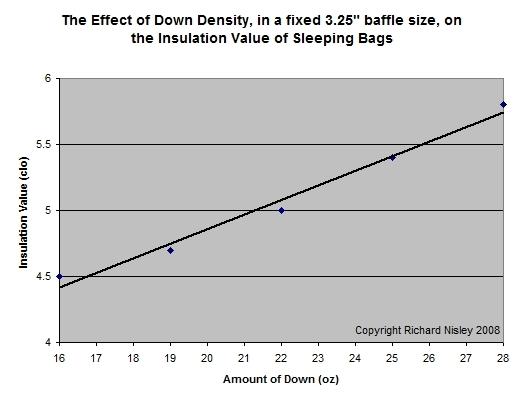
There still seems to be a contradiction between your comment "The insulation value is about the same in the range from fully lofted to 2.5x density increase. Down isn't warmer at 2.5x density." and the graph posted; it appears from the graph that the insulation value isn't the same as density increases; an increase in insulation by a factor of about 1.29 (5.8/4.5) [checks: clo is a linear-scaled measure] for a down density increase of 1.75 (28/16), which doesn't seem to be a cost-effective solution.

[edit: not having the article to hand, I don't know whether the above graph includes the 1 to 2.5 fill density range; all I know is the fill weight.]

Kevin Beeden BPL Member
PostedMar 12, 2010 at 10:09 am

> By continuing to overstuff down beyond its fully lofted amount, the air pocket sizes will continue to be progressively reduced (results in less conduction heat transfer)

Now, if you'd said 'results in less convection heat transfer, I'd have been tempted to agree with you; reducing the convection cell sizes, and therefore the speed at which heat can convect through the down.

PostedMar 12, 2010 at 10:12 am

Thanks Richard.
This has got me thinking. I have an Arc Specialist that i am happy with for most of the year. I was thinking of buying an Arc Alpinist with overfill for colder temps.
Would i be correct in thinking then, that a Specialist with the same fill as an Alpinist would have similar insulation value then? Is the taller baffles of the Arc Alpinist not of any benefit, as long as the amount of down is the same?

PostedMar 12, 2010 at 12:14 pm

"There still seems to be a contradiction between your comment "The insulation value is about the same in the range from fully lofted to 2.5x density increase. Down isn't warmer at 2.5x density." and the graph posted; it appears from the graph that the insulation value isn't the same as density increases; an increase in insulation by a factor of about 1.29 (5.8/4.5) [checks: clo is a linear-scaled measure] for a down density increase of 1.75 (28/16), which doesn't seem to be a cost-effective solution."

Without knowing the setup and testing that resulted in the graph, it is impossible to tell, but it appears it was done with a fixed volume by increasing the down amount. Hence the x-axis is down weight, not density, and hence the increase in insulation value. So I don't think Richard's comment is contradictory so much as the graph doesn't depict the situation he is describing. i.e. a fixed amount of down does not get warmer if compressed, but it won't lose insulation value unless you compress it beyond 2.5 times.

So as relates to the original poster, because his current bag is essentially a fixed volume, he would obtain greater insulation value by adding down if the density is kept below 2.5x.

Richard Nisley BPL Member
PostedMar 12, 2010 at 2:17 pm

Kevin,

You said, “… my understanding was that convection is the most significant (and, in turn, it's driven by conduction and radiation).” It has been at least 33 years since your first premise was disproved both by calculation and experimentation. See:

Pelanne, C. M., "Heat Flow Principles in Thermal Insulations", J. of Thermal Insulation, Vol. 1, July, 1977, p. 49.

Tye, R. P., Editor, Heat Transmission Measurements in Thermal Insulation, ASTM Special Technical Publication 544, Chapter on Definitions and Thermal Modeling, January, 1980.

Both early studies showed theoretically and confirmed experimentally that natural convection within ANY fibrous insulation material is unimportant as compared to conduction and radiation if Ra is less than 40 for the material. Countless others have reaffirmed these earlier studies. The Ra number for fully lofted down averages ~ .18 and improves to ~.012 in the 2.5X density increase range. Natural convection loss has never been a significant loss factor even in the very first solid fiber synthetic polyester insulation bats. They had a Ra value of 6.79 which was very poor compared to down but good enough to prevent natural convection from being a significant factor.

Your second premise is also incorrect; “conduction and radiation drive natural convection." Neither are variables in the Ra related calculations. The topic is far too complicated to explain in this forum. If you want to understand the variables that factor into the Ra natural convection calculation, see http://en.wikipedia.org/wiki/Natural_convection

Your two erroneous premises did not lead you to a valid conclusion regarding the relationship between down density and thermal conductivity. I hope that you understand that I mean no disrespect, but I have grown weary from this topic discussion.

Kevin Beeden BPL Member
PostedMar 15, 2010 at 6:36 am

Richard,

Thanks for the references and links. I'll go and do some reading.

Sorry that this thread has wearied you. I like to discuss things, and learn by thinking around problems, and trying to understand the issues involved for myself. I'm also quite happy to be told I'm wrong, provided that the correction is adequately explained. Unfortunately, the discussion in this thread didn't seem to provide a clear explanation. If someone had provided suitable links earlier, you might not have been so wearied.

Anyway, to bring the discussion back to the OP's thread, can anyone help with recommendations for where Dave might get his quilt modified? If he was in the UK, there are a couple of places I'd recommend, but I don't know about the US.

PostedMar 15, 2010 at 9:41 am

Kevin,
I have been trying to fathom this for a long time. Last time I got weary before Richard and gave up. I asked the same sort of question about the same graph a while ago.
Maybe we can help one another understand. A 29% increase in clo for an increase in down of 75% does not seem to be cost effective. I get the impression that a business suit is 1 clo so if you wore 2 business suits you would be wearing 2 clo I am sure your heat loss would not have halved, but you might think that double the down gives the potential to double the clo so the graph does not appear an impressive vindication of overstuffing.
I think Richard is saying that if you started with 16 ounces and stuffed more up to 28 ounces there is more insulation about 1.3 clo 5.7 clo in total but then let the 28 ounces of down loft fully it would not get more insulating. I would have expected 28 ounce to be worth 7.7 clo at full loft (4.4×1.75) . I am assuming this graph covers the relevant full loft to 2.5 times compression.

James D Buch BPL Member
PostedMar 15, 2010 at 11:14 am

I haven't been able to understand many of Richard's arguments. You may remember I called him on some data he presented as from down thermal conductivity vs density, and the data was in fact from chicken feathers and what little down chickens produce.

He got real huffy and retracted the data and then provided some data from a paper published by Gibson from Natick labs(US Army. He didn't give you the web link to get that data yourself. I provided the link for anyone who was interested in getting data.

I understand and share your frustrations.

The academic world has been little interested in "down" but there have been some interesting studies in the last few years. But, the academics tend to do basic research, and not generate much of the "engineering" type of data that one would use to compute the behavior of different combinations of down/feathers and fabric containers and ultimate user warmth.

None of this helps the average user who really wants to UNDERSTAND what is going on.

There is an International Down and Feather Laboratory which has some general information under "articles" at http://www.idlf.com/ but it doesn't come close to telling you how down behaves physically nor how down functions in clothing.

I have momentarily lost the link to the down and other insulatin paper, but the title, authors, and affiliation is given below. If you just google for the title it will surely come right up.

I have a fairly large folder full of down/feather research obtained from a "Google Scholar" search I did, and haven't
taken the time to read.

Send me a PM with your email, and I'll compress it into a couple of big files of up to 5MB each and send them to you.

Of course, you have to be dedicated to wade through that much stuff of various levels of quality.

=======================================================

Application of Nanofiber Technology
to Nonwoven Thermal Insulation

Phillip W. Gibson, Ph.D.1, Calvin Lee, Ph.D. 1, Frank Ko, Ph.D.2, Darrell Reneker, Ph.D.3
1

U.S. Army Natick Soldier Center, Natick, Massachusetts USA

Kevin Beeden BPL Member
PostedMar 15, 2010 at 11:48 am

Derek, Thanks for that.

The few articles I can actually access for free suggest (at a first glance) a reciprocal relationship between insulation thickness and thermal flux; conversely, this would suggest a linear relationship between thickness an 'insulation value'.

I can imagine that it may be a little more complicated, due to the effect of the different heat transfer mechanisms within the insulation (radiation, for instance, will follow Stefan-Boltzmann, a T^4 relationship).

As for the idea that overstuffing might allow fully lofted down to provide more insulation, I took it from the graph that the thickness of the insulation was in some way fixed, hence the title 'The Effect of Down Insulation, in a fixed 3.25" baffle size'.

The graph presents only a small range of down filling, so I have no idea what happens at zero filling (i.e. air trapped between inner and outer bag shells), and, since the down fill is measured in oz, rather than in fill density (as a fraction of 100% loft mass), it's not possible to determine what range of fill dnesities the graph is intended to cover.

I need to print out the other thread, and some articles I've found, and go away and have a think before I post some thoughts I had over the weekend.

I should point out that I'm not trying to be argumentative, or to be wearisome; I'm just trying to get a better understanding of how insulation works. To that end, I like clear explanations, using freely-available information, and terms that most people can understand.

I will just address one point in Richards last post:

"Your second premise is also incorrect; “conduction and radiation drive natural convection." Neither are variables in the Ra related calculations. The topic is far too complicated to explain in this forum. If you want to understand the variables that factor into the Ra natural convection calculation, see http://en.wikipedia.org/wiki/Natural_convection"

Surely, convection cannot occur unless the fluid in question is heated in some way (or, more generally, there are temperature differences within the fluid)? This heating occurs by the processes of conduction and radiation; direct conduction from the heat source to the fluid, and radiation from the heat source to the surrounding fluid (although, where the fluid is a gas, very little heating is provided by radiation). Convection can then spread the heat within the body of the fluid by a process of mixing and conduction. That's the sense in which I meant that convection is driven by conduction and radiation; a general description, rather than one applied specifically to the case of insulation. The Wikipedia page you kindly pointed to confirms this is the case, although it doesn't explicitly describe the means by which the heat is transferred ("In natural convection, fluid surrounding a heat source receives heat,"). How this system behaves in the context of a largely cellular insulation material is likely to be significantly more complex.

Kevin Beeden BPL Member
PostedMar 15, 2010 at 11:54 am

> I haven't been able to understand many of Richard's arguments. You may remember I called him on some data he presented as from down thermal conductivity vs density

Being fairly new to BPL, I'm unfamiliar with any of Richard's work on the subject, or his previous posts.

PostedMar 15, 2010 at 1:34 pm

Click on Richard's profile and scroll through his forum posts. I think Richard's reason for being weary with this subject is not this thread, but the fact that this discussion has been ongoing for a couple of years on the forums. Not wanting to speak for Richard, but his work and writing on this subject is exhaustive, and there is alot of his info here on the forums. Remember that this forum is a pastime for him as it is for us. If it started to feel like work, I would weary of it as well.

On the subject of adding down fill, I'm trusting all I've read to be correct, and I'll be testing the premise soon. I have a Marmot Hydrogen that I'm planning on adding down to. I think my long has ~11oz of down; I was thinking of adding 4-5 oz. Hoping to make this more of a 20F bag. I guess we'll see!

Viewing 25 posts - 1 through 25 (of 30 total)
Loading...