Today we discuss cooking kits. Specifically, ultralight cooking kits for multi-day and S240/Overnighter experiences. What I’ve learned has been through my experiences and from the folks in the ultralight backpacking world. Backpacking Light is just the tip of the iceberg in this respect. From BPL there is an endless stream of resources.
First up: What I’ll call my Luxury Ultralight kit. If I am going on an overnighter or touring this is the kit I take. Contents of the kit include:
- This spoon comes as part of a fork & spoon kit. You may be tempted to buy a spork, but do yourself a favor and don’t…you will ultimately find it does neither well.
DIY/MYOG Alcohol Stove (Pot Pressurized or Penny Style depending on the experience)
DIY/MYOG Windscreen and Stove Plate
Bic Lighter
- I use a clear lighter so I can see fuel levels. Bic also makes mini lighters that are more compact and lighter. I carry a handful of matches in my ER kit for backup…always, always carry more than one way to start a fire.
Bandana
- simple cotton, good for cleaning up and using for other needs in/around camp and on the trail.
Mesh SnowPeak Stuffsack (came with my SP700 Mug)
Total kit weight comes to 350g/12.5oz. without fuel (more on fuel later)
SP700 on a Pot Pressurized Stove
I made one modification to my SP700 that’s worth noting. The mug lid comes with a feature to hang it on the side of the pot. While it is clever, I ultimately found this feature useless and it snagged the side of the mesh stuff sack when unpacking. I cut it off, ground, then polished the affected area to finish it. I then drilled two holes in the center of the lid and used some paracord as a lid handle.
SP700 on a penny stove using two titanium stakes and the windscreen for pot support.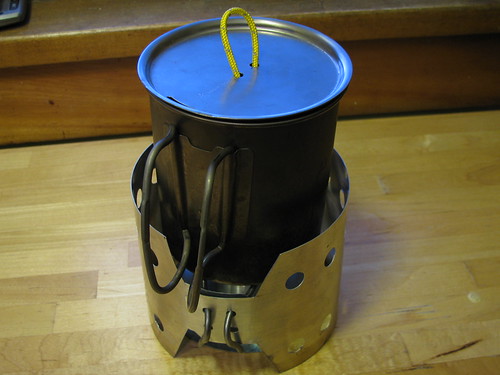
I consider this kit luxury as a result of one item in my kit. There is nothing better than sitting in the woods, leaning against a tree, drinking coffee or a cup of tea from this, my SP450 double wall mug. Without the double wall mug, this kit weighs in at 255g/9oz.

Now this kit is great! It’s light, flexible, and durable. However, to purchase this kit, costs well over 100US dollars.
This brings me to the second part of our discussion, The DIY/MYOG kit. Contents of the kit include:
- 24oz. Heineken can pot.
- Ziploc 32 oz. storage container
- Plastic Disposable Spoon
- DIY/MYOG Alcohol Stove (Pot Pressurized or Penny Style depending on the experience)
- DIY/MYOG Windscreen and Stove Plate
- Bic Lighter
- I use a clear lighter so I can see fuel levels. Bic also makes mini lighters that are more compact and lighter. I carry a handful of matches in my ER kit for backup…always, always carry more than one way to start a fire.
Bandana
- simple cotton, good for cleaning up and using for other needs in/around camp and on the trail.
Total Kit weight comes to 200g/7oz. without fuel
Heineken Pot on a P.P.S. The lid is removeable via the yellow cord. The top is cut just below the rolled rim. Many users of this pot will insulate with cotton cord, and/or silicon for handling and drinking from the pot. I’ll get to that at some point.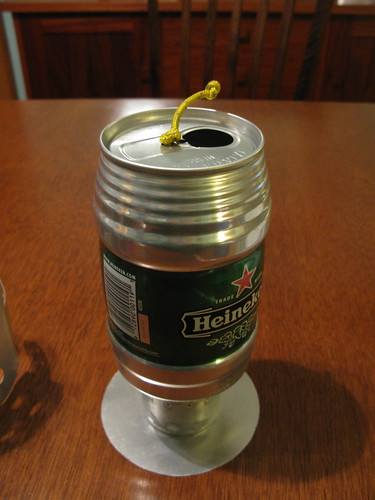
All contents of this kit fit inside of the Ziploc storage container, which protects it during transport. The pot fits upside down; lid, stove, lighter, and bandana go in the pot while the windscreen fits between the pot and container. The storage container can also be used as a mug or bowl.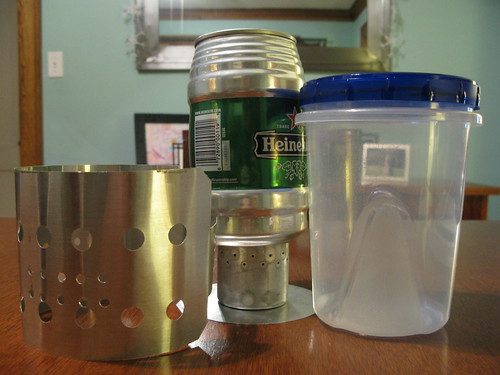
This kit is affordable, accessible, and a full 50g lighter than my luxury kit! You just have to like Heineken, or be willing to dump it out.
Finally, Fuel.
Alcohol stoves can use two types of fuel Methyl and Ethyl Alcohol. Before you use either of these I suggest you read up on the types of alcohol and potential hazards of handling and burning them. Zen Stoves has some great information regarding where to find them and what the risks are. This is not meant to deter you from using alcohol stoves. It is meant to encourage you to read and understand the tools you are using. I sound like Norm Abrams.
I’ve used both types of alcohol, but I prefer Ethyl. Ethyl alcohol is found at nearly all hardware stores, packaged as denatured alcohol. It is also found in several other products including the beer in the Heineken can and the hand cleaners found in nearly all public spaces these days. However, to be used as a fuel the product must have Ethyl alcohol near the 90% range or above.
My stoves use somewhere between 1-2oz. of fuel per burn. Depending on the length of a trip, opportunities for resupply, meals planned, and stove fuel consumption the amount of fuel needed can be determined. Typically I carry 4-8oz. of fuel in a Nalgene squeeze bottle.
Nalgene squeeze bottle with 8oz. of fuel.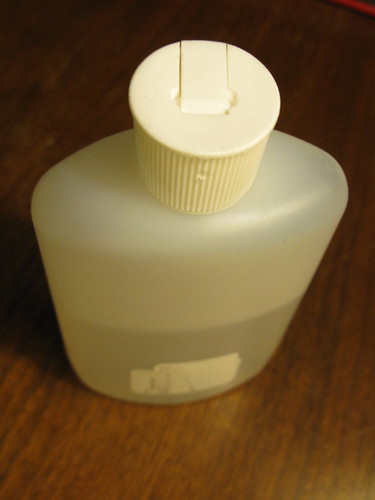
You can also find your own storage solution for fuel. An empty water, soda, or juice container, a used shampoo bottle, etc… All of these will work. Just make sure you won’t confuse it with your water supply.
So there you have it a luxury, go out and buy it kit and an ultralight, go out there and make it kit. Both are fully functional and both are elegant in their own way. Next up is alcohol burners, or more commonly, stoves.