Whenever I go hiking in the summer here in Japan it is always unbearably hot and humid. During the rains I would often wear my Gore-tex rain gear and die within the sauna and car wash of the garment. I started using Paramo rain wear about 11 years ago and have been completely weaned off "shell" type rain wear. For most mountain walking, when it is cooler, the Paramo is just right and breathes so well that there are no issues with moisture build up inside the garment, but when it gets warmer even the Paramo can't deal well… I just get too hot. So one time I just removed my rain jacket and hiked in the rain, letting myself get completely soaked. And it was fine! It was so warm that I couldn't cool off too much; in fact the rain made it refreshingly cool in the heat. Because of the amount of heat I was making from the hard climbs and descents whatever moisture my clothing accumulated evaporated from my body heat. I remember that first time pitying the climbers wearing full-Gore-tex rain suits who were coming up one steep trail soaked in their own heat and sweat and how much freer I felt not worrying about staying dry.
I've also realized that nylon pants with some three dimensional weave, such as Schoeller or Fieldsensor do much better when soaked than fabrics like Supplex, which cling to the skin when wet and make you feel much colder.
Like Roger Caffin I love eating local bread, cheese, and sausage when hiking, especially in Europe, where the bread and cheese and sausages are often unbelievably delicious. And like him I tried eating these with the tiny Classic Swiss knife that I have, but would drive myself batty trying to cut the baguette or brioche. So I bought myself a much larger, but simple Opel knife and couldn't have cared less about the extra weight… being able to eat the local foods while sitting atop a glorious crag overlooking those white peaks, well, there really isn't anything in world better than that!
Though I agree with Sarah about the expense that digital cameras lower in terms of image development, there is a lot of appeal in film cameras that digital has never been able to overcome. I like using a fully manual camera that doesn't require batteries and that has only the necessary controls for shutter speed, aperture, exposure metering, and flash, nothing else. It requires me to think more structurally about the image taking process, actually "seeing" the light I am about to capture, and calculate, in my head, what I need to do in order to get the right picture. I learned MUCH more about photography using a manual camera and film than I think I ever would have if I had started out with digital. I don't even really understand how the digital process works. And there are so many controls and menus and options that every time I need a manual in order to understand how to use my camera. I just don't want to think about those things when I'm taking photos. So, I might very well go back to film if I can find a way to reduce the cost of developing the film and afterwards scanning the images for the computer.


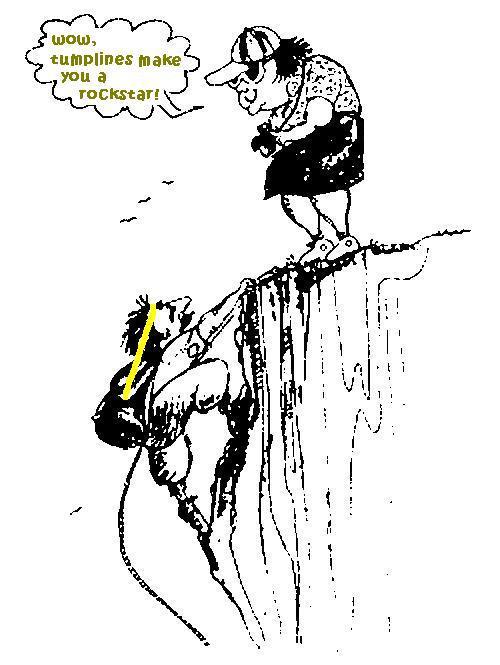 Awhile back famous mountaineering Mr. Know-it-All, Yvon Chounaird noticed indigenous people using tumplines to bring different musclegroups into play forestalling fatigue. He bacame a true believer when this gave him relief for a longtime neck injury and brought these out in his retail catalog complete with a concise logical explanation.