Topic

Help with Tipi

  • This topic is empty.
Viewing 12 posts - 1 through 12 (of 12 total)
PostedDec 28, 2009 at 2:17 pm

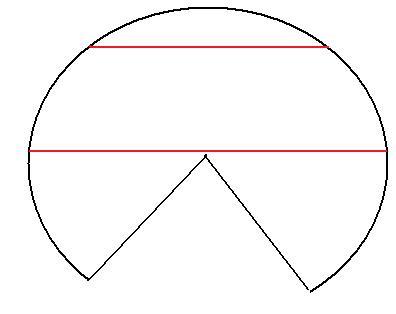
Trying to come up with a pattern for a tipi. I've done some math, and made a template out of a plastic drop cloth but it didn't come out as planned. I cut out a semi-circle with a 10 ft radius and taped the two flat edges together. I am attempting to end up with something like the ones made by Titanium Goat or Kifaru that I can use a stove in.

Does anyone have any useful tips? I've searched the site already.

Roger Caffin BPL Member
PostedDec 28, 2009 at 2:37 pm

I suspect that ground even-ness and fabric stretch may be rather important.

Cheers

Jim W. BPL Member
PostedDec 28, 2009 at 4:43 pm

Kifaru is an oval shape. Both are made with triangular panels where the seams run from peak to peg point. I presume that both have some sort of catenary curve to the seams.

One question that I have is how their panels are cut. It would be very inefficient use of fabric to run the grain of the fabric straight up each panel. I presume that one edge is along the fabric selvage and the other is bias, but I don't know if they match selvage to selvage on adjoining panels or alternate selvage/bias, selvage/ bias. I suspect the former because that way stretch is matched on each seam. (Woven fabrics are generally stiffer along the selvage and stretchier on a bias cut.

A pyramid like the BD Megalight or Oware runs selvage/selvage up the center seam with bias/bias up the corners of each side. Stretch is and greater on the corner seams than the center. This helps keep the center of the panel taut.

With fabric typically about 60" wide, that makes a reasonable distance for each side of your multi-sided pyramid. Even numbers of sides let you get the most use out of your fabric and satisfy the human preference for bilateral symmetry.

Here's a guy who made an 8 sided pyramid- sort of a tipi.
http://hikinghq.net/forum/showthread.php?p=26466#post26466

PostedDec 29, 2009 at 12:34 pm

That is exactly what I am looking for even the same dimensions. Now the only question would be how to maximize cutting the fabric so that there is little waste.

Jim Colten BPL Member
PostedDec 29, 2009 at 3:24 pm

I haven't seen one in the flesh but … Try a google image search for tigoat vertex

None of the results show seams converging at the peak and many of them seem to show seams that arch over the "back" side of the tent.

I'm thinking the following is a VERY crude representation of how they lay out the fabric.tigoatvertex

The red liens are seams. You can probably cut that with fairly low waste.

Search results for Kifaru tipis do show seams converging at the peak.

Jim W. BPL Member
PostedDec 29, 2009 at 3:41 pm

Jim is right- I was going from memory, which obviously failed me.

Jim

PostedDec 31, 2009 at 11:41 am

That's where I got the idea to cut the semi circle, I guess I should have cut it more like you suggest. I woder what the difference in strength is with the horizontal seams vs the vertical I haven't heard any complaints about Ti Goat tipis tearing in wind.

PostedJan 2, 2010 at 12:38 am

Know alot about tipis. They are cut off-center. From the "center" as in your diagram, locate a point about 30 inches "down" this will be the actual center of the circle to draw on the material. Flaps have to be added, pockets for poles, etc. Largest I built was a 30 footer. A tipi actually looks like it leans because it is not cut from the center and the floor area is really an egg shape. Great for camping. Had 12 scouts, 2 leaders, all our gear, bags out and a nice fire in it. plenty of room to cook and move around as well. Check out the following site for more complete details:
http://www.inquiry.net/outdoor/native/skills/teepee.htm

PostedJan 4, 2010 at 4:58 pm

If you start 30 in down wouldn't you have the same shape at a different point on the fabric?

PostedJan 4, 2010 at 9:29 pm

Great thread..

Brawny's "Cheyenne Teepee" is worth checking out:
http://www.google.com/search?q=brawny+teepee
It's cool in a lot of ways. One is that you can have a 360 degree view (of some sort) when laying on the ground.

Jeff: Jim Williams is saying to move the center "smoke hole" (that point, even if all points meet there instead) so that it's no longer centered relative to the outer edges. The effect (in a perfectly euclidean world) is like sinking a cone on edge, so that it's a bit lopsided. The shelter having a bit of directionality is useful.

Jim, thanks for that link!

Tension being the primary load bearing method can make a sweet materially efficient (high performance) structure. All sorts of crazy thoughts… What do you think of this: use cord (Dacron,Dyneema) as structural members that can better take high tension than ultralight wind- and water-"proof" fabrics, then have the fabric joined to it in a way that safely distributes necessary stresses? Perhaps less confusingly, I know that at least one successful large kite builder sews in cord to his big crazy kites, but I don't yet know in exactly what way.

Connie Dodson BPL Member
PostedJan 5, 2010 at 3:21 pm

Real tipis have a tie-down inside, from the apex down to a post sunk deeply into the ground.

By "real tipis" I mean, for example, the tipi of The Blackfeet Warrior Society.

Viewing 12 posts - 1 through 12 (of 12 total)
Loading...