Topic

Denali Insulation Options

  • This topic is empty.
Viewing 6 posts - 1 through 6 (of 6 total)
Richard Nisley BPL Member
PostedDec 14, 2009 at 3:47 pm

This question was asked:

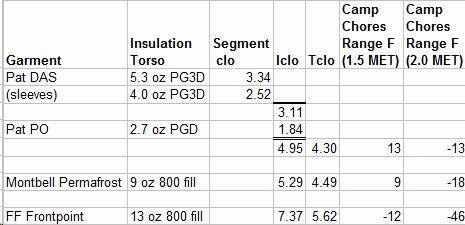
I was wondering how a Patagonia DAS parka (5.3 oz. Polarguard 3D insulates the torso while 4 0z. in the sleeves) and a micropuff pullover (2.7-oz. Polarguard Delta) or Down Hoody, would stack up against something like the FF Frontpoint Jacket (13oz down) or Montbell Permafrost parka (9oz down?).

The reason I ask is I've been looking at Denali and was wondering about how warm my system is in relation to some other options. Just trying to decide how much insulation I might need and if I have enough already.

Compare Jacks

PostedDec 14, 2009 at 8:44 pm

Hi Richard,

When I got my new Patagonia DAS Parka I thought I got ripped off in the insulation area. The jacket was much LESS puffy than my other DAS's. I called and Patagonia said that the secret was the Primaloft One which is much less lofty, but much more warm, and left the newest DAS much more packable then the older successor jackets also.

Jeff

Richard Nisley BPL Member
PostedDec 15, 2009 at 8:27 am

Jeff – I agree with your observation regarding PL1 garments. PL1 tested on average 30% warmer, for the same loft, as the continuous fill insulations.

Jack – Regarding the Denali location, the person who sent me the question sent a follow up email that said in part, "Just was talking with some of the rangers and it sounds like the DAS with some layers should be good to go. Have to say I'm looking forward to the trip."

PostedDec 15, 2009 at 9:05 am

Good morning, Richard,

I did, at least, attempt a search on Tclo, but I was not successful. Would you mind defining it?

Also, do the figures charted above imply that a person donning a Frontpoint would be comfortable doing camp chores in -12 to -46F temperatures without leg insulation. I recall in a recent thread, Jim was layering up his torso in an attempt to satisfy Clo/MET comfort at near zero temperatures, but I don't recall mention of leg insulation. It appears that there would be a scale of diminishing returns to "torso only" insulation, ending at some point of garment inviability. I can imagine a number of influencing factors regarding individual tolerance and perceptions of cold, but I will confess to reaching for leg insulation when sitting around in thirty-five degree temps.

On another matter,I suppose that the season is responsible for the recent interest and questions regarding garment and bag warmth, temperature ratings, clo, etc. The type of information that you provide is clearly demanded and appreciated by this forum. As demonstrated by the number of garment and condition specific requests, the Clo/MET data is often considered invaluable at the point of need/use: and as you occasionally imply/mention the data can be a useful tool in thinking about upcoming/potential trip parameters/conditions, as well as in the planning and procurement of a long term equipment strategy.

I'm sure that there are competing interests for your time, and I know that testing the marketing/merchandising driven world of garments is a never ending task. I know it's been said, many times, many ways, Happy solstice, Richard. Your top level contribution to this site remains conspicuous.

And appreciated

Richard Nisley BPL Member
PostedDec 15, 2009 at 11:23 am

SK,

Thank you for your appreciation! I am leaving tomorrow to begin a three week trip walking in cold temps and deep snow. I will only have occasional Internet access during this period.

Iclo = Intrinsic clo of the garment composite irrespective of the body surface area % it covers.

Tclo = Iclo multiplied by the body surface area % covered, plus the Tclo of the foundation layers, plus the boundary layer insulation (progressively removed as the wind increases).

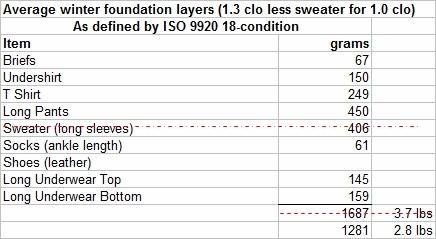
My Denali parka options analysis, as does all of my winter garment analysis, unless otherwise specified, assumes the ISO 9920 standard ensemble for the winter foundation layers. I removed the heavy wool sweater from the 1.3 clo (18-condition) case to achieve a custom 1 clo winter backpacking case. Both heavy long underwear bottoms and heavy long pants are assumed.

Foundation 1

Foundation layers are conventional woven material with an average clo per inch of 3.75.

Supplemental leg insulation contributes to maintaining the core temp using the same calculation methodology as the Parkas. For example, rather than wearing the Patagonia Pull-over under the DAS, you could achieve a similar core temp, with a higher comfort level, by wearing the equivalent supplemental pants insulation.

Viewing 6 posts - 1 through 6 (of 6 total)
Loading...