


I was clicking around on the web today and came accross a Tyvek jacket made by American Apparel. Interesting. I wonder what it weights? Probably not breathable at all tho.
Topic
Become a member to post in the forums.
I was clicking around on the web today and came accross a Tyvek jacket made by American Apparel. Interesting. I wonder what it weights? Probably not breathable at all tho.
Take a look at this recycled Tyvek windshirt. 3.5 ounces and $10. Worth every penny. I have used one for about 6 days out – in rain – as a windshirt and to keep arms dry when using a cape. I don’t expect great durability or great rain gear out of this, but it is holding up OK, breathes like a good windshirt and sheds water. No hood. I wear a hat, anyway.
Sportshell
Oh yay! Thanks Vick :) 3.5 times cheaper and I know how much it weighs. Nice. So… in a hard rain… would you get soaked eventually? I’m guessing it’s not really a great substitute for a 3M Micropore jacket (my jacket of choice) or other rain-specific jacket? In any case… for 10 bucks… you can’t go wrong! What size do you have BTW? I’m debating small vs. medium… 32″ waist… 36″ chest.
DL,
Can’t advise on size. I’m way larger than 36 and use XL.
Eventually soaked? Sure. The jacket has no hood and no cover for the zipper. I use it only for incidental exposure to rain and as a windshirt. It keeps my arms dry when using a rain cape/tarp, and it is good for short forays outside when the cape is being a tarp.
BTW, I stitched a mesh stuff sack to the zipper tape. Now I have a sorta pocket and a built-in stuff sack.
$3.81 a shirt, marketed as disposable. Full 3-button closure rather than zip.
Picture shows pants as well,which can also be purchased for a very low cost.
Here’s an even cheaper site that has it for under $3, but the smallest size is medium and I am unsure if that Tyvek logo is part of the shirt or not.
Can anyone comment to the loudness factor of a Tyvek jacket?
This looks like a good, cheap Tyvek poncho:
http://goodling_outdoor.tripod.com/Poncho.html
Can anyone comment on the effectiveness of these ponchos?
Effectiveness: Tyvek is the best poncho material you will ever use. Waterproof/breathable and it has enough body that it won’t cling.
Noise: If the manufacturer doesn’t soften it before shipping, you will probably want to do so. Unsoftened Tyvek is very noisy. Just wash it in a machine, then dry it with a couple of tennis shoes until it is beaten soft. It should feel almost like cotton. This does not hurt its water resistence as far as I can tell.
If you want to use your raingear as shelter, consider making your own cape. With no hood to contend with, a cape makes a great tarp.
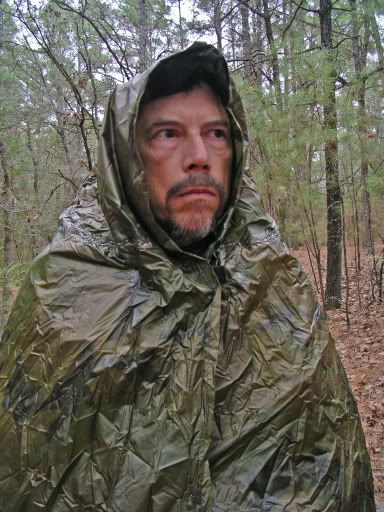
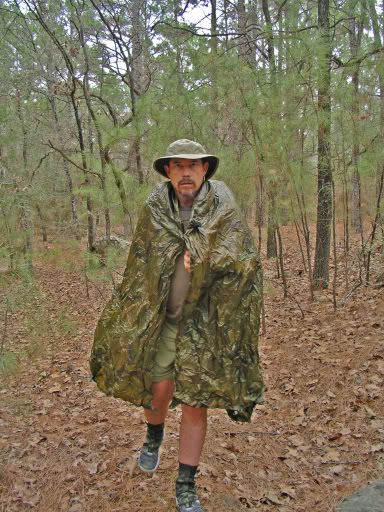
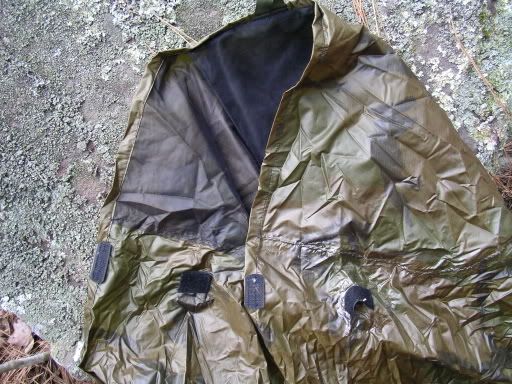
This is a nylon cape using velcro tabs to form the hood. You can do the same thing with Tyvek. This hood is lined because nylon clings. Tyvek does not. Note: the tabs are set 6″ in from the side hems and 18″ to either side of the center of a long side of the 5×9 foot cape. The “hood” forms when the tabs are connected.
Vick, Did I miss it? What is your source for a large sheet of tyvek, suitable for a decent enough sized cape or larger cape/tarp?
How about the weight? It’s going to be a bit on the heavy side from UL standards isn’t it?
[Note: this isn’t a criticism, just a question. For me, up here we’re gettin’ into some of our most humid weather with much precip – sometimes days of it straight – it’s impossible to avoid hills on most treks (some steep – typically 600′ to 1250′ of elevation change, but some up to 2500′ for shorter distances per mile – so some steep grades, but not much total altitude in most places – up and down most of the time) so breathability “trumps” weight in my mind – at least for me.] Sounds like tyvek could be what I’m looking for for some conditions/treks.
Paul,
Tyvek Homewrap weighs 1.75 oz per sq.yard. A 9×5 cape/tarp weighs 9 ounces. Combined raingear and shelter of 9 ounces is UL in my book. Especially since it breathes. That gives it an additional application as an emergency bivy. 3 for 1
Lighter Tyvek is available, but I haven’t tried it except in the Sportshell jacket. Not all Tyvek breathes and some of the packing weights are suspect in that regard according to DuPont.
Where I got it? I bought a 10×150 roll partly for a remodelling project that needed only 12 feet or so. I’ve been playing with the rest for 5 years. Homewrap is also available in 8X150 rolls. I find that size less useful for my purposes.
Current project: learning to dye it. The natural color is blinding white. I’ve tried acrylic paint with only moderate success. It adds weight and sheds residue. Surprisingly, Rit dye seems to work. I keep the solution temperature under 180F. Maybe you could go higher, but I haven’t tried. This is work in progress.
The cape does very good double duty as a tarp, either over a hammock or in a pyramid setup similar to the Alphamid or Bill Fornshell’s photos elsewhere in this forum … but a little larger. Being too tall for my own good, I like a longer tarp. Since the cape does not have a hood, but forms one because of its configuration, it saves some weight there, and eliminates the problem of sealing a hood. In addition, the cape forms a sortof cone instead of the envelope shape of a poncho. It is less subject to wind and snagging. It also ventillates less than a poncho. This is where Tyvek’s W/B capacity comes into play. As you have undoubtedly found, all waterproof but not breathing fabrics sweat, no matter how well they are ventillated. When wet air hits a cold surface, condensation occurs, period. Tyvek reduces that enough for comfort. It does not breath as well as Epic, but better than any W/B formulation of polyurethane.
Needless to say, a bug net either on a bivy or separate is pretty important in some seasons.
Vick, Only 9oz!!! That’s silNylon Poncho-Tarp territory! I never would have thought it, especially since the Tyvek groundsheet for the HS Squall, IIRC, is ~5oz. Your Tyvek material might be a lighter fabric weight – which isn’t a bad thing. A WPB poncho is exactly what I need some days. Thanks for the very informative reply.
Paul,
Weight. I think the homewrap is the heaviest grade. But what I reported is the actual measured weight of the garment. And yep, it weighs about like a 1.35 silnylon or PU nylon garment of the same size because it has no hem or other fittings.
The slow acceptance of Tyvek may be because it just don’t seem right. It starts out stiff and loud. It looks like paper. It’s snow white (until dyed). It has big DuPont logos. And using a building material is definitely low class.
I encourage scout groups to use it because if the safety factor. One is less likely to delay putting it on as raingear and when one does, it breathes. And it makes a good emergency blanket/bivy. In other words, it has a built in safety factor.
FWIW, Brawny and the Dancing Light Gear folks sell tyvek by the linear foot:
http://trailquest.net/dlgctyvek.html
Of course, the cheapest option is your local construction site, foreman willing.
I have a question for the folks using tyvek as a shelter: how noisy is the fabric after it’s been softened (e.g. in comparison to silnylon)?
Vick, yes, I am just a bit familar with Tyvek from lab coats and a HS Squall Tyvek groundsheet I have which is quite soft by now as compared to new, having been used a number of times. The lab coats at work are pretty thin as compared to the Tyvek groundsheet for the HS Squall. I’ll have to do some web research on this subject. Thanks again for letting me “pick your brain” – you always have such good info. I enjoy reading all of your posts. Take care.
Antonio, Many thanks for the URL to the DLG site.
Antonio,
Tyvek softens progressively as you use it and cram it in stuff sacks. You can speed that up by scrubbing it as you scrub items when hand washing. An hour in a dryer with a couple of tennis shoes helps, too.
Once softened, Tyvek’s noise is largely limited to the pings of rain drops. It is no noisier than 1.3 oz. silnylon in the rain, and much quieter than either 0.6 oz or 0.8 oz. spinnaker.
How do you keep legs dry when wearing a poncho or cape? Walking through wet grass could really be a pain. I would think chaps would be good. Anyone make Tyvek chaps?
Also, I understand there is Tyvek kite material that is “half the weight” of Housewrap Tyvek that works well. Anyone out there care to comment. My source is the webpage of the Southwest Ultralite Backapcker:
http://swultralight.home.bresnan.net/Tips%20and%20Tricks.htm
According to Brawny et al., they believe Tyvek is prone to leak if washed. I read this on the link from Antonio…http://trailquest.net/dlgctyvek.html
I read that also in the link. That’s probably why Vick recommends drying it instead of washing it. I’m not so sure that it is the wash process, per se, but rather agressive agitation in the top-loaders – this process can damage delicate fabrics (hence the delicate and hand-wash cycles on top-loaders) and also laminated WPB membranes. An agitator-less front-loader washing machine might be fine though. However, will it accomplish much in the way of “softening”? I’m going with Vick’s drying+tennis ball idea when I get around to trying a Tyvek cape. Since it’s the beating the Tyvek takes from the tennis balls, probably no heat is required when tumbling. Vick, is that last comment correct, or does heat soften it enough to make the “beating” by the tennis balls work better?
Steven, i do one of four things:
1) nothing – let em get wet if it’s not too cold outside. This has the downside of water wicking into boots or shoes via the tops of the socks – but if you’re not wearing waterproof boots or GTX sox, VB socks, or any WP or WPB sock to keep your feet dry then this is a non-issue. Some WP socks seal at the top to prevent water entry (e.g. some SealSkinz varieties).
2) chaps: i’ve been using for a few years Equinox Full-Moon silnylon chaps.
3) WPB gaiters: whatever height is necessary to allow your cape or poncho to cover the tops of the gaiters.
4) My main method is I have a few pairs of no longer sold LLBean Trail Cargo pants made from (maybe 3oz per yd???) Epic by Nextec fabric. Given the angle at which even driven rain hits the lower leg, and the continuous leg movement (no water pools), these work very well in all but torrential downpours or long term exposure (hours) to very heavy rains. [Note: The lighter Epic fabric in my windshirt and the angle of my arms holding trekking poles permits my forearms extending out of the poncho or cape to wet through long before the Epic pants covering my lower legs.]
You’re welcome, Paul.
Vick, thanks for the info on tyvek noise. I asked because I remember that a member in the yahoo backpackinglight group refused to sell tarp sized pieces of Tyvek because of the noise. His steadfast refusal seemed like a pretty strong indictment on the noise from wind loading.
Although I am not a fan of the poncho/tarp option anymore, I’m interested in making a tyvek version that is a bit larger than what’s available and as a belated intro to fashioning my own shelter/clothing gear. I have a sewing machine that’s been gathering dust for the past 2 years (a hand-me-down from my mother-in-law).
“According to Brawny et al., they believe Tyvek is prone to leak if washed. I read this on the link from Antonio…http://trailquest.net/dlgctyvek.html”
Many people tend to forget that, for decades, explorers simply used tight-woven cotton canvas (waxed or NOT) for outdoor shelters. The key to mitigating the ‘leak factor’ was NOT leak proof fabrics it was tight pitch. As long as you make it easier for water to ‘roll off’ rather ‘soak through’ (which can be accomplished at relatively low angles) you’ll be fine.
Now, the key to the above assumes that your AREN’T using 1600 series tyvek… 1600 series has been microperf’d to improve breathability (aka they punched holes in it…)
Paul,
I use tennis shoes, not tennis balls to beat up the tyvek. It takes some effort to soften it and you need tennies to pound it. The heat of a dryer dies not seem to hurt Tyvek. I think it may help speed up the softening process.
Washing? No problem, although I suppose if you failed to rinse thoroughly, detergent residue might let water through the Tyvek – which, afterall, works because it is hydrophobic. When I wash it before drying (and sometimes I’ll do that) I use hot water. No problem. I don’t think boiling water will hurt Tyvek.
Notice that my experiments are not systematic. However, I’ve used it for 5 years and learned a couple of things:
1) Tyvek is a lousy ground sheet. Pressure on it will force water through. A beat up groundsheet will still shed rain and not leak unless it has actual visible holes in it.
2) Tyvek seems to not last as long as coated or silpreg nylon. But it lasts better. That is, it performs well until it fails instead of slowly becomming a disappointing mess. Failure is usually getting holes poked in it. Just like any other fabric.
3) Tyvek makes poor water bags. It handles a lower static head than silicone impregnated nylon. However, rain does not splatter through Tyvek as it does through silpreg.
4) Other hikers get snooty about anyone using Tyvek gear. Even if they use stoves made from discarded pop cans.
Vick, many thanks for the clarificatiions and corrections to my misunderstandings. Always an education. Thanks again.
“4) Other hikers get snooty about anyone using Tyvek gear. Even if they use stoves made from discarded pop cans.”
I’ve noticed that…
Look into disposable Tyvek lab clothing (Sizes to 5XL+)
Prices are by EA=each and CS=case. Very affordable $10 ea.
You can buy two coveralls XL and then cut and modify to suit your needs.
Tyvek tape is found in construction supply stores.
Become a member to post in the forums.
 New Gear with Aluula FabricsLighter, stronger, more abrasion-resistant, and highly water-resistant - explore ultralight backpacking gear made with ALUULA Graflyte fabrics. Engineered for exceptional strength, durability, and lightweight performance, ALUULA Graflyte helps reduce pack weight without sacrificing reliability, making it ideal for demanding backcountry adventures.
 © Beartooth Media Group Inc.
 Loading...