Topic

cycling across America

  • This topic is empty.
Viewing 11 posts - 1 through 11 (of 11 total)
PostedNov 25, 2009 at 6:16 pm

This is my 1st blog. Bear w/me.I plan to cycle across America on a 1982 fuji S12 touring bike in July/2011. I'm new to the ultralight stuff and need help.

Given the wetness of Wash. state, the cold temp of the Rockies and the flat, hot northern route, what do you folks recommend for eqpmt, ie, sleeping bag (synth or down), tent (new or used solo),stove(fuel?)for a 3,000 mile+ solo adventure on a strict budget.

I have to consider – space, cost, useability & weight.
or where can I go to get this info.
This website is awesome.

PostedNov 25, 2009 at 7:36 pm

Keeping in mind size as well as weight here 3 items you could consider.
Cooking system
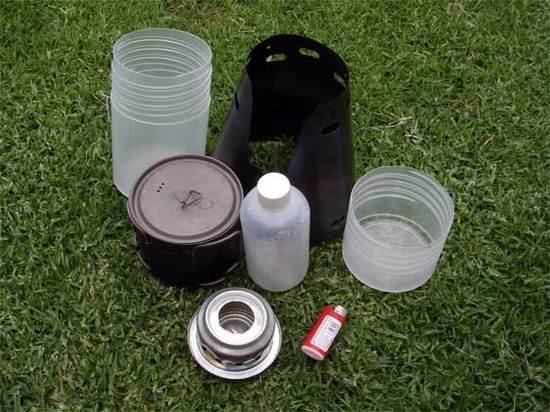
TiTri 550ml kit
http://www.titaniumgoat.com/TiTri.html
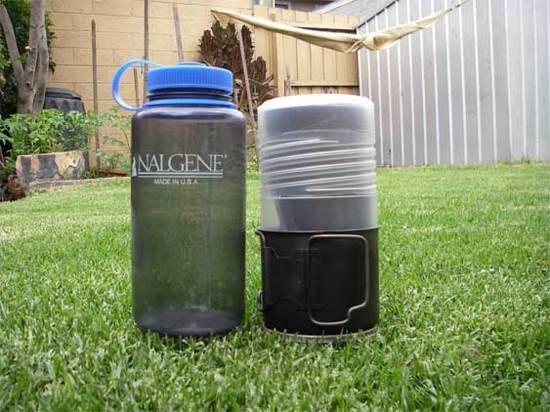
What you see in my pic is 250g . Add fuel. I use about 1/2 oz to boil 500ml
Note that the caddy top is your mug and the bottom is your bowl. Put your dry stuff in the bottom ,add boiling water, screw the top on , wait 10-20min and dinner is ready. You do not need to wash the pot that way. That fuel container is for 8oz. Add a cloth to clean the caddy and keep the bits from rattling. Almost no space lost.
Note that you can also burn wood or solid fuel (Esbit) with it. Works in the wind.
See http://www.trailcooking.com/ for food ideas.
Ti Tri kit
Kitchen comparo

shelter
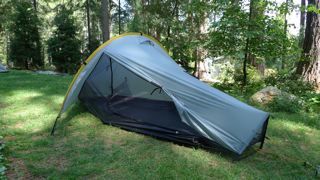
TT Moment. 28.5 oz with pole and two pegs. I would install guylines on the pole and take an extra two pegs. Depending on your pannier you could even get a pole with shorter sections (about 2" shorter) that will be a bit heavier and a bit more expensive but …
Full insect rain protection, good vestibule , smallish footprint. Not too claustrophobic.
http://www.tarptent.com/moment.html
Moment

mat
Thermarest Neo Air.
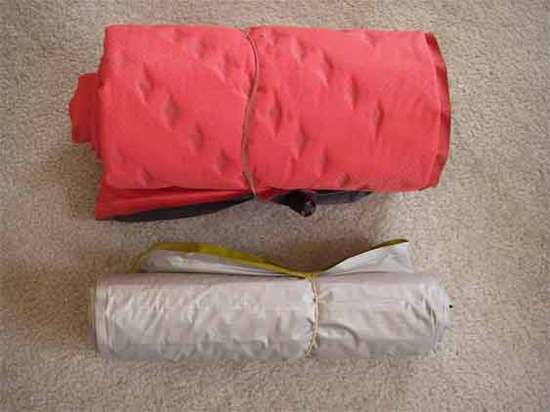
The M size is 66" long (use some of your other stuff as a pillow) 13oz, 9"x4" packed.
Rated to 32f , shove your rain gear/spare clothing (panniers if you are desperate..) under that for a boost . Make an adaptor so that you can use your pump to blow it up.
http://cascadedesigns.com/therm-a-rest/mattresses/fast-and-light/neoair/product
Prolite 4 -Neo Air
(the pink one is the Pro Lite 4 , R3.8 , the yellow is the Neo Air R2.5)
Franco

James Naphas BPL Member
PostedNov 25, 2009 at 7:53 pm

I pretty much agree with Franco on those items he's recommending.

I'd look at getting a 30F down bag. You really don't want to deal with the bulk of sticking a synthetic bag in a pannier. That should work for summer temps pretty much wherever you go, though you might have to add some warm clothing layers in the Sierras and Rockies on cold nights.

If you're on a strict budget campmor has Mountain Hardware Phantom 32 bags for sale for under $200 now. That is a really good price on a fairly nice bag. It's not as good as a Western Mountaineering ultralight or megalight, Marmot Hydrogen or Montbell UL stretch #2, but it would save you over $100 relative to those.

Richard D. BPL Member
PostedNov 25, 2009 at 8:06 pm

I would look for a roomier enclosure than just a bivy sack or small net tent for a long-distance cycling trip. I don't think you can cycle 12-13 hours a day like thru-hikers walk, so you'll be spending bit more time resting in your shelter. Bugs will be an issue at many points along your route. Something like an MSR Hubba or Tarptent Rainbow would probably be nice. An issue to resolve is how, if at all, you will protect your bike from precipitation. You could just drape a poncho over it or something.

A true 40 degree bag or quilt would probably be sufficient for you. Lower temperatures are unlikely unless you're up in the Northeast in early September. For much of your route you will probably have much warmer nighttime temps in the 55-60 range. Regarding Synth or down — I don't think it matters a ton.

On a bike, compactness probably trumps low weight as a consideration for a lot of gear. Therefore, I'd take an inflatable air mattress such as the Neoair, mentioned above. I personally use the BPL Torsolite, but I'm sure most people would agree that the Neoair is more comfortable.

Since you'll be on wheels, you'll have ready access to HEET in gas stations. I personally would go with an alcohol stove, such as the Caldera Cone mentioned above. However, you'll build up an appetite within a week or so, and 550 mL probably won't be enough volume for the big meals you'll want to have. I'd go with 850 to 1000 mL.

For raingear, you'll probably want a full waterproof-breathable rainsuit. I haven't tried biking in a poncho yet but intend to try soon. Since you won't be riding through brush, consider the flimsy Frogg Toggs or O2 Rainsuit. No need to get goretex or eVent, IMO.

Some eVent rain mitts (e.g. from Mountain Laurel Designs) would be useful to protect your hands from cold rain, and you might consider Rocky goretex socks. However, most of the time the rain will probably be warm, and putting on all this raingear might make you overheat. In that case you'd just want some good quick-drying clothes.

You could probably find most of the items you'd need on the Gear Swap forum.

That'll be an exciting trip. I hope to do something similar some day.

Jim Colten BPL Member
PostedNov 25, 2009 at 8:37 pm

Brian,

What's your route? Staying north kinda like Adventure Cycling's Northern Tier route? How many days are you planing on? (latitude, altitude and season will influence sleeping gear choices and miles per day influences the volume of food you need to cook).

Rick's advice is good … except I wouldn't conside a poncho for raingear (YMMV of course). Regarding pot size … it's not hard to burn 5000 calories per 80 mile day so plan on large meals … especially when on a tight budget (pasta, rice and taters!).

I'd start with warm foot and hand wear thru the mountains and then mail them ahead in a bump box for later in the trip.

You might find a 5×8 silnylon tarp useful for a front porch and nighttime bike shelter … less than 10oz with lines and stakes and less than a liter of volume.

You have over a year to shop and BPL's gear swap forum will likely list good good prices on good choices for shelter, pad and sleeping bag (or quilt!) in that time.

PostedNov 25, 2009 at 8:50 pm

I cycled with my wife around Europe for six months back in 1995. Learned a lot of things that are both the same as and different from backpacking and what kinds of things are not needed. We started out with a huge expedition weight North Face tent, but soon found it was way overkill and settled for a Tatonka Arktis II tunnel tent. The size was just right for two… (about the size of one of Roger Caffin's 2 person tunnel tents) enough room to move around and stretch out and to spend those days when the rain didn't let up lounging around reading books and napping. A smaller tent would have quickly driven us nuts. The tunnel tent was great… wind-worthy, comfortable in heavy rains, the inner tent handled the condensation on the outer well, the polyester material didn't stretch when wet. The problems we found were that the dark color made it unbearable to be in in hot weather and the need for staking it out in order for the tent to stand up occasionally caused problems when we had to camp on concrete or pavement. With a bicycle you're going to spend a lot of time on pavement, so that is a consideration, but not an impossible one to surmount.

Most of the rest of the gear is just as what you would do with backpacking. Usually the campsites are warmer than in the mountains, though, so you may not need a sleeping bag that handles high mountain temperatures.

Bicycle specific stuff are the bicycle tools and the clothing. My wife and I wore loose tights made of Field Sensor cloth, which I still feel is the best all-weather material I've ever used. We never needed our rain pants, even in the pouring rain way up north on cold days, because the pants dried so fast and stayed warm even when water was pouring off our legs. we found that the 3-D construction of the pants offset the loose weave of the cloth, unlike our earlier supplex pants which stuck to our legs and got very cold when wet. We did need the MEC Goretex polyester Bernouli cycling rain Jackets, though! Very well ventilated they kept us dry for days on end in the pouring rain. We also used fleece gloves when the rain penetrated our fingerless cycling gloves… the fleece kept our freezing fingers warm even when riding into rain drenched headwinds.

On our bicycles we had four panniers, the two in front for our cooking utensils and food. We'd stop by at a supermarket stock up on food that would fill one front pannier on each bicycle and have enough to continue without resupply for about five days. One large canister of Gaz fuel kept us going for five days, too.

I heard that if you're riding west to east in the States you will face a lot of headwinds. You're probably not going to want to use a poncho for rainwear, then. And when you're in the city a bright yellow rain jacket, like I used, stands out like a sore thumb, so think about a detail such as that when choosing a jacket. I also prefer clip pedals to clip-on shoes when cycling, in part because your shoes will look more normal when you go into town. Make sure your rear panniers clear your heels. And consider a dynamo lighting system rather than batteries. I once got caught out on a military road in the pouring night rain with no street lights when my battery powered front light went out. It was pitch black and I couldn't see far ahead. Suddenly my bicycle flew out from under me and I found myself flying through the air and landing in a ditch full of autumn rain mud. I would have seen the road if I had had a steady battery,

Just a few ideas.

PostedNov 25, 2009 at 8:52 pm

A couple of extra points.
That 550ml pot is not big enough to cook in but 500ml or so of boiling water is enough to almost fill the Caddy (water+food) that is about 4 cups.
Obviously If you like to cook, there are better systems…
One point often overlooked is that it takes less fuel to boil 2x 500ml than 1x 1L.
So the idea would be that as your meal re-hydrates, you can boil some more water for a cup of coffee or soup (well whatever…)

I hesitated about the sleeping bag. I would look at a quilt or something like the WM Summerlite (if you fit inside…) because you can open it up or have it fully closed with more down on top (continuous baffles) for the cold nights.
The downside (…) is the price.
However you will need to get a good solid waterproof stuff sac. I would not relay on WP panniers only.
Franco

PostedNov 26, 2009 at 5:48 am

Last summer i did my first bike tour 2000 miles from my house in Connecticut to Milwaukee, WI and i went pretty lightweight (especially compared to some bicycle tourists i saw) the basics of my gear list included, just a single simple rear aluminum rack, no panniers just a single 20L drybag strapped to the top of the rack. this drybag had all of my camping gear which consisted of my golite ultra quilt, hennessy hyperlight hammock (might not work so well in the desert areas but worked GREAT for my route, i never paid for a single campsite and slept great every night)i used an ems aircore sleeping pad (exactly like the big agnes pads)which was way overkill, but was very packable. I'm deffinitly going to switch this for a Neoair for this summer's tour. I didn't bring a pot, instead i just carried bagels, sandwiches, english muffins etc and all kinds of fixings. if i wanted a hot meal (which i typically didn't because it was so hot for most of the time) i'd stop in a local dinner or cheap restaurant, or most gas stations have microwaves and you can get pretty creative there. for clothes i carried a separate pair of bicycle chamois which for me was 100% necessary, i always had them on rotation of washing and drying, some extra thin socks, an 02 rain jacket (worked great and would recommend one! if it fits) some knee warmers, and a long sleeve shirt.

I also had a pretty large handlebar bag, where i would keep the rain jacket, all my bicycle tools, my snacks for the day and all the little odds and ends that i used in everyday life (sunscreen, bug repellent etc) and i had my map on top of the bag.

then i had my frame pump and 2 water bottles on the frame and that was it… the biggest difference from backpacking for me was the food situation, since i was covering 100+ miles a day, i was always going to hit a town at least once a day, so i always just carried enough. I loved how i could have access to pie at least twice a day.

I'll be out doing the northern tier this summer! and I'd love to run into you. (not literally of course)

mike!

PostedNov 26, 2009 at 8:24 am

This past August we bumped into a guy in Silver City, Michigan (Western UP) that had Cycled from Washington State, and was still on his way to Maine. He was going to cross the Mackinaw Bridge, cutting across, and down through Canada. Sounded like a very nice route. We bumped into him outside the hotel where we were staying before our hike into the Porkies. Unfortunately, we didn't talk gear, or ask how many nights he had spend sleeping outdoors.
Although, I'm not a Cyclist, I think most lightweight BP gear would work well for long distance Cycling. Seems like a Alcohol stove would be a great choice, as Heet is readily available in most Gas Stations. Look into the Packafeather stoves as they can simmer, and have long burn times at simmer, like 20 min for 1oz of fuel.
I'd want a freestanding tent, and a 8×8 Sil-tarp, and a good 32 deg down bag. Rig the tarp over the tent and possibly use the bike to support/hold up the other end to form a big porch to cook under, hang clothes to dry, and a bigger area just to sit under to get out of the rain.

Phil Barton BPL Member
PostedNov 29, 2009 at 12:03 pm

Casey, just read your journal from your '99 ride. I really enjoyed your story. My wife and I look forward to a transcontinental ride. Thanks for keeping me inspired.
Phil

Viewing 11 posts - 1 through 11 (of 11 total)
Loading...