Topic

Canister guage

  • This topic is empty.
Viewing 11 posts - 1 through 11 (of 11 total)
PostedNov 17, 2009 at 10:33 pm

Has anyone thought about making or know of a guage for stove canisters?

I generally weigh the canister before I use it and write on the bottom of it, kind of gives a rough estimate of how much further use you will get out of it but a guage would be really cool.

Cheers

PostedNov 17, 2009 at 11:45 pm

Great Franco, any ideas as to how they work?

I know with the ones for you house hold BBQ you pour water over them,

Cheers

PostedNov 18, 2009 at 12:12 am

They're some kind of thermochromic film, except that it changes color upon cooling not heating. It would be great to find a supply of this kind of tape…

PostedNov 18, 2009 at 12:36 am

On a thread here someone reported that if you put a full and empty canister in water and mark the waterlines before you start, on your new canisters, you can float your new canister in any water to get a reading between the 2 in the field

PostedNov 18, 2009 at 7:15 am

"… put a full and empty canister in water and mark the waterlines …"

Truly inspired! I'm going to try it!

PostedNov 18, 2009 at 2:41 pm

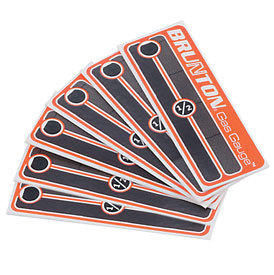
I have a Brunton canister that came with the gauge. I thought it would be handy, but…

I tried it at room temperature with the hottest my home faucet would produce. My results were that a very brief moment exists when an ambiguous reading can be taken. This is because it takes so little water to affect the gauge, that I tend to use to little before it returns to an erroneous reading of "full". Adding too much warm water causes an erroneous low or empty reading.

My testing was limited at best, so I encourage you to try yourself-you can't tell me an extra canister would hurt! I suppose it is better than nothing, but I opine that it is so inaccurate that goings sans gauge is just as good. I'll try to post some photos later, but I'm not promising.

PostedNov 18, 2009 at 4:26 pm

"I have a Brunton canister that came with the gauge. I thought it would be handy, but…

I tried it at room temperature with the hottest my home faucet would produce. My results were that a very brief moment exists when an ambiguous reading can be taken."

This has been my experience as well. The results are too brief and constantly changing so you don't get an accurate answer. Just hefting the canister by hand and guessing probably gives you the same level of accuracy.

PostedNov 18, 2009 at 4:48 pm

Marking water lines sounds like the most practical to use in the field. The temperature sensitive gauge is a good idea, just not refined enough.

PostedNov 18, 2009 at 6:11 pm

Mark, that is indeed Archimedes's principle ..
As long as you use the same type of cartridges (same nett and gross weight) should be really easy to make up a gauge and then scratch the marks on the side of a new canister using that as a guide.
I just tried that with an empty and one with 80g of gas, now to make sure I need to get a full one. I found it easy to turn the canister to the small writing bit (warnings) and take note of the wards just above or below a particular line and then mark the spot.
We had the Brunton Gauge bit here sometime ago and from memory results were mixed.
(BTW, for the gram weenies, the Brunton version adds weight, Archimedes's subtracts ..)
Franco

Viewing 11 posts - 1 through 11 (of 11 total)
Loading...