


Is there a way to determine the remaining battery life of an AA lithium battery? I've tried to stick with AA's and I have many expensive, partially used, lithium batteries around, with unknown power remaining.
Don
Topic
Become a member to post in the forums.
Is there a way to determine the remaining battery life of an AA lithium battery? I've tried to stick with AA's and I have many expensive, partially used, lithium batteries around, with unknown power remaining.
Don
Such as this one:
http://www.greenbatteries.com/ecunbate.html
No idea if this one is good or not, but the chargers on that site are, so I would guess this is at least decent.
You can test an alkaline AA battery fairly easily – the internal impedance is quite measurable and is a function of the charge state.
However, the internal impedance of a lithium battery is very low, such that ordinary battery testers cannot handle them. In addition, while alkalines batteries decay in voltage over their life, lithiums do not (significantly). It might be possible to make a special unit for testing lithium batteries, but you have to be able to handle pulsed loads of an amp or two while measuring voltages to at least 3 decimal places. naturally, at these currents the measurement would have to be done fairly quickly.
Can the cited Green Batteries unit handle all this? I don't know, but I admit to some scepticism. In addition, since the rest of the Green batteries web site seems dedicated to Lithium-ION batteries, rather than the e2 AA Lithium(-iron) type, I am not sure which form they are talking about.
Me, I carry a few spare AA e2 lithium batteries. They are much lighter than the alkalines, and last me a LONG time. I have also been known to preserve the 'dead' lithium e2 batteries out of my camera to use in one of my little white LED lights. Since the camera draws up to 1 amp, while the light draws only about 20 milliAmps, I can get quite a bit of life out of the old camera batteries before they won't power a LED any more.
cheers
Roger, your reply brought a tear to my eye thinking of all the things I've forgotten since college, or medical school for that matter.
Thanks for the response!
Don
I have a volt meter. Very precise.
You could also put them in a GPS or
other device that give you and idea of the charge left
in the battery.
Hi David,
Can you supply any specifics on how you use a vold meter to determine remaining battery life?
Thanks,
Tim
> how you use a volt meter to determine remaining battery life
You need the battery curve from the manufacturer. Works well with alkalines, more tricky with lithiums. Temperature can interfere, but it does give some indication – especially right at the end.
Cheers
Thanks for brining up this question, was thinking about the same. Love the weight and service time you get from Lithium batters, but hated not knowing how much power is left. I guess it just makes sense to carry spare Lithiums.
Roger, just curious, which AA digital camera do you use? I've always wanted a digital cam that would take AA for international travel and for the folding mini AA recharger I have, but could never find the camera I wanted in AA. Right now looking at the Canon Powershot S90 as a great point and shoot, and again, it doesn't take AA.

"Can you supply any specifics on how you use a vold meter to determine remaining battery life?"
Alkaline AA and AAA batteries are rated at 1.5 volts, but in reality, new ones are higher (~1.7 volts) and dead ones are lower (~1.3 volts). As mentioned, you'd need to know the voltage curve over the life of a battery to get a precise idea of how much charge remains, but the volt meter does give you a decent idea. If an Alkaline AA battery tests under 1.5 volts then I wouldn't bring it on a hiking trip unless I'm not expecting much from it. I had some energizer alkaline AAA's in my Petzl Tikka and at 1.3v they weren't good for much more than reading.
With Lithiums, the specified voltage is 1.2 volts. I haven't played around with these, but I believe they also start a bit higher than 1.2v and wind up a bit lower as they die. Knowing the voltage curve would help a lot (ie. does the voltage drop quickly but then stay around 1.1v for a long time? or does it drop linearly?) but even without this you can get a basic idea. Perhaps someone else can chime in with how the voltage of a typical Lithium AA decreases over time.
The relative battery curves are shown here:
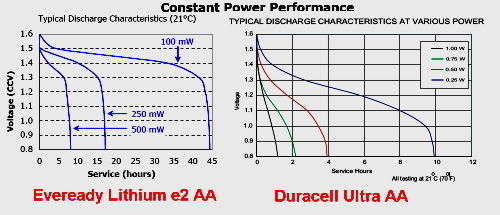
The vertical scales are the same but note the difference in the horizontal scales. At low power the Lithium battery curve is very flat – but usable if tested under load.
Cheers
Become a member to post in the forums.
 Pro-Grade Water RepellencyPolypropylene face fabrics: see the future of raingear.
 © Beartooth Media Group Inc.
 Loading...