


Im looking for an insulated hood to wear on cold nights to use with a quilt. Does anyone know what the approx temp rating would be on the Cocoon PRO 90 Balaclava or the UL 60 Balaclava?
Thanks.
Topic
Become a member to post in the forums.
Im looking for an insulated hood to wear on cold nights to use with a quilt. Does anyone know what the approx temp rating would be on the Cocoon PRO 90 Balaclava or the UL 60 Balaclava?
Thanks.
Ceasar,
The European Extreme (US temp) rating for the Cocoon PRO 90 balaclava is 52F for 2.4 oz and $40. The Down Works balaclava equivalent rating is 12F for 2.9 oz and $75. The Nunatak balaclava has the same temperature rating and weight but is $116. The Down Works is a cottage industry shop in Santa Cruz, CA and accepts phone orders at (831) 423-9078.

+1 down works balaclava. There is some variation… my down works balaclava is 2.4oz. I haven't measured it in the lab like Richard… but I have used it when it was 12F with my quilt (I think there was a polarbuff around my neck and over part of my head as well). My head was the only part of my body that felt toasty warm.
–Mark
Mark,
I have read that they made an UL version at 2.4 oz as well as a highly water repellant micro fiber shelled version at 2.96 oz. I only verified the temp rating on the 2.96 oz version.
When I went to their shop they had four balaclavas in stock. Each one had a tag on it listing its weight to within 1 gram. They were all different colors (reversible) and I selected mine based on the green/black highly water resistant version rather than the weight. I assume the warmth is comparable between the two types but didn't do any measurements.
If that info is correct then it seems a bit pointless since you can wear a cheap fleece beanie and still be to warm at 52*. I think your numbers may be a bit off but ill check out the down works also anyhow.
Thanks.
Ceasar,
90 g/m2 Polarguard Delta is ~2.7 oz/yd2. The manufacturer's clo per oz rating is .68 which yields 1.84 clo.
Your average "cheap fleece beanie" uses Polartec 200. The manufacturer's specification for this material is 5.7 oz/yd2 and 1.1 clo.
I respectfully disagree that they are equivalent in either warmth or weight. As an aside, a balaclava insulates ~8% of your body surface area and a beanie about 1/2 that amount.
> When I went to their shop they had four balaclavas in stock
Ah… Nice that Down Works is regularly stocking them now and there are color and material options. when I purchased mine Nick was only doing a light weight shell — which I think was left over material from bag work. You got whatever color was around and he didn't always have them in stock.
–Mark
Im not saying its equal,Im just saying at 52* F I can use a simple beanie and be comfortable. So don't understand why someone would pay 40$ on the pro 90 if it will only keep you warm to 52*. Thats where Im saying you "may" be wrong.
I think the point is that even the pro 90 is 60% warmer than your fleece beanie… so if the pro 90 is "good" to a given temp, the beanie wouldn't be. Your response does make me wonder why you'd bother asking the initial question…
I asked the initial question because Id like to get a hood/insulated balaclava to use with a 20* quilt. obviously a beanie alone would not work at that temp but in the mid 50's a beanie works just fine for me. I may be out on a limb here but Id assume most people would be. Hence my confusion with the statement that the Pro 90 is only good down to 52*.
Im just thinking the rating for the Pro 90 might be off a bit. Obviously a beanie wouldn't insulate as well as an lofty balaclava. So given the fact that in the 50's Ive used just a beanie and been fine the Pro 90, again may be wrong, should be able to handle colder temps.
Thats all Im saying.
Hi Richard
> The European Extreme (US temp) rating for the Cocoon PRO 90 balaclava is 52F
This puzzles me greatly. I am not sure the estimate is realistic for a hood. I have worn a Cocoon Pro 60 hood way below freezing and found it quite warm. At 32 F it would be FAR too warm. Even 200 weight fleece is pretty good some way below freezing – say to 20 F.
I would have said that the Pro 90 would be good to well below 10 F at least.
Cheers
Are we all talking about the same thing here? The original question involves a sleep system.
I have a better than average personal furnace and while 90gm/m^2 might allow my head to be comfortable sleeping at 10F, the head would be using a lot of warm blood that might better be used elsewhere.
I'm sure it'd be fine at 10*F when awake and moving about camp.
But I'm also confident it'd do much better that 52*F while sleeping (low 40's?)
As a point of reference I used a Patagonia R1 balaclava (6.9 oz Polartec Power Dry) down to 30 degrees this past weekend. The temp doesn't account for humidity (100%) or wind chill (15-25 mph). I was inside a 3 sided AT shelter and in a TiGoat bivy.
Roger,
The original question, in part, was, “… approx temp rating would be on the Cocoon PRO 90?”
I think we agree with my statement that, “…90 g/m2 Polarguard Delta is ~2.7 oz/yd2. The manufacturer's clo per oz rating is .68 which yields 1.84 clo.” I also think we also agree that the EN13537 temperature rating methodology is scientifically sound. I think we disagree on the how to assign a temperature rating to a balaclava as part of a sleep system.
Assume a vendor built an unconventional mummy sleeping bag comprised of a hood that could be un-zippered from the bag for use as a stand alone balaclava. Also assume both segments are comprised of 90 g/m2 insulation yielding a bag with an average insulation value of 1.84 clo (Rt). Do you think the EN13537 Extreme rating would be closer to 10F or 52F? Hint-Hint… an EN13537 10F Extreme rated bag requires an average insulation (Rt) value of ~5.23 clo.
Rt =1/((.08/RBclv)+(.92/RBdy))
The above formula shows how the insulation value of a sleep system is determined by the insulation value of a balaclava (RBclv) and the body (RBdy). The unconventional mummy bag’s balaclava covers 8% of the body surface area (BSA). The other portion of the unconventional mummy comprises 92% BSA.
Using EN13537 methodology, Rt is converted by an algorithm to find the equivalent EN13537 Extreme temperature rating. In other words EN13537 only measures the insulation value. The temperature assigned to the insulation value is a regression formula previously derived from human testing.
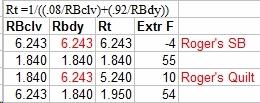
Your statement, “I would have said that the Pro 90 would be good to well below 10 F at least” tells me the clo value of your system minus the balaclava. Your quilt system comprised of you sleeping pad, quilt, sleeping clothing, and wife’s body heat provides 6.243 clo. If you used a balaclava with similar insulation to your quilt, your combination rating would be -4F not the 10F you experience with the Pro 90.
A person using a 60/gm2 PGD summer quilt, in combination with the Pro90, would be comfortable to about 55F. If he used a balaclava constructed similar to your quilt he would only gain about 1F in Extreme rating. Now the problem should be clear, he would rate the Pro 90 balaclava as good to 54F and you rated it to 10F. He would rate your quilt like balaclava as good to 54F and you would rate it to -4F.
I rated the balaclava by its intrinsic insulation value (RBlcv); the same thing done with EN13537. This allows any individual or lab to come up with a similar number when reporting the warmth of a balaclava.
Hi Richard
> I think we disagree on the how to assign a temperature rating to a balaclava as part of a sleep system.
Correct.
I am basing my comments on my experience in the field snow camping **with regard to the balaclava**, not on calculations.
> The unconventional mummy bag’s balaclava covers 8% of the body surface area (BSA).
> The other portion of the unconventional mummy comprises 92% BSA.
> The above formula shows how the insulation value of a sleep system is determined
> by the insulation value of a balaclava (RBclv) and the body (RBdy).
Great theory, but …
The heat flow to the body is far less than the heat flow to the head on a surface area basis. So a simple comparison is not valid imho.
> A person using a 60/gm2 PGD summer quilt, in combination with the Pro90, would be comfortable to about 55F.
At 55 F I would not even have a balaclava on. The combination does not make sense.
This is why I don't think that trying to apply EN13537 to something as small as a hood or balaclava makes sense. (But note that I support the use of EN13537 over the traditional marketing wild guesses.)
> Your statement, “I would have said that the Pro 90 would be good to well below 10 F at
> least” tells me the clo value of your system minus the balaclava.
Sorry for the confusion – that is not what I was trying to say at all. What I meant was that a Cocoon Pro 90 hood would be adequate for my head when combined with an *adequate* quilt at 10 F. I wasn't trying to say that the hood/balaclava had to have the same insulation value per square metre as the quilt.
Case study: my MYOG quilt. The hood contains about as much down per square metre as the body. But if I have the hood tucked around my head the same way I have the rest of my quilt tucked around my body on a cold night (say 32 F), then fairly soon my head is going to be far too hot. I have to partly remove the hood from being close around my head, to being pretty loosely laid over only part of my head. It's the extra heat being pumped into my head that upsets the simple calculations.
Cheers
Become a member to post in the forums.
 REI Gear Guide: evidence behind the selectionField use, design and engineering analysis, and measured and observed performance inform which products make this selection.
 © Beartooth Media Group Inc.
 Loading...