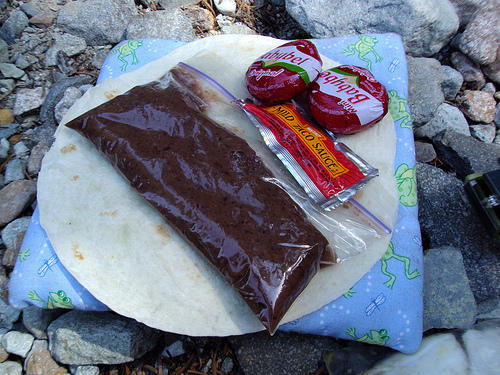
I take lots of dried fruit and nuts to snack on during the day and avoid a formal "lunch." Nuts are really good–high calorie and high in fat, but with the good fats that are good for you and don't clog your arteries. I may change this next year because my-daughter-the-veterinarian recommends I feed my dog small amounts 3 times daily to avoid overloading his sensitive stomach (which forced me to abort a trip last summer). That means I'll have an hour's break at mid-day, during which I might eat more than a snack.
As Sarah says, hot beverages are great in cold weather. One caveat–at night, tea, coffee and chocolate all have diuretic qualities. I stick with herbal tea in the evening–I have to get up enough times during the night without adding anything to stimulate this process! In the morning, and say until 4 pm, this isn't an issue.
I've often found that I'm not very hungry at night. This is partly fatigue and partly because I eat enough dried fruit and nuts all day that my stomach isn't empty at dinnertime.
Note that items high in sugar, especially refined sugar and definitely candy, tend to set up a vicious cycle–you eat the sugar which quickly ups your blood sugar; then your body responds by producing more insulin which reduces your blood sugar, often to lower than it was before. I've seen a number of people "p**p out" about 30-45 minutes after eating candy as a snack. Of course doing this a lot can bring on Type 2 diabetes. I don't seem to have this problem with dried fruit, probably because it contains enough fiber to slow down the sugar absorption, as do the nuts I eat along with it. I wouldn't say avoid candy, just keep it to a small amount, preferably as dessert after a meal (the food already in your stomach helps slow the sugar absorption, too).
Some people (my 9-year-old grandson is one) tend to get the "runs" from dried fruit and nuts and so must rely more on starchy foods like crackers and pretzels for snacks.
It's also important that you like your food! When adding new dishes, be sure to cook/rehydrate a sample at home (using the same method you would out in the wilds) and do at least a taste test. While it's possible that items that taste good at home may turn your stomach after a long day of hiking, I've never found a food that I disliked at home that I wanted to eat out on the trail!
Then there was the time I dehydrated a chicken casserole containing peas, and didn't test before the backpack. I boiled and boiled the stuff for almost 20 minutes until everything else was a glutinous mess, but the peas remained the consistency of buckshot.
I've also found that it's a good idea to take at least one no-cook dinner so that if I'm too tired to fire up the stove, I can still eat.