


In shopping for a new tarp I basically came to do I want a 6×8 tarp or a 5’3″x8.5″ tarp. I know its only inches in this example but what do you guys generally find more valuable, width or length? I’m about 5’8 if that helps
Topic
Become a member to post in the forums.
In shopping for a new tarp I basically came to do I want a 6×8 tarp or a 5’3″x8.5″ tarp. I know its only inches in this example but what do you guys generally find more valuable, width or length? I’m about 5’8 if that helps
Length is way more important to me. The actual (usable) width of a tarp depends on how it is pitched anyway, so there’s some variability there. With ul gear, most of your stuff is in use when in camp, hopefully not much LEFT to pile beside you! My first tarp was an Oware Cat 1.1, like your 2nd dimensions. Width was very comfortable when pitched med-low, length was my dislike. (In windy rain, a bivy was essential for me – I’m 5’9″). This year I’ll be using an MLD tarp, and I’m looking forward to the 9.5′ length in similar conditions, even w/ a bivy. 8.5 is fine tho for most situations. 8′ I’d personally only be happy with in mild weather.
I agree with Jason:
How you pitch the tarp makes a difference in what length will work. I’m 6’2″, but I can use an 8.5 if I use a pyramid pitch. For more conventional setups such as the A or leanto, I’m uncomfortable with less than 9.5.
A w/b bivy makes sense when using small tarps. The ground is never level, the groundsheet is always slick, and I always wake up with my feet out from under the tarp.

Here’s a third vote for length. I’m on the taller end, approaching 6′. I like a tarp that’s similar to my own proportions, like a 8.5-9.5 footer.
-Mark
Just to offer an alternate view…
If you carry a rain jacket, remember you can drape it over the head or foot of your bag as needed for spray protection. I’m 6’2″ and I get by with a 93″ long tarp in A-frame pitch by draping a jacket over the foot end of my bag. I’ve also tried clipping the jacket to the tarp to enclose the foot end, but I find the “drape” technique much less hassle.
By choosing extra width rather than length, you gain headroom when the tarp is staked to the ground along the sides (again, in A-frame pitch).
Cheers,
-Mike
PS — Vick, does your “pyramid” pitch put the pole on a corner or side of the tarp?
Jason,
Which MLD tarp did you decide on?
Bob
Michael,
In the center of a long edge. Start by staking a long edge- giving you a full 8, 8.5, 9 or 9.5 foot length – however long the tarp is. Then put the pole at the opposite center, and stake the ends. You get a very wind resistant shape that sheds storms. I usually put my rain hat over the pole. It takes a little practice to get the height right – depends on the true length/width of the tarp. I add pullouts on the short ends at quarters. Pardon the pack explosion.
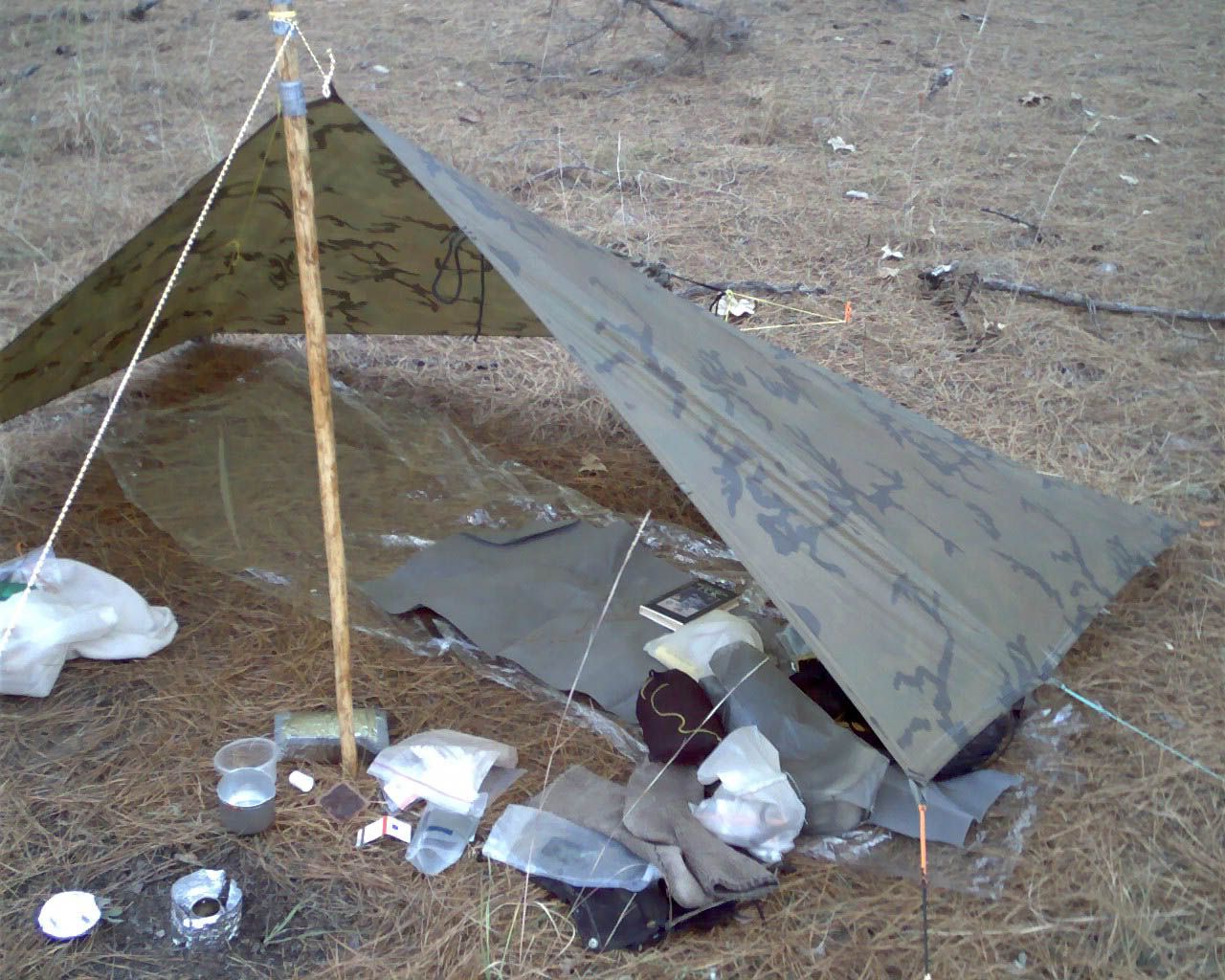
Vick,
What tarp is that?
(We now return this thread to its regularly scheduled programming … )
Folks who like the pyramid pitch: do you use a poncho tarp? does having the hood it make a difference?
Thanks, Vick.
Always nice to see solutions that work for tall folks too.
-Mike

I know this might be heresy, but I would suggest a slightly different take… why not upsize both dimensions a bit. We are talking about a few extra ounces, which you will truly appreciate if you actually have a serious rain storm.
Remember Dr. J Lost Coast trip http://ftp.backpackinglight.com/galleries/LostCoast04/imagepages/image31.html,
or the backpacker challenge the editor http://backpacker.com/gear/article/0,1023,3645_P,00.html
In both cases, two very experience hiker got pretty well soaked. If it had turned a bit colder for Dr J, or if the sun hadn’t come out for Jon they could have been in a serious spot.
A larger tarp would have made it a lot easier manage the wet conditions of the lost coast. I am sure both Jon and Ryan are much more skilled than me, but I managed to basically stay dry in the same location / conditions. My shelter/rain gear was maybe an extra 4oz… but it was worth it to me. I managed to stay mostly dry and comfortable.
Just a homemade poncho/tarp made from 1.1 PU coated from OWF.
Nathan,
The pic shows a poncho/tarp. The hood is no problem if properly designed. It just flops over.
Better than a hooded poncho is the cape. The side of the tarp forms the hood. No leakage and no distortion. I’ve been using capes for about 16 trail days now. I’m sold.
this is the original from Karen I don’t have pics of mine.
Vick,
I’m glad to hear that you’re enjoying using your tarp as a cape. I plan on doing similar this summer.
for those interested, here is a (translated from french via google) link to a post with pictures.
Vick and Joshua,
Any experience using trekking poles (or a hiking staff) with a cape of that configuration with no sleeve slits and a size that drapes rather generously over the arms?
Paul,
My capes have no sleeve slits at all. The cape drapes naturally to cover the arms without restricting them. Velcro tabs on the hem pick the back corners up. Otherwise, they drag. The hood is formed by Velcro tabs set 6″ in from the hem and matching tabs on the hem. One tab is on the inside, the other on the outside to make the hems overlap.
I have found the cape works as well as a poncho as raingear and better than a poncho as a tarp. Heretofore, I have put spindrift collars instead of hoods on my ponchos, to form a water seal and to reduce deformation when using it as a tarp. Having no hood or collar at all is a much better way to go, IMHO. I usually put the ‘hood’ back and use a wide-brimmed hat, but the ‘hood’ is always available.
Lack of sleeve slits eliminates another leak point (and weight) as well as an opening that has to be shielded and only sheds water from one direction.
When setting up on the ground, I generally use a trecking pole and just put the guy line through the wrist strap or through a hole in the handle (depending on which poles I am using).
When setting up over a hammock in an ‘A’ or peaked configuration, the collar or hood of a regular poncho is a real problem unless the neck opening is a slit instead of a hole and unless the slit is aligned with the ridgeline. That is a lot of unlesses.
BTW, I’ve been using 1.1 oz PU-coated ripstop from OWF for the last several poncho/cape/tarps. It doesn’t spray through like silnylon and it is not noisy. But it is subject to all the perils that PU is heir to.
Vick, Many thanks for the swift reply. Sounds like you’ve got a great cape there. I looked at the pics in the link and coupled with your description, I can easily understand the benefits you elucidated.
One more question, when wearing your cape, does it interfere at all with the normal arm swing when using trekking poles while hiking?
Mark Verber,
That isn’t heresy, just good sense. If you increase tarp size, you can do without the bivy sack and save serious ounces.
It’s always a tradeoff. I hammock camp mostly, so my 9.5 foot cape/tarp is almost too long. And for ground camping, 9.5 is plenty if you use a pyramid setup. But only barely enough for an ‘A’ or a leanto with my height. If I am planning to be on the ground, I take a bivy with cape sometimes and a longer dedicated tarp sometimes. Mood, time of year and the state of the sciatica have a lot to do with it.
Paul,
The cape doesn’t interfere with arm movement, although it doesn’t have the potential (important word) freedom of movement of a poncho. It seems to work out. ON the other hand, a cape doesn’t flap in the wind as much as a poncho. It vents from the front instead of the sides… but, as you know, ventillation of ponchos is a deceptive idea since condensation occurs whenever moist air hits a cool surface so you can’t prevent condensation to any appreciable degree. It would be a great service to humanity if someone would make yardgoods available in a nice 1.1 ripstop with one of the W/B PU coatings or something similar. You will notice several makers have ponchos with W/B fabric. But I would rather have 9.5 feet of fabric.
Hey Vick,
That pitch looks really nice! I noticed you had some of those self tensioning lines on the front corners. Where else have you found them useful in that particular pitch (ie, do you use them on just the front two corners or the back two as well?)
Jay,
Usually, I just nail down the corners opposite the pole peak right through the stake loops and bungee the rest of the pullouts. You will note that the back hem is lifted up in the photo. That’s because it is staked out at a distance (with a bungee) and that makes it lift – making for more room underneath. The pole line is also bungeed. I bungee enough to pull out the early morning sag and absorb wind shock. That does not necessarily require tensioners on every corner.
Vick,
When you say bungees are you talking about just elastic cord you can pick up at fabric shops (not the weak beading stuff or whatever its called) atached to spectra or something like that? I think I remembered you saying something about using this stuff doubled over in another post on the topic. I’m trying to figure out the best way to go about this tarping thing.
Jay,
I use the round elastic commonly used for hood and waist drawstrings on parkas and such like. This stuff is too stretchy IMHO and has to be doubled to give the resistance needed for guy lines. The doubled smaller cord is better than single larger cord because it has more residual stretch for absorbing wind shock.
I stitch (you could easily tie) the elastic into the ends of gutted parachute cord to form loops that are about 2/3 elastic and 1/2 parachute cord sheath.
If you don’t want to stitch these or want to whip up a couple or four for a test, tie some elastic into loops using water knots. YOu could even make the mixed elastic/cord loops with knots alone.
Google on ‘knots’ to see a ‘water knot’, or just tie a simple overhand knot in one end of the elastic and follow the knot backwards with the other end of the elastic – in other words parallel to the first knot, going the other way.
Bob: Above I was referring to the MLD Poncho Tarp in silnylon, used with a Vapr Bivy (not wp/b as others mentioned). I also ordered an MLD Grace 2-person in Spinntex at the same time, for exactly those times when the extra weight is worth it in foul weather (maybe 70% of my trips). Popular items now, 8 week waiting list!
Become a member to post in the forums.
 Tactical Wool Thermo ShirtSuperfine merino wool-blend mesh baselayer with a slim unisex fit and densely knitted shoulder panels for pack-carrying comfort. Weighs 4.9oz | 140g
 © Beartooth Media Group Inc.
 Loading...