Topic

Powermax Canisters

  • This topic is empty.
Viewing 19 posts - 1 through 19 (of 19 total)
Hikin’ Jim BPL Member
PostedSep 23, 2009 at 9:28 pm

So, how long are Powermax canisters good for? I bought four canisters just to make sure I have some if Coleman ever stops making them. However, whenever I remove the little black plastic protective cap over the nipple, I can clearly smell gas. In other words, some gas is seeping out. My oldest canister is from 2007 and my newest from 2008. How long can I expect these canisters to last in terms of shelf life? Anyone (Roger C) got any ideas?

Roger Caffin BPL Member
PostedSep 24, 2009 at 12:50 am

Hi Jim

If you can smell gas you should take it back and demand a better replacement! That should NOT happen!!!!! Very very bad!

If kept dry (to avoid rust on the outside) … they should last 10 or 20 years at least.

Cheers

PostedSep 24, 2009 at 8:11 pm

Yeah, get that out of the gear room and back to the store. I too have a few canisters. About 10 right now as I am worried like you they will discontinue the best winter canister ever.

But that brings up another question for our friend Roger. Is there some way to "treat" the seal to make sure that it stays good? I had a canister fail to seal upon removal last winter. I watched it spray! I tried screwing it back on then off and it just kept spewing fuel. I finally set it to the side to drain while I broke camp.

Roger Caffin BPL Member
PostedSep 24, 2009 at 9:51 pm

Hi Ray

> Is there some way to "treat" the seal to make sure that it stays good?
Um … Well, not really.
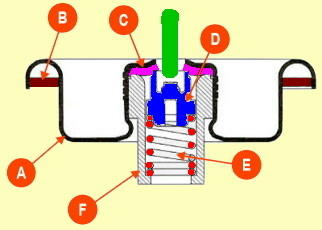
But more important is the question of WHY the seal leaked. The seal itself is a neoprene disk pressed against a bit of plastic tubing which is the valve plunger.
.
LindalValveSection3FAQ.jpg
The blue thing is the plastic valve plunger – it moves.
The pink thing is the neoprene washer which does the sealing bit.
The red thing is a fairly strong spring which keeps the valve shut.

I can only assume that somehow the face of the (blue) plastic part was damaged such that it could no longer seal. I do not think the (pink) neoprene seal itself would degrade – neoprene rubber does not do that easily.
Or … perhaps dirt or rust got into the valve seat somehow. I ALWAYS carry my fuel cans with the plastic cap over the Lindal valve to keep all dirt out.

One could perhaps prod the blue valve bit down briefly to try to flush any dirt out of the seat. This sprays fuel everywhere of course – outside!

Cheers

PostedSep 24, 2009 at 10:31 pm

Yeah, I always keep the cover on it.

It sprayed for quite a while to "clean" it out before I re-attached it to stop the spray. As soon as I unthreaded it again it started up again. It sat attached all night long, but I have done that many times in much lower temps than what I was at.

Weird one.

Hikin’ Jim BPL Member
PostedSep 30, 2009 at 4:48 pm

Thanks for the input everyone. The canisters I have don't emit any smell unless I take off the small black plastic valve cover cap. Then, immediately after I take off the cap, there is a faint smell of butane/propane. It's not nearly as strong as when I detach the bottle from the stove or something like that. The smell disappears quickly. It seems like perhaps there's a very very small amount of gas getting out through the valve. I'm wondering if the amount is even worth fussing about. I could return the canisters to my local retailer, but all of the canisters they stock are equally as old as the ones I have (a year or two), and the ones I checked in the store the other day have the same faint smell.

I wonder if the very faint smell isn't normal. Do your canisters have absolutely no smell at all? There's definitely no "hiss" sound or anything like that.

I suppose I could give them an immersion test in a tub of water. If there are no detectable bubbles, perhaps then the amount of gas is so small as to not be worth worrying about?

The only hesitation I have about an immersion test is that water will get into the valve area which appears to be steel. I'd hate to ruin a canister with rust while proving that it has no appreciable leakage problem.

Hope this rather stream-of-consciousness post is intelligible. Basically, I'm soliciting ideas as to whether or not the very faint smell I'm detecting is a material problem or so slight as to be insignificant. Input appreciated.

Hikin’ Jim BPL Member
PostedSep 30, 2009 at 4:51 pm

P.S. Roger: Thanks as always for the diagram of the valve. You have no idea how helpful all of the technical background you provide is.

Roger Caffin BPL Member
PostedSep 30, 2009 at 9:59 pm

Hi Jim

IF (and only IF) the smell is extremely faint straight after you take the cap off, then it is possible that what you are smelling is a residual amount of the odorant (usually mercaptan) left behind from operating the stove. It can deposit on the nipple and evaporate slowly. MAYBE.

It might be worth while taking a nearly empty Powermax canister and dunking it to see if there are any bubbles. Then dry it out in the sun etc straight after. That shouldn't do any harm.

If you do, please let us all know the result!

Cheers

Hikin’ Jim BPL Member
PostedOct 6, 2009 at 11:03 am

I did a little leak testing over the weekend with my Powermax canisters.

First, I weighed three brand new canisters thinking that differences in weight might tell me which canisters were leaking. Two of the canisters were manufactured in June 2008, and one of the canisters was manufactured in November 2007. There were some variations in the weights of the brand new, unused canisters; their weights are 391g, 392g, and 394g. I then measured some "regular" canisters and found that they varied a gram or two in weight as well. Weight doesn't appear to be a good determiner as to whether or not a canister is or is not leaking. Still, does anyone know the per specification weight of a full Powermax canister?

Interestingly, the Powermax canisters really are lightweight compared to "regular" canisters. For example, a snow peak 110g size canister weighs ~88g empty. A Powermax 300g size canister weighs ~92g empty. For a mere 4g in additional canister weight, I get nearly three times the amount of fuel.

I set all four of my canisters (3 brand new, 1 used but nearly full) in a tub of water and weighted them so that the valves were fully submerged. On two of the canisters, after an hour a (very) small bubble had formed withing the opening of the valve in the canister. The two canisters were not bubbling (as say a punctured tire would); they simply had a very small bubble form after an hour. The bubble did not detach and float to the surface, although if left long enough, perhaps it would. I wasn't willing to watch continuously to see if a bubble would eventually detach.

Conclusion: Two of my canisters do have a very slow leak. Given that all of the canisters are over a year old, it's not much of a leak since the canisters are very close to full weight (full weight is assumed to be between 391 and 394 grams unless I receive better information).

Speculation: The black valve cover caps may be sufficient to hold in the gas from the very slow leak effectively nullifying the leak or at least slowing the rate of loss of gas to a nearly negligible level.

Question: Is the leak significant enough to warrant replacement?

Further information needed: Specification weight of a full 300g size Powermax canister.

Comments: After the tests, I then blew the water out of the valves and dried the canisters in the sun. Hopefully no harm done to the valves. Rather ironic if I ruin the valves while proving that they are functioning properly!

Roger Caffin BPL Member
PostedOct 6, 2009 at 2:56 pm

Hi Jim

One very small bubble after an hour? Trivial.
I would say you should keep the canisters and use them!

As to the weight variations – +/- 2 g in 400 is 0.5%. That's pretty good!

I found my canisters weighed about 86 g rather than 92 g, but I am sure the weight of the canister varies too.

Now, when are you going backcountry?

Cheers

Hikin’ Jim BPL Member
PostedOct 6, 2009 at 7:48 pm

One very small bubble after an hour? Trivial.
I would say you should keep the canisters and use them!

Excellent! Thank you for your perspective.

I found my canisters weighed about 86 g rather than 92 g, but I am sure the weight of the canister varies too.

I'm more or less estimating the weight based on the manufacturer's stated fuel weight. 392g full weight – 300g stated fuel weight = 92 g canister weight. I wouldn't be the least bit disappointed to find out that the canister actually weighs 86g and that Coleman threw in 6g extra.

QUESTION: What does one of your canisters weigh when full?

Now, when are you going backcountry?

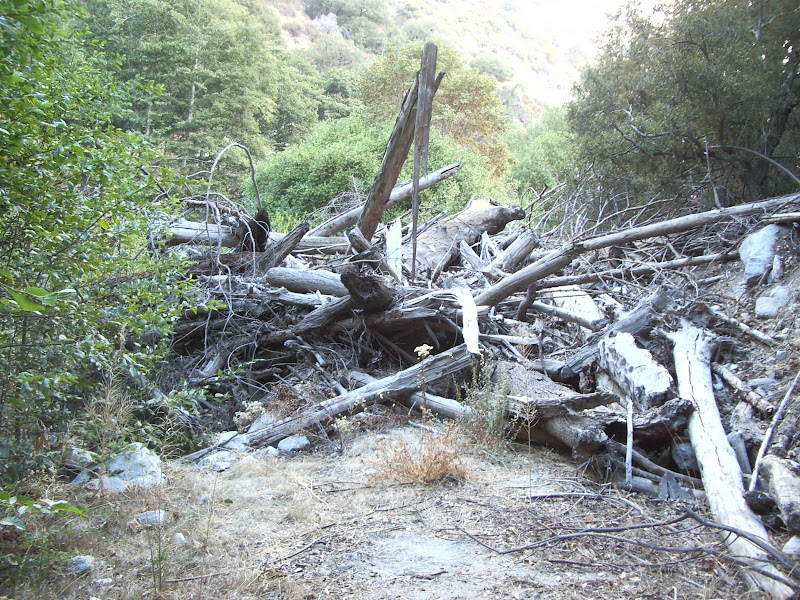
We've a new born in the house, so the wife has nixed overnight trips for a while. Just doing day trips right now, but prepping for winter snow camping and X-C skiing (hence the great interest in my Xtreme). Did a very nice canyoneering day trip on Saturday. Here's a photo of the drop in (below). If you look closely, you can see the shadow of me taking the photo.

Looking back up:

The canyon bottom (not too bad for travel):

Water snake:

Storm wrack (this wasn't such easy going, lol):

Happy trails,

HJ

Roger Caffin BPL Member
PostedOct 6, 2009 at 9:58 pm

Hi Jim

> What does one of your canisters weigh when full?
Ah … usually a few grams over the nominal. The can weight has been pretty stable, but I think they always overfill by a few grams to avoid any 'false advertising' legal problems. Very standard practice.

Cheers

Hikin’ Jim BPL Member
PostedOct 7, 2009 at 2:48 pm

What is the nominal weight? Was I correct in saying 392g? That was just an educated guess.

By the way, I looked up the MSDS for a Powermax canister. You are correct that Mercaptan is the odorant.

I notice that according to this 2007 MSDS http://www.coleman.com/coleman/msds/peak1.pdf, Powermax fuel is 65% n-butane and 35% propane. I somehow had it in my mind that it was a 60 – 40 split. Still a great fuel regardless.

Roger Caffin BPL Member
PostedOct 7, 2009 at 2:56 pm

Hi Jim

'Nominal weight' is not given by Coleman.
All the large canisters I have weighed are very close to 86 g. Given the ?millions? of similar canisters made for hair spray etc, I imagine they have that manufacturing process pretty tight.
The nett wt of the fuel is stated to be 300 g.
So the nominal weight of a full can should be 386 g, but as I said, they usually make sure they are slightly above that for legal reasons.

As to the fuel composition – yeah, I thought it used to be 60/40 as well. They may have changed it?

Cheers

Hikin’ Jim BPL Member
PostedOct 7, 2009 at 4:48 pm

Oh, duh, I'm a little slow today. 300g fuel + 86g empty canister = 386g nominal weight. New born in the house. Obvious case of sleep deprivation. :)

So if a Powermax canister weighs just 86g, then a 300g Powermax canister is actually lighter than a Snow Peak 110g canister. Dang, now that's light.

I wish someone would manufacture an upright aluminum canister with a standard threaded Lindel valve.

Barring that, If Coleman were to use their side laying canister (WITHOUT the liquid feed tube) and intall a standard threaded valve, one could could use it on a remote canister stove with significant weight savings. One could also use something like the Brunton Remote Canister Converter for upright stoves, but there goes any weight savings.

Anyway, I now delve into (very) wishful thinking. If wishes were horses, then beggars could ride.

Cheers.

Roger Caffin BPL Member
PostedOct 8, 2009 at 1:44 am

Hi Jim

> I wish someone would manufacture an upright aluminum canister with a standard threaded Lindal valve.
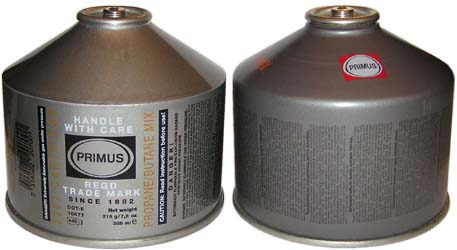
Primus used to sell an aluminium canister with the screw-thread, but the manufacturer was undercut by the Chinese (or someone) with a steel canister. Cheeeep!

> If Coleman were to use their side laying canister (WITHOUT the liquid feed tube)
Think about it. The canister WILL fall over on its side sooner or later, and if it is anywhere near full you will get liquid fuel coming out of it. And some idiot will put an upright stove on it while it is upright, and create a fireball. And sue. Not pretty.

Cheers

Hikin’ Jim BPL Member
PostedOct 9, 2009 at 12:02 pm

> I wish someone would manufacture an upright aluminum canister with a standard threaded Lindal valve.
Primus used to sell an aluminium canister with the screw-thread, but the manufacturer was undercut by the Chinese (or someone) with a steel canister. Cheeeep!

Oh, that's right Primus did at one time make an aluminum canister.
Aluminum left (sharp "shoulder"), Steel right (more rounded shoulder).

It's a shame they did away with them. I wonder though, with the current popularity of going ultralight, if someone could deliberately market aluminum canisters. I'd pay a dollar more for a lighter tank. Something for a focus group I suppose.

It's just so galling to me to carry weight that serves no purpose. It's like typing on an old manual type writer when there's a brand new laptop sitting right beside it.

> If Coleman were to use their side laying canister (WITHOUT the liquid feed tube)
Think about it. The canister WILL fall over on its side sooner or later, and if it is anywhere near full you will get liquid fuel coming out of it. And some idiot will put an upright stove on it while it is upright, and create a fireball. And sue. Not pretty.

I was envisioning some kind of plastic sleeve with legs to keep the canisters upright, but, yes, you're right, some idiot would turn it on it's side and get himself burned (or worse).

PostedOct 9, 2009 at 1:08 pm

Wow, I have a bunch of those Primus canisters sitting at home and I'm pretty sure they are the "Old Style". I never knew I was sitting on a pot of gold – How much do you think these would fetch on eBay? $100 each?

Hikin’ Jim BPL Member
PostedOct 9, 2009 at 2:10 pm

Wow, I have a bunch of those Primus canisters sitting at home and I'm pretty sure they are the "Old Style". I never knew I was sitting on a pot of gold – How much do you think these would fetch on eBay? $100 each?

$100? Good luck.

But who knows? I've seen people pay OUTRAGEOUS prices whenever one of the rare titanium MSR fuel bottles comes up on eBay.

Viewing 19 posts - 1 through 19 (of 19 total)
Loading...