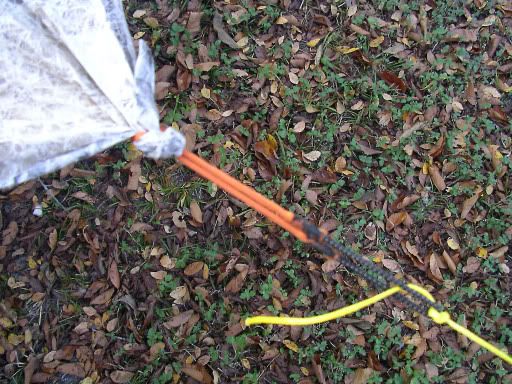
Al, I believe Vick is right, hence my “Bingo” comment. Vick (if he read one of my earlier posts???) understood what I meant by vector analysis and number of tie-outs determining the number of panels. I’d really like to see a finite element analysis of a tarp under loading – that would be very interesting.
I wasn’t going to get into this stuff as I’m nowhere near the engineer DrJ is – I was hoping that he’d reply. I’m going to be somewhat brief and in some nitpicky respects maybe technically inaccurate, or technically “lean” here.
Keep in mind, that as I stated earlier, I believe that the problem is even more complex and that both Vick’s and my comments are mainly related to a static loading of the tarp. Dynamically loaded, the tarp will want to shift, bot the tarp and guylines are essentially, to some small degree, springs, and therefore subject to Hook’s Law (F=kx). Some lines of force on the tarp’s conceptual “panels” will go slack (or to zero), others will increase in tension. This dynamic loading will give DrJ’s single continuous guyline approach an advantage since the lines of force can change somewhat as the tarp attempts to shift due to wind loading. Also, in DrJ’s approach, since the three middle stakes are connected by, conceptually, two guylines, they don’t have half the force applied to them, they have the same force (but each conceptual guyline on a stake bears half the load) – the two end stakes being an exception.
I still think as I stated in a prev. post that the number of panels doesn’t really change, either statically or dynamically, since any shift results in the same number of panels but in different directions, so “straight” conceptual panels will become “diagonal” conceptual panels. I’m open to instruction here as maybe I’m forgetting something or not visualizing this properly.
Depends upon what you mean by “best”. Easiest to adjust – well,…you know the answer to that one already.
Strongest in wind – “the more’s the merrier.” You could end up adding so many stakes and guys (or larger, longer, better shaped stakes, and stronger guylines – either single or multi-guyline arrangment) that either the tarp fabric, or sewn seams, or the tie-down stitching is the weakest link – would depend on the tarp material and construction – not that such an arrangement is necessarily practical.
I would imagine that the conditions that exist on any given night might be better suited to one approach or the other.