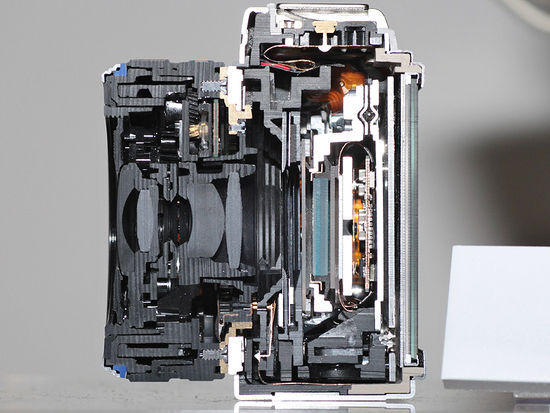
>Without many lens elements set in a few groups (see above cross cut) it isn't possible to get an image that is acceptable by today's standards.
Are you confusing webcam lens with a liquid lens?
There are many type of liquid lens designs but this one is probably most suitable:

I believe that you need multiple lens element in order to focus or zoom. Fixed focus lens [webcam/some mobile cameras] obviously cannot compare with the the quality of autofocus/optical zoom lenses.
Liquid zoom lens is designed to change its convexity and/or concavity in order to focus and zoom.
>And keep in mind that there is a lot of image manipulation going on in firmware in the EP1, to correct the limitations of such a small lens design.
>BTW, you also need a focal plane shutter in there…
these feature can be implemented in a liquid lens camera also.
>If you are not after photographic quality comparable to a good compact,
I am obviously after serious photographic quality, but something in SUL realm.
I could be wrong but I am not convinced that making a prototype will cost "a few million dollars". May be a few of thousand dollars max, if I can write application software myself.
Liquid lens fabrication process seems very simple compared to conventional lens.
I am not aware of what liquid is used by lens manufacturers but according to a bit of research I did 66.7% glycerol – water solution is colourless, has freezing temp of -50F, better refractive index then water and very good surface tension comparable to water.
What I have in mind is SUL integrated system for under one pound consisting of
>iphone 3GS
>zoom lens camera with amazing photo quality, flashlight, weather tracker
>Iridium satellite transceiver/antenna module for 2way communication and real time GPS tracking
After more thinking it seems like very big niche – outdoor photography, journalists, researchers working in remote places, sea travelers by ship, and military form a huge market.