Andrew Skurka posted a question to the Alpacka forum about the viability of a very light Pacific Designs paddle for packrafting. I answered his question and will repost my response here.
Andrew,
I am responding to your paddle question from the perspective of a pack rafter, sea kayaker, and WW kayaker and I use a wide range of paddles. The Pacific Design's paddles are a good option for recreational paddlers but are not rugged enough for expedition use. Pacific Design's was/is? the OEM supplier of the Dory convertible rowing and kayaking paddle sold by Alpacka. Five people I pack raft with purchased Alpacka dories in combination with a Pacific Designs rowing/paddling convertible paddle.
I did two packraft trips last year with group members who broke Pacific Designs paddles. The first failure occurred on the Upper Sacramento River in CA. The shaft snapped from just powering a packraft during an up river ferry; the paddle did not hit a rock. That paddle set and the other sets owned by fellow pack rafters I know were then modified by the manufacture. He added a reinforcing sleeve to the inside of the shaft about at the midpoint. After those modifications the shafts held up but the ABS plastic blades that are riveted to the shaft tore on a couple of blades. This occurred on a SF Flathead river trip in Montana’s Bob wilderness. They have now all switched over to beefier paddles. I have used the same Werner 4-piece white water paddle for five years of packrafting and two multi-month folding sea kayak expeditions along the Alaska coast without any type of paddle failure. I have used a Werner one piece blade in my WW boat for five years without a paddle failure.
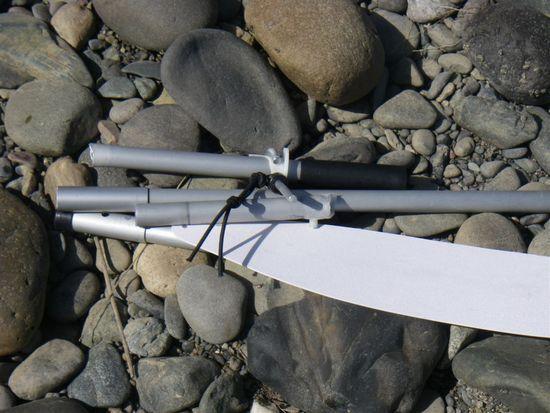
The Alpacka site recommends 210 cm length paddles for their boats. Roman recommends 215 cm lengths for pack rafts. I suggest that you purchase a copy of a forward stroke training DVD by Brent Reitz or Greg Barton. Learning this high angle racing technique will provide three packrafting benefits. First, you will learn to use your torso for propulsion rather than your arms. Your arms will tire but the large muscles of your torso will allow near effortless dawn to dusk paddling. Second, the high angle technique will minimize the yawing inherent in any short length boat such as a packraft. Third, you will be able to use a 210cm high angle white water paddle rather than a 215cm to help reduce the paddle weight. When you need to quickly power to avoid a rock or hole or brace in highly aerated water then the larger blade surface (min. of 1000 cm2) and higher thickness of a white water paddle provides a significant safety margin. 2 lb + is required for an adequate WW paddle. Also add drip rings to the shaft to keep you dry. Offset the paddle weight and drip ring weight by using a rubber bumper on the paddle shaft in place of hiking sticks. Use two halves of the paddle and drip rings to provide vertical friction in combination with rope or Velcro to hold up your tarp up.
With your long distance backpacking accomplishments legendary, you should easily qualify for a pro discount from a premier carbon fiber 4-piece white water paddle manufacture such as Werner or Lendal. For a lower price but less strength, Aqua Bound or Sawyer is also an option.