


Brows knitted in deep thought, smoke rising from the ears…
"If a sleep pad is sandwiched between a 98.6°F body and the ground, what is the relevance of air temperature, assuming the sleeping bag is doing its job?"
We may be in for long ride here…..
Topic
Become a member to post in the forums.
Brows knitted in deep thought, smoke rising from the ears…
"If a sleep pad is sandwiched between a 98.6°F body and the ground, what is the relevance of air temperature, assuming the sleeping bag is doing its job?"
We may be in for long ride here…..
Ah, but can you always assume the SB is adequate?
Cheers
Roger,
Even if the bag is inadequate, and you lose heat, you are still a 98.6°F source relative to the transfer through the pad into the ground. R Values are heat impedance values between source and sink.
I don't see how air temperature affects heat flow between a body and the ground.
Except maybe for some edge effect on the unprotected perimeter of a 2.5" thick pad.
Hi Greg
> I don't see how air temperature affects heat flow between a body and the ground.
Well, it doesn't. But the heat flow through the mat by itself is not really the most important thing. How warm you feel is the most important thing.
So … if you have a rather inadequate SB on top of you, or if the air is really cold, the heat loss from your other three sides is going to be significant. That may push a poor mat beyond what your body can handle. This is why people talk about sleep *systems*: you have to look at the lot together.
Mind you, I do like my mat to provide adequate insulation … For the rest, I snuggle up to my wife.
Cheers
Roger,
"…the heat loss from your other three sides is going to be significant. That may push a poor mat beyond what your body can handle." Nia raised this question in the Neoair thread.
A warm top can compensate for a marginal bottom. And warmer air temperatures contribute to that. In the big scheme of things, it is all connected.
But, I think to define pad performance around sleeping bags, air temperatures, and someones metabolic rate is bogus. The R-Value of the pad, by itself, should do the job.
Whether or not the top part of the system is doing its job, air temperature really doesn't impact the heat transfer function of the pad.
Edit: Or -The pad is directly connected to the ground and to the body, not to the ambient air, making pad function independent of air temperature.
nm

I'll just add that for whatever reason, placing the foam pad on TOP of your inflatable will be much warmer then placing the same foam pad below.
Example #1…this is good in winter sleeping on snow and ice
Ground: GG 1/8" Thinlite
Middle: Montbell 90 SI
Top: GG 3/8" Torsolite
Example #2…this is too cold for me on snow and ice
Ground: GG 1/8" Thinlite
Middle: GG 3/8" Torsolite
Top: Montbell 90 SI
Agreeing with Steven.
That's my experience too. When combining an inflatable and closed cell pad I get the best performance with the closed cell on top.
Joe, Steve, and Jim,
Agreed. That more pads and better locations lead to better sleeping is a given. There are a lot of ways to stay warm.
But I was asking “Why do we insist on rating pad performance as a function of air temperatures?” Isn’t a mostly function of ground temperature?
Perhaps a consideration would be that a bag draped over the top of the pad next to the sleeper would thwart lateral transfer to cold ambient air, and if so, then losses would depend, to some extent, on air temperatures. (Edge effects.)
What are pad losses to the ground And to the air?
How do you divide the losses?
In This thread Mr. Nisley touches on pad performance, but doesn’t shed light on why ground temps are ignored.
Again, why don’t ground temperatures come into play when looking at pad ratings?
“But I was asking “Why do we insist on rating pad performance as a function of air temperatures?” Isn’t a mostly function of ground temperature?”
I’m just guessing here, but I think the key interface is between the pad and the body. The pad weather foam, inflatable or whatever is filled with air. Convection will continue exchange heat with the surrounding air. So the ambient air temperature is the predominant factor.
Conduction through to the ground also plays a role but on solid ground perhaps a lesser one as there is little convective heat exchange. Is there more heat loss when sleeping on snow?
If you were to lay flat on the ground than conductive heat loss and the ground temperature would be more of a factor.
Again I’m just guessing and googling. Understanding R-values was a useful write up for dummies like me. I’m sure there are better ones.
As someone said previously the neoair works on convective and radiant heat loss only. Not on conductive. The benefits of radiant heat barriers are highly debated. CD claims about 20% of the neoairs r-value based on the addition of the radiant barrier.
Hi Greg
As as rating pads and mats goes, then I think you are right: the R-value should do the job.
But sometimes other factors come into play when translating the R-value into how well you sleep. As you said, it is all connected.
Cheers
nm
That is why ratings can only be approximate. Sleeping bags don't come with a high and low relative humidity ratings do they ?
Franco
Greg,
I have just returned from a five day backpacking trip. There were 28 pages of new posts since the last time I looked at the forums. Your question may have already been adequately addressed in this thread or another thread but I don’t have time to catch up on the old posts.
In a thermo neutral state, skin temperature averages ~34.45C (94.01F). Most forum participants live in an ephemeral soil frost zone. In this environment there is strong correlation between the soil temperature (5cm depth) and the air temperature during the three seasons when most of us backpack. During the winter there is little correlation when soil freezing and snow cover has occurred. The following chart uses centigrade temperatures that cover the range of most three seasons backpacking.
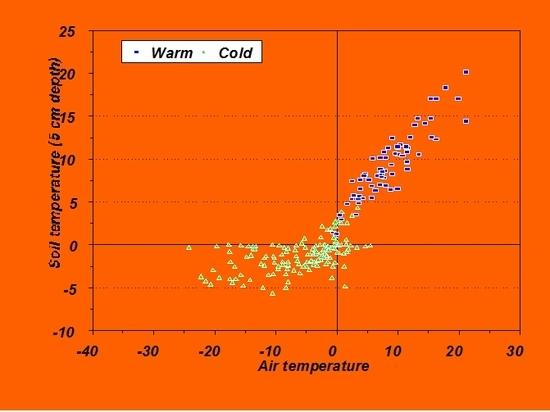
Your sleeping bag provides significantly less insulation under body's pressure points. For a back sleeper; ~35% of the sleep systems insulation is contributed by the compressed bag in combination with the sleeping pad.
Let’s assume you will be backpacking in an environment in which the average daily high temperature is 70F and the average low temperature is 37F. You have an EN13537 rated 35F sleeping bag. Let’s also assume you are the average 30 year old male with .6 clo of long underwear to sleep in. Let’s assume you believe that there is no correlation between air temperature and the required pad so you are using a GG Torso pad with an R-Value 2.27. Here is what would happen. The sleeping bag (4.71 R-Value), your sleeping position (back for 35% pad contact), and your pad (2.27 R-Value) would provide a total insulation system value based on the formula: Rct = 1/(.65/Rup + .35/RDown) = =1/(0.65/4.71+0.35/2.27) = 3.42 = Sleep system temp LLimit rating of ~50F. Now let’s replace the Torso pad with a BA IAC with an R-Value of 4.1 which yields an Rct of ~4.48 and sleep system LLimit rating of ~38F for thermo neutral sleep.
In summary, brows knitted in deep thought, smoke rising from the ears…now I get it…ground temperature is correlated with the air temperature and the heat lost to the ground and the heat lost to the air determine if my sleep system will be thermo neutral.
> Most forum participants live in an ephemeral soil frost zone.
Richard, you're not suggesting we are all worms are you? ;-)
Ashley,
That got a big laugh from me… thanks.
Richard,
"In this environment there is strong correlation between the soil temperature (5cm depth) and the air temperature during the three seasons when most of us backpack."
That says it all. I assume it holds above 30° as well?
It is not intuitive to me, and I can imagine exceptions, but for the 80% solution this is as good as it gets.
Thank you.
Is there a standard which defines the lower temperature bound of "Three Seasons"?
Greg,
The air/ground temperature correlation chart uses centigrade temperatures. The range of linearity is 30 degrees centigrade (86F) to 0 degrees centigrade (32F). 0 degrees centigrade (32F) arbitrarily defines the lower temperature bound of "Three Seasons". If you are winter camping on deep snow you can frequently get by with the same pad that is appropriate for the lower bound of three seasons camping on soil. This is an R-Value pad of 4 or higher.
The non-correlated air/ground temperature winter pad insulation requirements were discussed in detail by Mike Martin, me, and others in a thread about 6 months ago.
Thanks once again.
The text was in Degrees F, so naturally I assumed ….
And I won't be doing any intentional sub-zero °F camping, thank you very much.
Richard Nisley posted: "Your sleeping bag provides significantly less insulation under body's pressure points. For a back sleeper; ~35% of the sleep systems insulation is contributed by the compressed bag in combination with the sleeping pad".
Question: What is the corresponding average compressed contact percentage for side sleepers ?
Thanks.
18%.
I reference that post not to far above.
Become a member to post in the forums.
 Analog by Design: The Vaer C4 Tactical Field SolarThe best gear works the moment you reach for it. The VAER C4 Tactical Field Solar (41.5mm) combines rugged functionality with everyday practicality, featuring a matte dial with bold stencil numerals, raised 3D Super-LumiNova markers, and a 12-hour bezel for timing a climb or tracking a second time zone. Powered by light, it delivers up to six months of operation from just six hours of exposure, with no routine battery changes required. A sapphire crystal, 200 meters of water resistance, USA assembly, and a two-year waterproof warranty make it a dependable companion for adventures on and off the trail.
 © Beartooth Media Group Inc.
 Loading...