Topic

Homemade Trekking pole

  • This topic is empty.
Viewing 25 posts - 1 through 25 (of 91 total)
PostedJan 17, 2006 at 3:01 pm

Todays Project for me was converting a broken golf club I found into a trekking pole, For the tip, I chopped off the end of a $20 trekking pole I got from target and for the handle I used the cork end of a broken fishing pole. It is looking good, an almost unbendable graphite pole for 4.5oz.

the tip and handle are wedged in pretty tight, it could work, but I want to put on some kind of cement to hold it together

I will post some pictures when I am done But I need some advice on glue/cement

PostedJan 17, 2006 at 3:45 pm

Never mind, I could not even get the tip off to put on glue in the first place, and I put some Duco cement on the handle and I think it will work just fine.

let me go into more detail about the pole, my family bought a place up in WV for skiing and stuff, and there I found an old golf club without a head, I dont golf anyway so there was no use getting it fixed, so I took it home to my work shop (my garage) and took off the handle that was on it, and hacked off the tip from my eddie bauer trekking pole I got from target for cheap and wrapped a little tape around the end and forced the thing on the thnner end of the graphite club never to be removed again. and for the hanlde I began to chop off the end of the target pole to put on it, but it was big and plastic so I figured, it would be to heavy. so I remembered that broken fishing pole I have had in my garage for years, pulled it out and cut off the handle(this was much easier than the metal of the trekking pole) driled out the center a bit so the end of the club would fit and stuck it on, but this was not sturdy, because I only wanted an inch or so of the pole to be in the handle so it would be the 125cm length I wanted, this gave me a hollow cork grip that would bend, so I cut about 10 inches of the fishing pole, glued it inside the handle with a few inches still sticking out to go in the pole andn put a bit of tape on the end so it would be the right diameter and stuck that in the pole. so there was a frame in the handle and a few inches of the pole to keep the cork from bending.

I probably did not explain this well and you probably dont understand a thing this may be because I was rushing and misspelled a few things, so ask as many questions as you want :-)

PostedJan 18, 2006 at 5:08 am

Ryan,

I did this a number of years ago with some old clubs that I re-shafted. You need to use a shaft from a wood, preferably a driver as it is longer in length. I just used the actual golf grip as my grip. You can get them from a golf supply store such as Golfsmith. They are relatively cheap <$2 and are fairly easy to install (you need some grip tape also). I made a strap from some old shoe laces, tied it in a knot and forced the knot through the hole at the end of the golf grip. For a tip, I epoxied a 1/4 inch copper end cap on to the end of the shaft. You can find the end caps in any hardware store or plumbing supply <$.25/ea. The end caps hold up extremely well, I have used them for a couple of years and their is little sign of wear. They are also very grippy on rock. The whole pole weighed in at a hair over 4 oz.

PostedJan 18, 2006 at 12:04 pm

Thanks Charles,

the only reason I did not use the golf grip as the handle was because te pole would not be long enough without the few extra inches I added with the fishing pole handle, I also needed a few inches from the trekking pole tip instead of the cap you suggested. I turned out to be the perfect length.

thanks I will post some pictures soon

PostedJan 18, 2006 at 1:16 pm

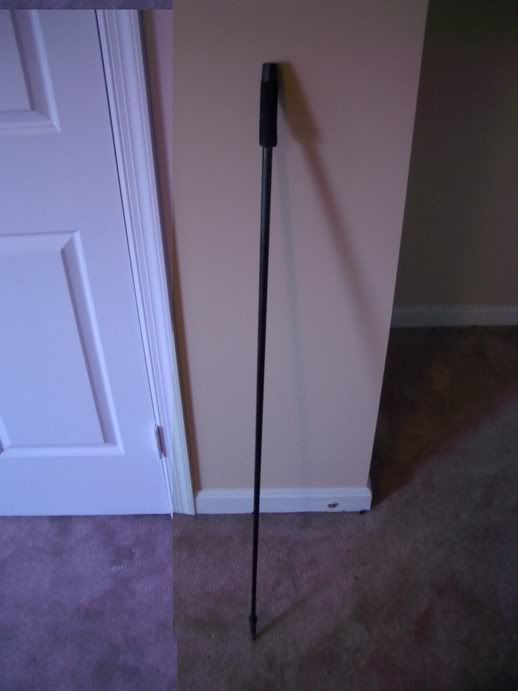
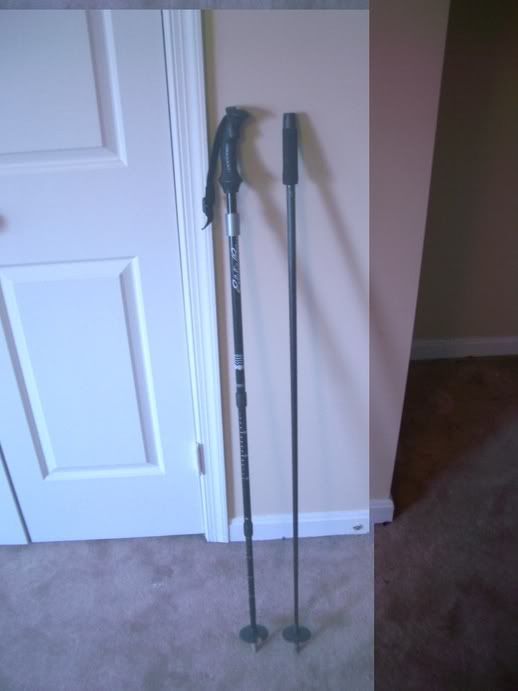
Here are the pictures of my 4.5oz 125cm home made graphite trekking pole with a cork grip

Image hosted by Photobucket.com

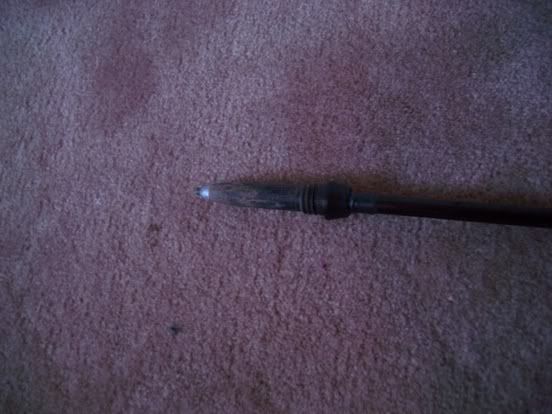
here is a close up of the tip

Image hosted by Photobucket.com

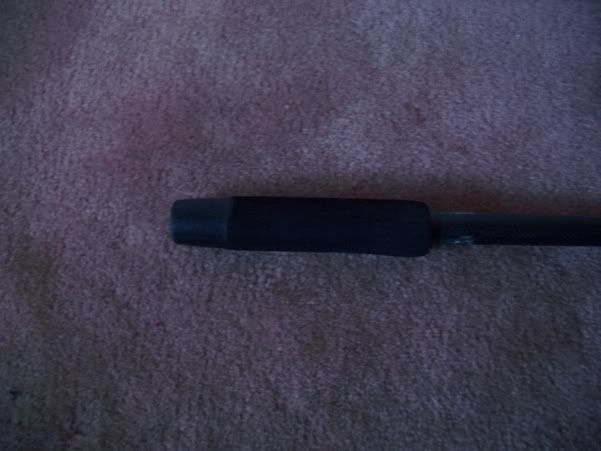
here is the grip close up (note: the graphite is only in about an inch of the cork in order to bring the pole to the 125cm length I wanted so the rest is kept straight and sturdy with a peice of a fishing pole for a frame that extends from the tip of the handle, to 7 inches down inside the shaft of the pole,.)

Image hosted by Photobucket.com

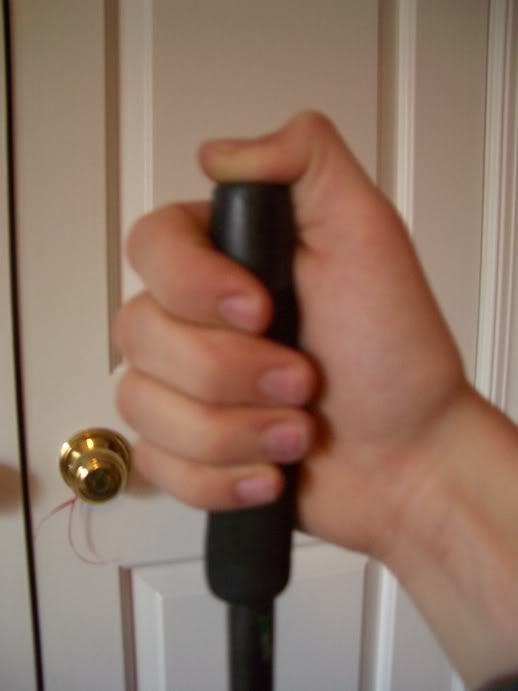
there is a good sized grip with a plastic cap on the end that will be good for setting up my tarp

Image hosted by Photobucket.com

Here it is compared to my surviving target pole extended to 125 cm

Image hosted by Photobucket.com

PostedJan 18, 2006 at 3:50 pm

Hey Bill Fornshell,

I seem to remember from some post that you have made your own trekking pole, would you mind posting a picture or two and give some info?

Thanks

PostedFeb 14, 2006 at 3:33 pm

I was cruising the internet recently and saw some really cheap carbon fiber tubes at a place called Goodwinds Kites. Does anyone have any thoughts on whether their .375″ OD pultruded tube would work as a trekking pole? Or do you think it would just be too wobbly? I might just buy a pair to check them out anyway, seeing as they’re only $7 a piece. I’d appreciate any thoughts you guys have on this. Thanks.

Bill Fornshell BPL Member
PostedFeb 14, 2006 at 4:46 pm
Benjamin Smith BPL Member
PostedFeb 15, 2006 at 11:57 am

Interesting – it looks like the largest diameter rods weight a hair more than 3 oz for a 48 inch length. Shorten it a bit for a pole, add handle and tip, and you’d come in heavier than the GG Lighttrek poles, at least. That would lead me to believe that the rods have more material than the lighttrek poles do (clever of me, huh?). I know with fiber there are more considerations than just mass, though. Anyone else know of any other factors that could influence strength/rigidity?

A $20 set of SUL carbon trekking poles is certainly a fun thing to think about…

Ben

math…

PostedFeb 17, 2006 at 8:52 am

That looks like a good material source! I’ll try to get a couple of shafts to test out and let everyone know how the material works out for trekking poles.

Looking at the numbers, these are going to be heavier than BMW Stix by about 10 g/m, and their straight shafts will likely flex more.

Here’s a hot link for the website selling the material (same url as above post).
Goodwinds Kites

I know fishing rod building suppliers will have EVA foam grips with an inside diameter to fit these shafts. Does anyone have a good grip supplier they would recommend?

Thanks,
Jay

Bill Fornshell BPL Member
PostedFeb 17, 2006 at 9:29 am

Daaaa, Good reading Jay. Yes, I did say I used EVA grips on my Home Made Trekking Poles. I guess I needed to say fishing rod grips and give the street address of the store I bought them at.

Glad you at least read the post about us out here making some of our own gear.

Waiting on your latest efforts.

Marion Watts BPL Member
PostedFeb 20, 2006 at 1:21 pm

I call Goodwinds kites and asked them about their carbon poles. They said they are very rigid, but are formed in a lineal pattern. It looks like the Lighttrek poles from Gossamer Gear are wrapped around the pole in a cross section manner. She stated, “they are very rigid, but if you beat them against a rock, they will break.” What are your thoughts on if they will be “up to snuff”?

Benjamin Smith BPL Member
PostedFeb 20, 2006 at 1:58 pm

Marion,

Great info! Thanks for doing the legwork for the rest of us. It sounds like these may not be ideal for our application, given the likelihood that trekking poles would get bashed on rocks…

Ben

PostedFeb 20, 2006 at 2:07 pm

Don’t know. Not sure what she meant by “beat them against a rock”. Not the usual method of employing trekking poles. I can understand that a pure linear lay up of CF would make the pole very stiff and also cause fiber breakage if the pole is flexed sufficiently. Wonder how many layers of CF are layed up?

Mark Hurd BPL Member
PostedFeb 20, 2006 at 4:09 pm

Don’t mean butt in here, but as a long time kite flier and sometime builder, I have purchased a fair amount of stuff from “kitebuilder.com” you may want to check out the following website.

http://www.kitebuilder.com/catalog/index.php/cPath/33_56?osCsid=827de0bbfdebb514c4a84d91b1aad5eb

They offer a wide variety of graphite “framework” parts and even ways to join poles. Ultralight graphite packframe anyone? I haven’t checked out specifics on trekking pole applicability, but thought I would add my two cents.
-Mark

Bill Fornshell BPL Member
PostedFeb 20, 2006 at 7:13 pm

Mark, You should check out my Ultra Light External Pack Frame thread, Carbon fiber Tubes – Been there done that.

Marion Watts BPL Member
PostedFeb 20, 2006 at 7:47 pm

Mark,

Thanks for the link to Kitebuilder, cool site. As a builder, do you have any experience with the wrapped fiber poles? I’m looking at the Excel series. They don’t give outer diameter, but the inner diameter I think was .245″, placing the O.D. somewhere around .300-.340″, I’m guessing. Any thoughts on rigidity and durability?

Mark Hurd BPL Member
PostedFeb 20, 2006 at 7:57 pm

Bill,
Like many folks on this forum I am certainly inspired by your inventiveness and tenacity in developing and re-engineering gear. I was aware of your efforts in fabricating an UL pack frame, but always wondered why you ended up with a titanium/graphite hybrid instead of an all graphite model. I would think it woud be lighter and stronger than the hybrid. I have been making my own large diameter graphite tubing for an UL camp stool (knees aren’t what they used to be) and see a lot of possiblities for crafting other light wt gear. Anyway, keep up the great work.

Mark Hurd BPL Member
PostedFeb 20, 2006 at 8:25 pm

Marion,
I have a couple of kites made with wrapped fiber poles. The spars are very stiff for their size, but I really have no experience using them for a trekking pole application. As I understand it the wrapped poles are just that. The carbon fiber is wrapped onto a form and resin applied and allowed to harden. This is a somewhat more expensive operation than the “pultruded” graphite tubes where carbon fibers fillers and resin are pulled though a die to form a tube. The wrapped tubes will have strength in multiple directions because the carbon fibers are wrapped in multiple directions, whereas the pultruded tubes have to get some of their strength from increased wall thickness because the fibers are oriented along the length of the tube. (Wow that was a long sentence.) Bottom line: wrapped graphite should be the strongest for the weight. Whether they are strong enough I don’t know. My guess is yes, but only a guess.
-Mark
P.S. Another source for graphite spars is “Into The Wind Kites”
http://www.intothewind.com/shop/Repair_and_Kitemaking/G-Force_Graphite

Viewing 25 posts - 1 through 25 (of 91 total)
Loading...