


Hmmmm. I envision MYOG Guyline Tensioners v1.01. Back to the drawing board.
Topic
Become a member to post in the forums.
Hmmmm. I envision MYOG Guyline Tensioners v1.01. Back to the drawing board.

I'm heading home in a minute. I'll take a picture and show you exactly how the JRB tensioners are setup.
Here are some pictures of my JRB tensioners. Turns out they're about 5" Joe! They stretch to around ten inches. The line has a simple knot and the tube is held in place by a cheap black zip tie. Never had problems, but i've only used them on a few trips.
Let the tutorial draft begin Denis :P


I ordered 6' of red theraband tubing on EBay, so I'll make some. Cost more to ship than the tubing cost though.
I'm a bit out of the loop here. I don't quite "get" tensioners. When I stake out a tent (say w/Spectra cord) I just pull to maximal tension and set the stakes. With a tensioner you couldn't pull to that maximal tension, and although I can see the tent keeping relatively static tension, it doesn't seem like the canopy would be as taut as if pitching "normally." Thoughts, feedback?
Brad,
No problem. Check this.
So what you do is attach the self-tensioner to any tie out point you'd like. Pull the tensioner as far as you can, essentially to the length of the excess guyline w/in the tubing. Now you have your "normal" tension if the rubber tube wasn't present.
Skip ahead to 2am when your shelter wants to sag under dew/rain. Now the slack of the shelter sagging is pulled in by the self-tensioner wanting to spring back to original size. Essentially it's tightening up the line as if you went out yourself and adjusted your taut-line hitch or whatever tensioning method you use.
Make sense?
– Dana
"Skip ahead to 2am when your shelter wants to sag under dew/rain. Now the slack of the shelter sagging is pulled in by the self-tensioner wanting to spring back to original size. Essentially it's tightening up the line as if you went out yourself and adjusted your taut-line hitch or whatever tensioning method you use."
And all the while you're snug in your shelter, "sawing logs".
Does anybody have any idea how long these things will last? I made some a couple of nights ago, but got to thinking…If they're always pulled to their max, will they eventually just be a long piece of silicone (or rubber)? Either way, I'm planning on using them till they fail.
Kyle,
I really wonder this myself too, except i'm concerned with a different cause of failure.
I was riggin' up my tarp with a new guyline configuration and while putting back on the self-tensioners I started thinking about how/when they'd break. Then i got to thinking about how long the tensioners could withstand storage before becoming dry/brittle.
IMHO they're going to dry out and crack before they fatigue from being strained constantly.
But hey, they're cheap and easy to make. The next ones i'll make myself and I figure, if they last a season, great. If they last 4-5 trips, i can handle that too.
What does everyone else think?
– Dana
I think the latex will have a different life span than the theraband I used. I don't know which will be longer, but theraband is meant to be stretched over and over and over for workouts.
edited for spelling
my JRB are theraband, so i'm in your boat.
I'm planning on using therabands too. These are similar to the exercise bands that came with my P90X. I've had those over 2 years, and through use and non-use, I have had no problems.
The first pair of these that I made used the tubing from an old slingshot I found lying in the weeds. It had been there for a while, as the tubing at the "pocket" fastening had rotted away. I trimmed off the rotted parts and subjected the rest to a good strong tug. There were no "dry" parts or cracking evident, so I went ahead and used the tubing. Two of the tensioners shown in the above photos are those original units. We'll see if they make it through the summer. If not I'll whip out a couple of replacements.
Regarding the use of bungee tensioners: They're only bungee. If they fail there's nothing left. If the surgical tubing of the Auto Tensioner fails, you still have the internal guyline. Just reset the stakes, and you're good.
A suggestion for how far to stretch a tensioner:
The tensioner has two purposes, to take up the sag that develops as rain, dew or insensible perspiration causes the fly, tent, tarp, or canopy to stretch and sag; and to absorb wind shock to reduce stress on the fly and its components including stakes. If you pull a tensioner as tightly as possible, it has no reserve left to absorb wind shock. If the tensioner must be stretched to its full extension to get the tarp/tent set up properly, you need a stiffer tensioner.
Actually, tensioners have a third, specialized use: to keep hammock flies properly tensioned when your weight on the hammock would otherwise cause the fly to sag.
JRB has been making these STL for three years now….all of the ones we personnaly use are doing fing with no apparent stretch set in… Only two reported failures to date…. one was the second knot pulled out of the theraband…. as noted above the line was still usable…. The second failure was in the vicinity of the artic circle when the theraband froze, then the stove pipe it was securing caused a nylon sting failure….
They will eaasily stay resilant through a 6 months thru hike…As mentioned above they are meant to stretch, relax and stretch again repetitively.
Again, remember that I'm biased but these are just facts I've observed or had reported to me.
Pan
And ordered some red Theraband tubing to make some tensioners. I thought the red would be good because I didn't think heavy-duty tension was needed. Bad thing is, I wasn't thinking about the inside diameter. It's so small on the red tubing that I can probably only fit about an inch of guyline up in it. Oops.
Just run a thin metal wire through it, then tape the guy line to the end of wire and pull it back through.
Red Thera-band eh? Well Joe, use it as it was designed… start exercising.
If the thera-band is too narrow try this:
Use a small section of plastic weed eater line or other thin item to serve as a "needle" to thread through the band, tape your guyline to the line and pull it back through.
I don't think threading is the issue, I was talking about needing bigger ID, so the slack in the line would have a place to go when it's relaxed. If that makes sense.
Well yeah! You've got to have somewhere for the excess cord to bunch up. On my tensioners, when relaxed, the cord twists in tight coils about a quarter inch apart. At that point the cord is pretty firm and won't compress much more.
I’ve used the latex/theraband tensioner for a long time and they work very well, But I have now switched to using tensioners made from shock cord.
The shock cord tensioners work just as well as the latex/Theraband but are much lighter. I think 4 guy lines (approx 8 feet each, using Speer’s No Tangle Guy Line) with shock tensioner come in just under an ounce.
I wrote of a tutorial over at HammockForums.net that shows 2 different methods to make the tensioners (tried posting instruction here with no luck):

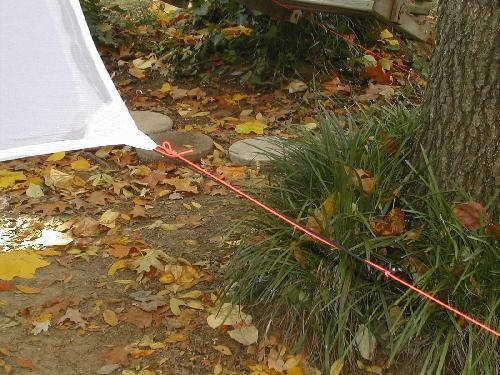
Do these have slack inside the tubing or something? It just appears to be tubing over coradage which wouldn't stretch. What am I missing here??
Michael,
When making the surgical tubing tensioners, you stretch the tubing over the guy line and fasten it in place, while stretched. When you release the ends of the tensioner's guy line loops, the tubing retracts, gathering up the guyline inside the tubing. I'll try to take a backlit photo to show what's happening inside the tubing.
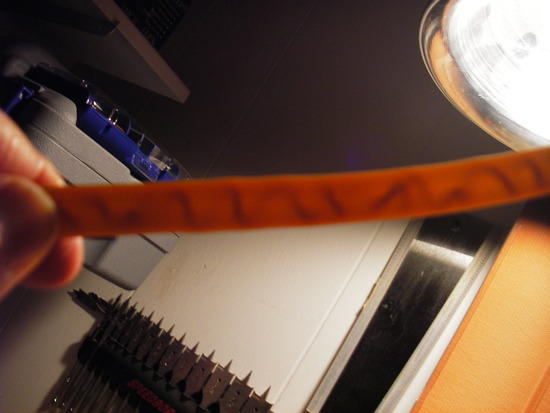
Sorry that this is a little blurry. The tensioner is relaxed and you can see the guyline curled up inside the tubing. When in use the tensioner is set, stretched to full length. As the silnylon material sags in the cool, damp conditions the tubing shrinks, pulling the silnylon tight.
I hope this description is enough for you to understand how the tensioner works.
Thanks Denis, I was hesitant to make a bonehead question but I'm glad I did, I am headed to the hardware store now! Is there any limitation on the thickness of the line used? I have MLH .8mm and it is extremly slippery, made of dacron. 5.99 on ebay though!!
Become a member to post in the forums.
 Creamy Dijon ChickenCook-in-the-bag chicken, tarragon, and rice backcountry meal with 2 servings. Net weight 5.7oz | 162g
 © Beartooth Media Group Inc.
 Loading...