Topic

Steripen Adventurer Charger Modification

  • This topic is empty.
Viewing 14 posts - 1 through 14 (of 14 total)
PostedMar 5, 2009 at 5:45 pm

Hello All,

This is a modify/make your own gear question. Has anyone successfully reduced the weight of the steripen adventurer solar charging case, or devised an alternative, lighter charging solution that can be made or purchased by someone who lacks specialized electronics training? I'll be in plenty of sun, and would love to use it to my advantage!

Thanks,
James

PostedMar 5, 2009 at 7:19 pm

I checked out the Steripen web site. One option you may wish to consider is getting the classic instead of the adventurer. It can use NIMH rechargable batteries. Silva makes a 4 oz. solar charger (see photo) that hangs off your backpack.

The classic weighs a little more, but by carefully choosing your other electronics such as your headlamp to use NIMH you use the charger to charge their batteries too.silva solar charger

Roger Caffin BPL Member
PostedMar 5, 2009 at 7:33 pm

Hi James

But of course!
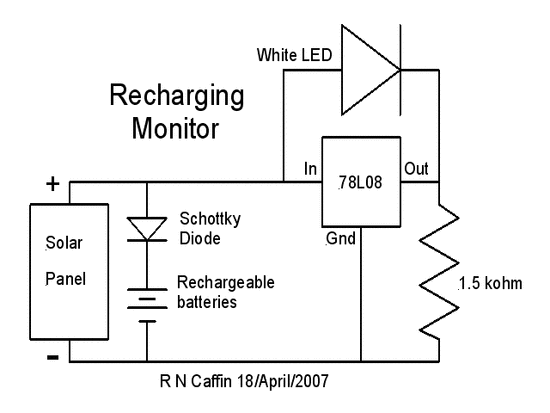
I used a solar panel from the Steripen solar charger, but other nominally 6 V panels should work. The circuit I used is thus:
Steripen recharger circuit
.
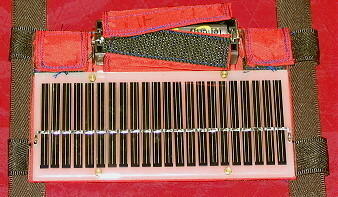
The engineering looks thus:
Steripen recharger engineering
.
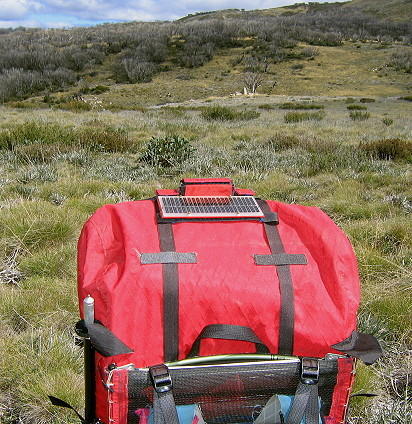
It mounts on my pack thus:Steripen recharger on pack

Cheers

PostedMar 5, 2009 at 7:41 pm

Herman,

The wall charger specs:

Input AC 100V-240V, 50-60Hz max. 0.2A
Output 9V, .35A

Batteries (runs on 2) that came w/ the steripen are Tenergy brand, 900mAH RCR123A (CR123) 3.0V rechargeable li-ion

The charger case has a 2"x5" solar panel on top, and the actual charger is inside the case. The case is quite overbuilt, with heavy plastic, foam padding to hold the steripen for storage, and a locking mechanism to hold the case shut (not connected to the charging process at all).

I'd like to get rid of as much of this as possible while keeping the charger and solar panel- the UL version, so to speak. The foam looks easy to dislodge, but I have no electronics knowledge and would hate to break my device.

James

PostedMar 5, 2009 at 7:45 pm

Roger,

Wow, super cool! How might someone who knows just enough about electricity not to pee on an electronic fence go about assembling or purchasing something like that? I am a grad student at a university- should I try to make some friends in the engineering department?

James

PostedMar 6, 2009 at 12:00 am

Herman,

Interesting idea. My only issue is that the classic, according to the website, is 1.8 oz. heavier than the adventurer, and the charger that comes with the adventurer is 1.7 oz. heavier than the silva charger, so I don't really save any weight, and I have to carry more weight on short trips when the charger would not be needed. I like the idea of adapting all batteries to the charger, but I'm not quite there yet!

Roger's setup appears to be much lighter, but also perhaps a bit more fragile (?), than the silva.

While we are on the topic, have you used the silva or other solar technologies on the trail? Would be interested to hear about your experiences.

Thanks,
James

Roger Caffin BPL Member
PostedMar 6, 2009 at 1:15 am

Hi James

Yes, descend on somewhere like the engineering or physics schools!

I had better explain how the circuit works: it is actually rather sophisticated and NOT obvious. Note that I am not sure what the nominal output of the solar cells is: I only THINK it is 6 V. It might be 8 V.

The solar panel generates a voltage which can go way over the 6 V on the two Tenergy cells. But while charging those cells through the Schottky diode the solar cell voltage is restricted to whatever the Tenergy cells 'want'. Note that the Schottky must be able to take 1 – 2 A. That bit is easy.

Now while this is happening the voltage from the solar cells is restricted to about 7 to 8 volts, and the rest of the circuit does nothing. In fact, you could use just the solar cell and the Schottky diode and skip the rest. Doing so would leave you not knowing what the state of charge was however.

Now for the really obscure bit. When the Tenergy cells are fully charged the safety circuit hidden inside each cell will turn off. No more charging current will enter the cells. This behaviour is unique to rechargable lithium cells.

Without the current load, the voltage on the solar cells will rise quite a bit. There will be enough voltage in fact to turn the 7808 voltage regulator on, and this will put 8 volts across the resistor. But the solar cell voltage will go even higher, up to about 11 volts (which is why the solar cell may actually be rated higher than 6 volts).

Now, with 11+ V on one side of the white LED and 8 volts on the other side, we have enough voltage to turn the white LED on. So when you see the white LED turned ON, you know the Tenergy cells are fully charged. Of course, if the sun goes away, so does everything else!

I used this charger during our 3 month walk in France in 2007. Tt was quite robust. The solar cell is mounted on some blank FRP circuit board. At the edge there is a battery holder to take two Tenergy cells. You can't buy anything suitable, so I made this by hacking an AA cell holder and stretching it. I bolted the battery holder down onto the FRP board with some 210 denier nylon sandwiched. The nylon has hook & loop fastening on it which closes oveer the top of the batteries, to make sure they don't fall out. The rest you can see. Ah – the LED and the 7808 are tucked in beside the battery holder.

Cheers

PostedMar 6, 2009 at 5:42 am

James, my experience to date has been the experimental phase. The charger hangs in a window on the Northwest side of my house where lighting is indirect most of the day, and the attenuation of the window glass also takes it's toll. It's an attempt to simulate non-ideal panel illumination on the trail. Despite the poor lighting, 4 AA batteries charge in about two and a half days. I haven't tried AAA's yet, but the instructions say they'll charge in about half that.

I would say if the Steripen is the only electrical appliance, the lithium charger is a good way to go. My load, however, is rich in electronics. I carry a GPS, PDA phone, blue-tooth keyboard, headlamp, camera and FM radio. All but the GPS see daily use. I couldn't find a suitable lightweight camera or a phone that takes NIMH's so I augmented my setup with a very small and light DC to DC converter that outputs 5 volts.You can see it in this thread:

http://www.backpackinglight.com/cgi-bin/backpackinglight/forums/thread_display.html?forum_thread_id=19234

The goal of this setup is to free me from multiple chargers, begging for outlets and waiting around town for appliances to charge up.

PostedMar 6, 2009 at 6:16 am

http://www.flexsolarcells.com/index_files/OEM_Components/Flex_Cells/pages/Flex_Cells_Individual_06_SP42_37.php
http://www.flexsolarcells.com/index_files/OEM_Components/Flex_Cells/pages/Flex_Cells_Individual_01_SP3_37.php

I got two of each.

Connected together should gives me 7.2V – 44mA at only 3GRAMS!

I hacked my mobile charger and connected it directly with the panels. I left it for a day on the window but it didnt seem to charge at all. :(

I am sure I connected the modules correctly. May be I didnt give it enough time?

PostedMar 6, 2009 at 6:52 am

Huzefa,

Thanks for the links. If I'd known about those panels before I bought the Silva, I'd probably have made my own and saved a few bucks.

Without more details it's hard to say what your problem is. Did you include a diode in your charging path. A diode is crucial to prevent the battery from discharging back through the panel. I can also tell you that some cell phone manufacturers build in detection and identification circuitry into their phones and chargers, and won't charge with other chargers.

If you upload a schematic of your setup, it might be possible to point out potential problems.

PostedMar 6, 2009 at 10:19 am

Roger,

I am extending friendly requests for assistance to this motley looking bunch:

http://jilawww.colorado.edu/

A few more questions: how much of the stock steripen charger did you use in this system? Are you still able to use the wall charger provided with the adventurer? Did you find steripen's figure of 35 liters between charges realistic? Finally, did you charge anytime there was sun, or wait to deplete the batteries and only charge when they were low?

Thanks again for your generous assistance. I will update here as things progress.

James

PostedMar 6, 2009 at 11:03 am

Huzefa –

Nice panels they have on that site. They say you shouldn’t mix different panels and should only put like panels together. I don’t really buy that that’s your problem, but I suppose it could be. There’s also this one:

http://www.flexsolarcells.com/index_files/OEM_Components/Flex_Cells/pages/Flex_Cells_Individual_15_RC72_75.php

which, though it’s twice the weight at 6g, it outputs 100mA, and therefore earns it if that’s useful. And it’s less prone to problems as a single piece. It also costs more that your combo though, and wouldn’t be foldable.

What you really need to do is bust out a multimeter to debug the thing.

Roger Caffin BPL Member
PostedMar 6, 2009 at 1:15 pm

Hi James

Yeah, well, someone there ought to be able to wield a soldering iron!

I have to admit I cheated over the solar panel. Because I wrote the BPL review of the Adventurer and had been discussing accessories with the VP of R&D there, they sent me a spare solar panel to see what I could come up with. So my original solar/mains charger is intact.

I did some battery testing for the BPL review of the Steripen and found that batteries are not all equal. (Understatement!) The cheap ones simply cannot support the load drawn by the Steripen; only the good non-rechargeables and the Tenergy 900 mAh cells are useful. The cheaper 600 mAh Tenergy rechargeables were a disaster (both for me and for Hydro-Photon!).

Tenergy claim a certain capacity for their cells which should give the 35 L capacity. My battery testing did not make that figure seem silly. However, I make it a policy to put the batteries into the charger on top of my pack at every convenient (ie sunny) opportunity after every use. So I do not have good life-time figures for you.

On this score you should note that running rechargeable lithium batteries to completely flat may result in them never recharging again. The internal safety circuitry may not be able to turn back on to allow recharging if the internal voltage is too low. So do NOT use the batteries to extinction!

Cheers

Viewing 14 posts - 1 through 14 (of 14 total)
Loading...