


Has anyone seen this:
http://www.spadout.com/r/backpacking-stove-test/
I thought the Vargo would have performed a lot better in windy conditions….
Topic
Become a member to post in the forums.
Has anyone seen this:
http://www.spadout.com/r/backpacking-stove-test/
I thought the Vargo would have performed a lot better in windy conditions….
I was not impressed at all.
> A 0.95-liter pot with a 13 cm diameter was used for test.
This is a very narrow pot. We know that being so narrow will influence the results. No mention is made of this. Ignorance?
> To guarantee that the pot started at the same initial temperature for each test,
> the pot was dunked in water (75 degrees) for 60 seconds between each test.
A silly idea showing considerable ignorance of physics. Start with a good supply of cold water instead. Anyhow, 60 seconds would not be nearly enough time, although it probably does not matter given the rest of the testing.
> Water was considered “boiling” when the digital thermometer read 190 degrees
> (which is a strong simmer). The thermometer was placed in the center of the pot,
> hovering in the water 1.5-cm above the base.
> 190 degrees was selected as the "boiling" temperature because it allowed us to easily
> monitor the temperature
Oh Great. Now we have a new definition of 'boiling'! Talk about misleading spin doctors and snake oil salesmen. If they wanted to use 190 F, that's OK, but don't call it what it is not!
> without having boiling water splashing all over the place (which was a problem when we
> initially tried to use 200+ degrees as a measure for the test).
Comes of using a microscopic pot, doesn't it?
> A lid was not used.
What competent walker ever does this? Without a lid the results are extremely susceptible to any wind too.
> Wind Tolerance
What competent walker ever uses his stove without a windshield?
Interesting (and gratifying) that other web sites are now trying to emulate the scientific testing done at BPL, but methinks they have a long way to go.
Also, I note that while they produced raw numbers, I don't think they had much understanding of what the numbers meant or what caused the differences.
Cheers
Edit: I guess I didn't read Rogers post carefully regarding the methodology of the test. I can't see how my Micron can be that much better than the other stoves on the post. Still like it though.
Funny, I bought a Primus Micron a few years ago and really love that stove. It's light, fast and easy to use. Last summer I melted the plastic on one by trying to use a wind screen. Even though it was all melted it still worked for the duration of a 2 week trip. Bought another when I got home.
If I use a canister that is my go to stove.
Thanks Roger – I was awaiting patiently for your reply.
Considering I had the Vargo on the way to me I was looking for someone to poke some holes in the review.

Hi Roger,
What is your opinion of the Primus Micron, if any?
Hi Tom and David
There is a mini-review of the Primus Micron 2.5 in Part 3 of the CO series, at
http://www.backpackinglight.com/cgi-bin/backpackinglight/stoves_tents_carbon_monoxide_pt_3.html
Basically, since I am able to pick and choose between stoves, I am not greatly enthused about the Primus Micron. The pot supports look a bit weak to me and the way the burner focuses the flame into a small area is not to my liking. The CO performance is not too good in comparison either.
At present, my favorite stoves are the Snow Peak GST-100 (and successors) and the Vargo Jet-Ti. The latter is near to being a clone of the GST-100 anyhow. There is a Kovea version of this general model too.
How does Snow peak get such good performance out of such a small stove? It's all in the hidden and patented inside parts of the burner head. Very cute, and the concept does work. Yes – I have experimented …
Cheers
Primus has releast a new stove that looks a bit like Snow Peak GST-100 and Vargo Jet-Ti.
http://www.primus.se/Templates/Pages/3_cols_white_middle.aspx?SectionId=5888
The specs. is not clear abuot the actual weight of the stove since it is sold together with a titanium pot.
The maximum output is set to 13500 BTU/h.
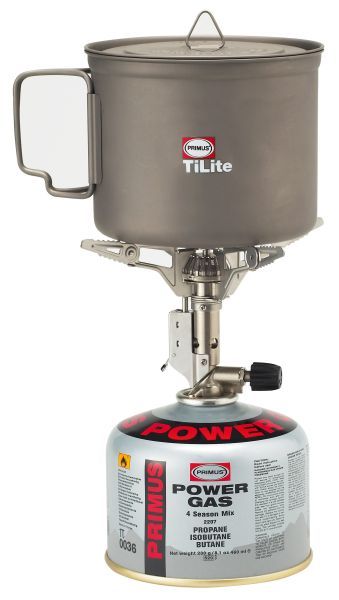
Roger – yet another stove to check CO performance and functionality on?
Otto, I've tested the TiLite for the UK magazine TGO. The stove weighs 100 grams, the 1 litre pot 127 grams with lid, 105 grams without. The two don't go well together as the pot is 115mm wide while the pot supports are 148mm across. In tests the stove used 9-10 grams of gas to boil 500ml of water with a Primus 2207 canister with the power turned down slightly (with it on full the flames lick up the sides of the pot). After a night in the tent porch at -2C the stove started first time (with an almost full canister). The 2207 canister fits inside the pot.
The original Primus Micron has been my favourite little gas stove for several years, mainly because it is the most fuel efficient. The Micron Ti is as fuel efficient but Roger is right about the legs – I've had one snap off and another one bend.
Thanks for the info Chris!
The stove looks interesting due to the similarity with Snowpeak and Vargo especially looking at the design of the burner head.
Does the flame spread wider than the Micron?
The pot support looks stable, perhaps it will work fine with larger pots for my family backpacking trips.
Hopefully it might get possible to purchase without the Ti pot which I don´t need.
Regards Otto
Otto, the flame does spread wider than the Micron. The burner head is small but the flames come out of the sides. The pot supports should support 2 or 3 litre size pots, though I haven't actually checked this.
Become a member to post in the forums.
 Vaer C4 Tactical Field SolarDurable timepiece for wilderness users - 20ATM (200m) water resistance, 120-click bezel, 316L SS casing, sapphire glass, solar-powered, Epson VS-42 Japanese movement, C3 Lume, USA assembly.
 © Beartooth Media Group Inc.
 Loading...