I have probably made my decision (at least subconsciously). The question is: will trekking poles be a better solution for me, and will they enhance/improve my efficiency/enjoyment?
Some background. I have used a single hiking staff for over 40 years. Sometime in the late ‘70s or early ‘80s I purchased a Tracks two section staff that weights 19 ounces. I have used this on every trip to include short day hikes until a couple of months ago.
The Tracks staff’s locking mechanism is getting worn and sometimes slips. Tracks has a very similar model called the “Sherlock” staff, that uses a “sure locking button” which looks like it will be much better than the twist locks that most poles use. I have not purchased this staff yet.
I did buy a REI 4 Winds staff a while back, because I can pack it in a suitcase. I travel a lot for business and decided that this would be a good pick, when I might take time off a business trip and go for a day hike. In addition, I wanted to see how I would like a much lighter staff. This weighs 8.8 ounces.
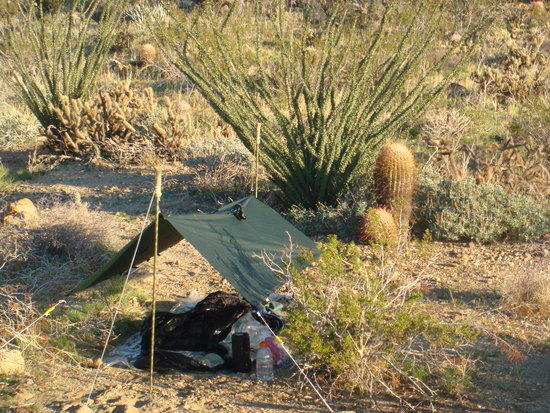
Over the past few decades I have lightened my equipment, and now have a base weight under 10 lbs. I do go ultralight most of the time… but not always. I figured that with a lightweight load, I would not need a staff. But I cannot hike without a staff. The staff just keeps my walking in a smooth rhythm, even on flat ground. Also the staff makes a great tent pole for my tarp or tarp tent, moves rattlesnakes off the path, and does provide support at times when needed. So at a minimum I will always use a single pole staff.
The staff does help me up and down slopes. Plus when tired, I can just lean on it for a couple of minutes rest, and then move on. I really appreciate the round wooden knob at the top. When leaning on it during a short rest, I can place one hand over it, lay the other hand on top of the first and lean on the pole. It is comfortable, and I don’t need to sit down to recover. On flats, I don’t use it to support any weight, but just hold it lightly in my hand and swing it in tempo with my pace and am so used to the hearing it tap the ground as I move along, it is hard to hike without it.
Most of the time, I carry the staff in my right hand. I do occasionally shift it to the left. On windy days, I keep my free hand in my pants pocket, and then shift hands when the exposed one gets cold. I really don’t like gloves when hiking, unless it is absolutely necessary. Otherwise, I just slightly swing the free arm as I hike.
The 19 oz weight of the staff has never felt heavy. With a single pole, if I need to use all fours, I just toss it ahead, or even drag it behind me with a piece of cord. No need to stop and attached it to the pack.
The REI 4 Winds staff “feels” flimsy. Actually it is not, but I am used to the heavier construction of the Tracks model. Lately on long trips, I have been taking the 4 Winds because it is lighter, but on day hikes I just like the feel of the Tracks.
I do carry a 2 oz carbon fiber pole in my back for the 2nd pole when pitching my poncho/tarp. I figure I could eliminate this weight in the pack, and with a pair of GG LightTrek poles would have two poles that are lighter than even the REI 4 Winds. Also, I think that two poles would provide more stabilization in situations like crossing a stream.
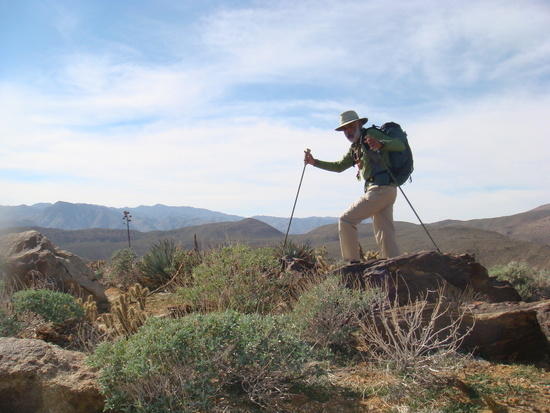
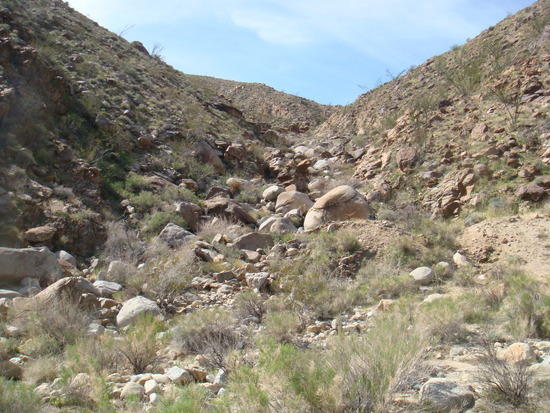
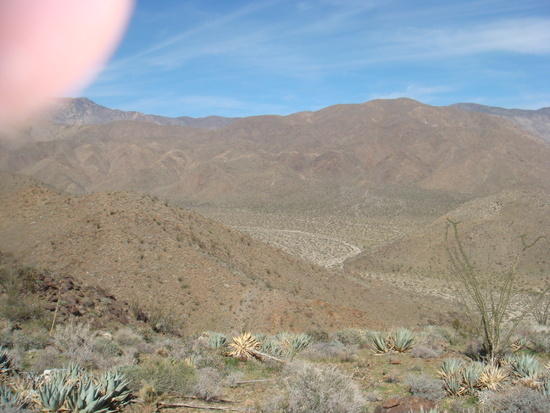
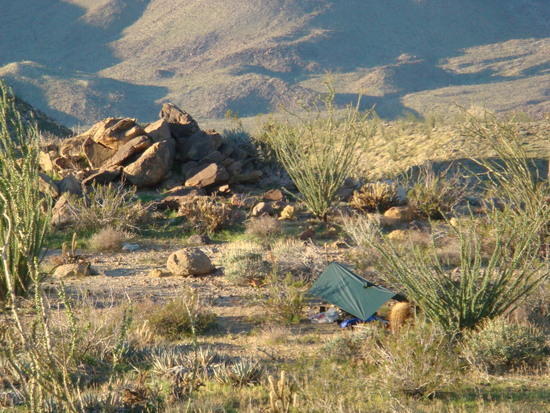
Last December I did a cross-country trip in the desert. The easy way would have been to take a two-mile trail at the beginning… but since I really work hard to avoid other people, I took a canyon a mile away from the trailhead and planned to work my way up over a ridge and then hike down to the wash I wanted to follow. There is a saddle in the ridge I planned on crossing. While working my way up to the saddle, I ran a serpentine route moving up to the ridge. I think that if I had two trekking poles, I would have been able to make a more direct route. I was moving across the slope as I neared the saddle (the terrain was not too loose), I slipped and fell. My high foot was planted and the downside foot went out from under me. I slide about 10 feet and looking at the contorted position of my left leg, thought I had caused a serious break. Fortunately it was just a soft tissue injury, and I was able to continue the rest of my trip (although somewhat painful – mostly when sleeping at night). During the day when hiking the pain was not as bad. However, I am sure with the injury, it would have been much easier to hike with two poles. I have tried hiking with the two staffs to simulate trekking poles, but given the different shapes, handles, and weights I can't get comfortable with these two poles at the same time.
Although I am almost 60, my knees and joints are in solid shape, so I do not need poles to help overcome any wear and tear on my body from the aging process.
So based on the above observations, here are my questions (especially for those who might have switched from a single pole to a pair).
1. When using two poles, are you now using them to propel yourself and reduce the effort of your legs? Obviously, the legs can do much more work than the arms and chest. However, reducing the work of the legs and transferring it the upper body might not be a bad thing. A little less fatigue in the legs, balanced with a little bit in the upper body might make things a little easier on the body overall. Is this correct?
2. Do you find having both hands always holding a pole, more of an inconvenience (or efficiency for other tasks), than a single pole?
3. Do you find two poles more stable than one for such activities as stream crossings?
4. Can you take routes that are more direct uphill with two poles, versus one? Does is sound feasible that my injury might have been mitigated by using two poles and taking a more direct route?
5. Any feedback on the GG LightTrek 4 poles. I really do not want to spend money on a cheaper pair, and then end up buying a more expensive set. And, of course, I don’t want to buy an expensive set and not like them either. But I figure that if trekking poles are not for me, it will be much easier to recoup most of my investment by selling the GG’s. Does this make sense?
Thanks, in advance.
– Nick