Topic

CCF vs Self Inflator vs Synth Mat

  • This topic is empty.
Viewing 20 posts - 1 through 20 (of 20 total)
John G BPL Member
PostedFeb 2, 2009 at 5:32 pm

I see many people prefer CCF pads over self-inflators for winter warmth, despite the higher "advertised" R values of the self inflators.

How do the "actual" warmth of these 3 pads compare at normal inflation values ?

1. CCF Ridge Rest (3/4", 15?oz trimmed to 66" length to match 2 below, R3.1)

2. Womens Prolite 4 (1.5", 24 oz, R4.1)

3. Big Agnes Insulated Air Core Petite (2.5", 22oz, R4.1)

Also, how comfortable is the 3/4" Ridge Rest compared to the Prolite 4 ? (ie: 75% as comfortable, etc)

Thanks.

PostedFeb 2, 2009 at 6:18 pm

John
The preference is due to one or more of the following :
Safety ( CCF is not going to let you down instantly, it takes time)
Weight
Masochism ( you have given up sleeping on sharp rocks but still want self pity)
Laziness (can't be bother with inflating the self-inflating)
Exhaustion ( hike till you drop brigade, cannot find the energy to think let alone blow at the
Exhibitionism ( with the mat inside my pack I sometime look like a day hiker)

Some will disagree with my list

I use the PO equivalent to the BA, not as warm as the Prolite 4 W but more comfortable ( 28.35%)
(I don't fully inflate either)
I have tried the Ridgerest. That goes under the masochist banner for me, but I am a grumpy old man.
Franco

PostedFeb 2, 2009 at 6:23 pm

comfort, you must be kidding….the Aircore is amazingly comfortable, the Ridgerest is not comfortable AT ALL. The Prolite is inbetween. You must supplement the Aircore with a CCF pad for insulation, though, but I am able to sleep in with no cramps, aches or pains with the BA pads.

Bob Bankhead BPL Member
PostedFeb 2, 2009 at 7:14 pm

Having used all three, I rank them for comfort (most to least) as BA Insulated Air Core, Thermorest inflatable, and Ridgerest.

Which I carry depends on where I'm going. Places with lots of sharp, pointy objects (like the desert areas of the PCT) means I carry my Ridgerest. Any inflatable will let you down if punctured. Depending on where, how badly – and if you can FIND the darn thing – repairs may or may not be possible. A full 20×72 is 14 oz but won't fit in the pad pocket of my pack; the 3/4 (48") length is 9 oz and does fit. I find I can sleep fairly comfortably on one after a couple of nights of acclimation.

The Thermorest inflatables but are a lot thinner than the Big Agnes, albeit more durable. For the big difference in weight and thickness, I'll take the BA any day.

I don't camp on snow any more so never have any need for an insulating pad atop the BA, although some recommend a Gossamer Gear 1/8 inch Thinlite pad for that. I've had the Ridgerest on snow before and never been cold.

For 3 season use, I'd bet they are all comperable for warmth. Comfort and convenience are far bigger issues.

YMMV.

Rick Dreher BPL Member
PostedFeb 2, 2009 at 8:11 pm

IMO the R rating on the BA pad as given is quite optimistic; it's perhaps half that. But as to comfort apart from warmth, the responders are spot on–inflatable, self-inflatable and cc-foam in that descending order, with cc foam trailing badly.

Camping on soft forest duff it's not a critical difference and cc foam is fine. In rockier places it becomes literally the difference between sleeping and not, and foam pads are just not up to the task. It also helps to be seventeen.

Brad Rogers BPL Member
PostedFeb 2, 2009 at 8:34 pm

If you want a warmer version of the Big Agnes style mat, look at the Exped Downmats. Super Comfortable and Super Warm. My Downmat 7 has a R value of 5.9. In warmer weather, I switch to a lighter Prolite 3 or Z-lite, but don't sleep as well on them.

PostedFeb 2, 2009 at 8:35 pm

The Ridgerest is 16.988% as comfortable as the Prolite 4. But most people won't be able to tell the difference if you tell them that it's only 25% as comfortable.

A person decently worn out and decently trail-acclimated will be able to get sleep on a Ridgerest while waking up every couple hours with a sore shoulder (if you're a side sleeper). A person who doesn't feel anything after he/she falls asleep will be able to get a full night's rest. I fall somewhere in between those two extremes most of the time. The pressure points get annoying, since I am a side sleeper, but I try to wear myself out during the day enough that I can either fall asleep on my back or sleep on my side desipte a little discomfort on my shoulder and hip.

As for the warmth, I have not compared those pads side by side. Keep in mind that with inflatables, the R-value is measured when the pads are fully inflated. Therefore, the weight of your body will decrease the local R-values around pressure points. Incidentally, a 2.5-3" thick pad like the Big Agnes has the most to lose from this feature, as people tend to deflate these pads the most to fully realize the squishiness and comfort. So–somebody mentioned earlier that the BA pads are the most optimistic–it would make sense that for the 2.5-3" inflatable pads, the reported R-value will represent a hypothetical pad perhaps 40-50% warmer than you can actually get comfortable using, due to the extreme firmness that would be required to achieve it. Self-inflators (generally 1-1.5" thick inflatables) deflate some, but I don't think they deflate to as extreme of a percentage of their maximum thickness as the 2.5-3" inflatables do. You'll get cold spots on your hips and shoulders on the coldest night, but that's about it. The closed-cell foam pads deflate a little with the pressure points on your body but, as anybody who has slept on one can tell you, they don't have as much give as an inflatable, so they could be counted on to remain closer to their reported R-values when you sleep on them.

PostedFeb 2, 2009 at 8:50 pm

Incidentally, a 2.5-3" thick pad like the Big Agnes has the most to lose from this feature

Not sure about that. The air in the 2.5 inch pads isn't very insulating, due to convection currents. That's why the insulation foam is put on the top-inside of the pad. So if you lose half of the thickness because you deflate it to make it more comfy I don't think you would actually lose a whole lot of insulation value. If the air was in tiny air pockets it would be a different matter, but these pads aren't like that.

PostedFeb 2, 2009 at 8:59 pm

Art
Good point about inflation and R values ( and I don't mean inflated R values, I did that yesterday on a different thread)
as people tend to deflate these pads the most to fully realize the squishiness and comfort.
yes and some so that they don't roll off their mat. (so I have been told)

Camping on soft forest duff
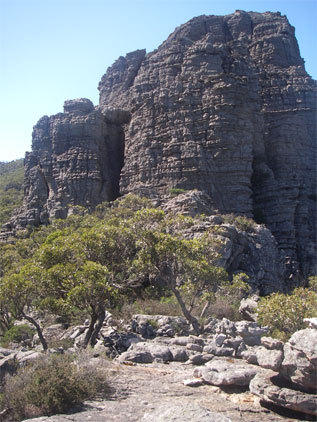
I keep reading about this "forest duff" I wonder what that is, maybe Roger knows of the Aussie equivalent for that.
We have sand that appears to be soft and sometimes warm, not so good at night.

Franco

Roger Caffin BPL Member
PostedFeb 2, 2009 at 11:39 pm

> I keep reading about this "forest duff" I wonder what that is,

Thick layer of dry pine needles in the pine forests, afaik.
Think of a thick fluffy dry layer of casuarina needles.

Cheers
PS: sand? No Way!

Jason Brinkman BPL Member
PostedFeb 3, 2009 at 12:35 am

"PS: sand? No Way!"

Hmmm… While sand is definitely not soft, I find that I can get very good night's sleep on it, even with a CCF pad! The trick is to "pre-contour" it beforehand. I will lay down, dish out the sand for pressure points at shoulders, hips, etc., then place my CCF over the top. Takes a little experimenting to get it right, but when I lay back down, the pad/sand combination are just the right shape.

Have done this quite a bit on rafting trips. But make sure you are on dry sand, and well above where the water level will rise to overnight!

The same trick works to some degree on duff or dirt, but be cautious to practice LNT methods. Rocky ground is the worst case IMO. That's where the air mats shine.

Roger Caffin BPL Member
PostedFeb 3, 2009 at 1:30 am

With a mat – sure.
I was talking about trying to sleep directly on sand. Been there … :-)

Cheers

Brad Groves BPL Member
PostedFeb 3, 2009 at 10:43 am

Quick soapbox: I have a Therm-A-Rest from the 80's, switched out the brass valve for a plastic one–the pad's never been punctured. My next-oldest self-inflater is from the 90's, I've never gotten a hole in it. I changed to a Downmat last year, surprise, no holes. If you exercise a reasonable degree of care with your pad, you won't get a hole. I keep them stashed in my pack; they stay there until the tent's up, go in for the night, and get rolled up in the tent in the morning. Don't use something that can get punctured as a camp chair when sharp pointy objects are around or you're near a campfire… YMMhaveV…

RidgeRest=Not comfortable. But like Franco, I am a grumpy old man. I do love my downmat, and I never need to bring a second pad for extra insulation.

Bob Bankhead BPL Member
PostedFeb 3, 2009 at 11:39 am

Alas, the Women's Prolite 4 is no longer available – per Cascade Designs website. It has apparently been replaced by the Prolite +, due out in March.

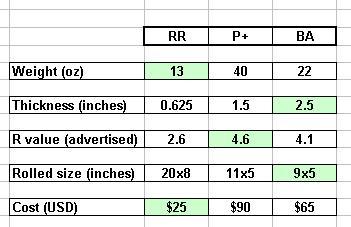
I made a comparison matrix for the RidgeRest (RR), Prolite + (P+), and the Big Agnes Insulated Air Core (BA) using a uniform size of 20 x 66 inches. Note that like the P+, BA will also be available in a 66" length in March. The weight of the 72" RR was adjusted down proportionally to 66". Numbers are rounded.
matrix

Green indicates "BEST OF CLASS". IMO, there are no surprises here.

RidgeRest has the lowest weight and cost
Big Agnes has the greatest thickness and smallest rolled size
Prolite Plus has the greatest R value

Again, it is where and how you intend to use it that matters. Choose accordingly.

PostedFeb 3, 2009 at 2:52 pm

Franco,
I don't know about Australia, but in the midwestern United States, there are expansive temperate deciduous forests (comprised of things like oak, maple, hickory, birch, beech, walnut, sumac, etc), on the floors of which rest the leaves from the past several autumns, in various states of decay. It's the "in various states of decay" part which leads to the ground being somewhat squishy due to the layer of leaves. It's not really as squishy as a CCF sleeping pad, imo… but as far as forest floor goes, it's a bit more comfortable to sleep on than the rocky hardpan of a more arid region. In many pine forests, you will see fallen layers of pine needles that function in a similar fashion (thus you can have duff in many different forest types). Pine needles tend to be softer, but the natural layer of needles in a pine forest tends to be a little thinner than the layer of broadleaf leaves in a deciduous forest, so sometimes you need to take a few minutes to rake the needles on the nearby ground into a suitable pile to sleep on.

Not really my cup of tea, sleeping on piles of leaves or pine needles, but in some forest types, it's more viable than others.

Brad Groves BPL Member
PostedFeb 3, 2009 at 3:36 pm

Bob, thanks for doing that chart! Always helpful to see direct comparisons like that. There is one typo; the Prolite+ weight is 24 ounces, not 40… not quite as dramatic weight difference!

PostedFeb 3, 2009 at 6:00 pm

Art
It was meant to be a silly comment. I grew up in Northern Italy and slept on mattresses made with leaves (from chestnut trees) common at the time inside shepard's huts high in the mountains.
The problem is that where I hike here I end up on hard soil or sand, occasionally grass .
What came to mind was the often read comment in a particular forum of "why have a mat when you can sleep on leaves" …
Franco
Duff, what duff
duff duff
Duff ? are you talking to me ?

BTW downunder duff/duffer means idiot or "simple" but I have seen the American version long enough to recognize it. If I ever use cookies or pavement, please have me put down. Not in the sense of…, never mind.

PostedFeb 4, 2009 at 9:13 am

Hey John,
I have the BA insulated air core 21 oz short and find it warm to about 25 deg.If I add my thermarest ridgerest short 8.0z on top, Its warm much colder say 10 deg or less. I also have a self inflater made by thermarest 2.5 lbs at a 6.7 r rating. They dont make it any more.But its very easy to set up and is very warm. My winter choice for short hikes.
"My thinking" about self or forced inflaters is that the mfg may get the R rating with the pads full height 2.5 inches say. But when you lay on them, the distance to the ground is shorter, thus cooler.
My BA is very comfortable and warm enough for most 3 season outings. Although I do agree with others that if you are worn out you'll sleep on rocks.
Have a great day……

PostedFeb 4, 2009 at 2:34 pm

Just making sure. I've lived in the southwest part of the States, which is largely desert, and I can see how someone living in a place like that could go their entire lives without ever seeing "forest duff."

Viewing 20 posts - 1 through 20 (of 20 total)
Loading...