Topic

What features in a compass?

  • This topic is empty.
Viewing 13 posts - 1 through 13 (of 13 total)
Tim F BPL Member
PostedJan 31, 2009 at 11:12 pm

Looking at (mirrored) baseplate style compasses for the first time recently, I started wondering what hikers considered important from the plethora of features available in a compass. How much importance (and just as importantly, why) do you place in the following features:

* Screw or locking declination setting- some require a "key" to adjust
* Sighting hole at base of mirror
* "Sapphire jeweled bearing"- what?
* Scale markings on baseplate- or inch/mm markings
* Clear baseplate- as opposed to some that I've seen which are black
* Length of baseplate
* size of the capsule and needle- is bigger better?

I am experienced with a lensatic compass and protractor, but this will be my first foray into using a compass that performs both functions. I don't really need the accuracy of a lensatic, but I want it to be as close as possible given the form factor. Any information will be greatly appreciated. Once I figure out what features I want, I will ask for specific recommendations if you have them.

Thanks,
Tim

PostedFeb 1, 2009 at 6:44 am

Tim, I'm a bit of a land navigation nut, I can tell you what I look for pertaining to some of the features you discussed.
– I wouldn't worry about a locking declination setting unless you are very clumsy.
– A sighting hole is important to shoot accurate azimuths, useful if you want to walk a very accurate course or accurately use resection/intersection to determine coordinates on a map.
– I don't know what that is but it sounds good.
– Scale markings are handy, you can orient yourself on the map with the compass and measure your distances without using two different tools (like a protractor/grid measure). Although you will still need a protractor to accurately plot azimuths on a map. I recommend tying a very thin piece of string to the center of a protractor to do this. Maybe I'm crazy, but I don't really see how you could use a compass as a protractor effectively. I use a flat plastic square protractor, and it weighs next to nothing for the degree of accuracy it provides.
– I don't see how a clear plate would make that much of a difference.
– With a longer baseplate, the edge of the compass would be more useful to mark azimuth lines on the map or as a distance measuring ruler.
– If the capsule and needle are longer, the circumference of the outside will also be, meaning there will be more space between degree markers, making the compass more accurate from a usefullness perspective.

Phil

Michael Martin BPL Member
PostedFeb 1, 2009 at 9:23 am

* Screw or locking declination setting- some require a "key" to adjust

The problem with some keyless dec adjustments is that they can slip when you don't want them to. OTOH, the key is is a PITA…

* Sighting hole at base of mirror

Handy but not critical. The mirror itself is a great dual-use item for applying sunscreen, removing foreign objects from your eye, etc.

* "Sapphire jeweled bearing"- what?

That's a low friction precision bearing. Good, you don't want "sticktion" in the bearing.

* Scale markings on baseplate- or inch/mm markings

Ho hum.

* Clear baseplate- as opposed to some that I've seen which are black

Clear is very nice when working with a map to draw bearing lines.

* Length of baseplate

If you are triangulating bearings on a map, the baseplate length is critical…or you can carry along a ruler to extrapolate your lines.

* size of the capsule and needle- is bigger better?

Bigger = greater precision, but heavier.

Another feature I like is a clinometer to figure vertical angles. I've used it to calculate distances from known elevations and figure slope angles in avalanche terrain.

My two favorite compasses:

Suunto MC-2G Navigator: the global needle is such nice engineering.

Brunton 54LU: This lacks a mirror and declination adjustment, but the sighting prism is awesome. I keep hoping that Brunton will come out with an adj dec version — that would be close to perfection. :)

Cheers,

-Mike

Dale Wambaugh BPL Member
PostedFeb 1, 2009 at 10:43 am

I like a clear base and a sighting mirror. As others said, the MC-2 is a great compass. The Brunton 8099 is another top compass. Look at the Silva Ranger CL too.

Adjustable declination is a nice feature. The main thing is that you are aware that declination exists :) Your compass. should have a declination scale at the very least.

Back it up with a small keychain/zipper pull model in case yours goes over the edge, gets stepped on, or just plain lost.

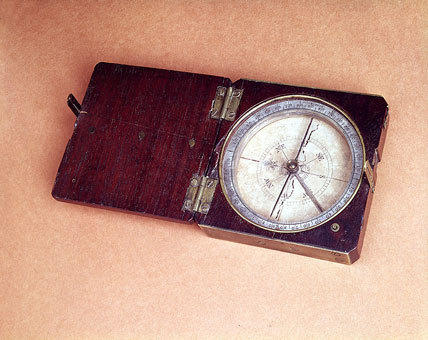
On a tangent, Lewis and Clark took four compasses for a party of 38 and paid $2.50 each for three. Lewis paid $5 for the one below in 1803 — that is about $98 in 2009 dollars. It's a pretty simple compass for an expedition that was just this side of going to the moon.

Merriweather Lewis' compass

Tim F BPL Member
PostedFeb 1, 2009 at 8:49 pm

I keep coming back to the Suunto MC-2G. Looks like a good set of features.

Another one that really piqued my interest is the K&R Dakar. I like the lensatic part. Only problem is that I would need a protractor too (no 'meridian' lines on the bottom of the capsule). Defeats the purpose of having a baseplate compass.

I read somewhere that the Brunton 54 didn't sight so well if the terrain you were taking a bearing on wasn't fair flat. Anyone experience this?

There was a review on REI for the Silva Ranger that said that the newer ones sold in the US are not the same as the old one. He stated the old one was made by a company called Nexus for Silva, and they still make it, but it is marketed under Brunton 15TDCL in the US (IIRC). The new Rangers are made in the far east and have some quality problems. Anyone know if this is true?

Thanks for all your responses so far. It took me a while to reply because I spent most of the day cooking, watching football, imbibing copius amounts of alcohol, and trying to find out what else Jonathan has that I can't live without!

-Tim

PostedFeb 1, 2009 at 9:25 pm

I own an MC-2G that was issued to me in the military. It is an amazing compass and has every feature you could possibly need. Of all the compasses I have used it is the easiest with which to shoot an accurate azimuth (not a "bearing"). The universal needle is also handy if you ever need to use your compass while traveling.

James, good luck finding a compass that will tell you which way is north. A compass will indicate your direction relative to the magnetic poles of the earth. From there it is up to you.

Phil

Dale Wambaugh BPL Member
PostedFeb 1, 2009 at 9:32 pm

The Suunto is an excellent instrument. I got one last summer at a flea market and it has all the bells and whistles needed for map and compass navigation. I wouldn't get too hung up on the global needle unless you plan on going to the southern hemisphere.

Tim F BPL Member
PostedFeb 1, 2009 at 9:43 pm

Phil-

You had one issued to you? Would you have an NSN for it? Maybe my supply sgt could get it for me. With all the choices, and not really knowing what features I want, I thought about just using my Army-issue lensatic and protractor. But I am intrigued by being able to use one compass for everything. Besides, that thing weighs a ton. I do want something with comparable accuracy though. And I used 'bearing' because I thought more people would understand that.

PostedFeb 1, 2009 at 10:08 pm

James, good luck finding a compass that will tell you which way is north. A compass will indicate your direction relative to the magnetic poles of the earth. From there it is up to you.

Well if I were being pedantic I would say that I want a compass to show me the local orientation of the earth's geomagnetic field, which may or may not indicate the true direction to the magnetic pole. ッ

That wouldn't have conveyed the same meaning however.

PostedFeb 1, 2009 at 10:08 pm

Tim,
The compass was a unit purchased item that we specifically requested. To my knowledge there is no NSN for it. I didn't realize you are military, but I have to ask, are you needing this for personal recreation use or for military use? For any military application, I cannot think of a situation where you would not need to have the ability to plot a grid with a corner measure (If you need that then you would have a protractor already). No matter how good you are at compass nav, you will still need to be able to relate your position to other elements rather quickly in grid format.

Thanks for the clarification James, I just wanted to make sure before I sent you in the direction of buying a gyrocompass ;-) Not sure how UL friendly those things get…

Tim F BPL Member
PostedFeb 2, 2009 at 5:20 am

I don't need any grid coordinates, thankfully. This is purely for my own recreational use, but I do sometimes take an item that was issued to me to test it out or fill a need in the field (while hiking). I was just surprised when you said that because I thought you meant they were in the supply system.

I am used to military maps as well, so it looks like it's going to take some getting used to the USGS type.

Viewing 13 posts - 1 through 13 (of 13 total)
Loading...