Topic

Solar power – anyone?

  • This topic is empty.
Viewing 25 posts - 1 through 25 (of 31 total)
PostedJan 23, 2009 at 6:01 am

I am about to embark on launching a range of solar powered products to reduce the carbon footprint, get something for nothing etc etc. I like hiking, i like my camera, my ipod, my gps, my cellphone, my flashlight, my headlamp but they all need batteries that end up dieing. Especially ipod and anything used for camplighting.

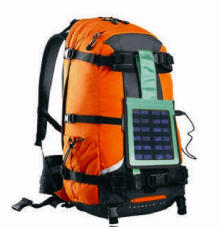
A solar panel strapped to a backpack

So I wanted to ask your opinions – if you had a solar panel that strapped to the outside of your pack (easily), could either directly charge many of these devices OR charge a small (10 cigarettes)battery pack, to enable you to always be ready, would you be interested? They are a variety of sizes, with a variety of outputs.

The smallest would be available, say here on BPL, at an approximate price of $30-$40 dependent on offers, membership etc.

Is it something I should pursue? I would welcome your thoughts, one and all!

Dana S BPL Member
PostedJan 23, 2009 at 6:14 am

I like the idea and have thought extensively about it for a while.

I'm really interested in the products they have over at solarstyle.com and have been considering purchasing the larger compact. It's only $25 and has an array of connectors available.

Of course, the downside to all of this is the weight penalty. The larger charger on their site is 131g which is pretty significant.

Bottom line, for me at least, is that i would like to see more products of this type and weigh (pun intended) the options.

So YES! i'd be interested! :)

John S. BPL Member
PostedJan 23, 2009 at 6:29 am

There is no always ready with solar. Like say when your solar panel isn't facing the sun or on cloudy/rainy days.

You should know what the market already offers and be prepared to offer something different? Otherwise it would seem difficult to compete.

Also, most hikers can get by easily for two weeks with a couple extra batteries. Your product is only marketable to the even smaller percentage doing long trips.

Just a few concerns I thought I'd bring up for discussion.

Dana S BPL Member
PostedJan 23, 2009 at 6:58 am

Yes, my intentions are to use solar charging for my thru hike of the AT 2010/11.

I too carry sufficient battery backup for up to 10 day trips.

PostedJan 23, 2009 at 6:59 am

I agree there are many items on the market but I feel that this unit has merits over and above a fold out unit as it is always watching 'some' sunlight during your day…not stuck in a backpack awaiting its use.

The other intersting thing is the true function of these units – some are jsut horrible!

It's not a lightweight solution compared to two batteries. But for an ipod user that cant carry batteries, or to recharge your phone or other device that doesn't take standard batteries, a trickle charge device seemed sensible.

Again, i welcome ALL the comments and love to hear more!

PostedJan 23, 2009 at 7:07 am

If your question is "is there a need for a light, relatively durable, effective, and inexpensive solar charger?" The answer is a resounding yes!

Aside from those factors, here's specifically what I would look for in a solar charger:
1. good electronics so it doesn't fry my expensive camera!
2. Either waterproof or sturdy enough so it doesn't shatter when I put it in my pack during bad weather
3. I'll underscore it because of the forum you're on – very light. The calculus that it can expect to face is how much battery weight it displaces. Now, that's not in ideal conditions, but in expected conditions.
4. A super-universal way of attaching it to a pack (maybe just a tie-on point at each corner), so that it can fit the myriad pack designs and be move up or down on the pack depending upon the angle of the sun.

Good luck!

Steven Evans BPL Member
PostedJan 23, 2009 at 7:31 am

"Again, i welcome ALL the comments and love to hear more!"

John, no doubt some work went into this product. But for me, personally, I wouldn't carry one because of the weight penalty. It would have to weigh less then a spare set of batteries for my camera, and even then I would only consider it on long hikes (like Dana's AT Thru-hike)

I would however be interested if say the solar panel was on the brim of a baseball cap, or perhaps wrapped around hiking poles, lenses of my sunglaases :) – "hidden" in weight that I already carry and therefore an additional feature at no weight penalty. If this is possible, I have no idea, but that's how you would win me over.

Dana S BPL Member
PostedJan 23, 2009 at 7:47 am

"wrapped around hiking poles"

I really like that idea, though could be potentially heavy. I'm a structural engineer, not an electrical so i have no idea how you would harness that power. I guess the handles would be a good place for the circuitry and the poles a good place for the receivers.

Just rambling…

Steven Evans BPL Member
PostedJan 23, 2009 at 8:18 am

…I envision the handles of the "polars" (pole + solar) opening up to reveal AA or AAA battery slots – UL of course.

Mr Davis, look what you have started now! ;)

EndoftheTrail BPL Member
PostedJan 23, 2009 at 9:47 am

I think the concept is potentially good for long hikes — perhaps better suited for PCT than AT (which has more tree covers and also more stores along the way for replenishing batteries and everything else).

Looking at the photo, hanging the panel down is going to be suboptimal. The panel should be installed on the top and at not too steep an angle — to catch the rays. As such, it should also have a protective film (if not already).

Rick Dreher BPL Member
PostedJan 23, 2009 at 9:52 am

I'm all for some sort of breakthrough here, but am skeptical that on-the-go solar collection can be effective AND light AND small.

To state the obvious, one first has to be hiking in the direct sun, generally meaning desert, beach, meadow and alpine territory in a mostly cloudless climate. Then, the panel(s) must be reasonably aligned to catch the sun straight on, or at least at a somewhat direct angle to achieve enough current. Examples that come to mind: solar might work heading northbound on the southern PCT, probably not so hot on the northern PCT or the AT.

Static solar collection (in camp or on breaks) would seem to be a lot less of a technical hurdle, but of course long distance hikers tend to be hiking from mid morning to mid afternoon, at a minumum. Basecamp-and-daytrip adventures in sunny climes could be ideal for effective solar.

If all I need to do is top off a flashlight battery or two daily, a simple and small pack-mounted collector might do the trick. But if I'm trying to maintain batteries for a host of electronics gear, I wonder whether solar technology is mature enough for the task, at least from the standpoint of being weight-effective versus carrying spares? Clearly, the longer the trip, the greater the attraction of recharging in the field.

Does anybody know whether kinetic chargers have made any progress? I have hopes for that technology being a great match for long-distance hiking, and seem to recall DARPA was working on it.

PostedJan 23, 2009 at 10:43 am

There was a movie out about 5 years back about a couple that followed the caribou mating using something similar to charge their camcorder batteries. Can't remember the name though.

PostedJan 23, 2009 at 11:20 am

How about a few flexible solar panels configured to fit over the tip of an umbrella, extending at least part way down the umbrella's panels, with wiring running from the solar panels down the inside of the umbrella's shaft to charge AA/AAA batteries "loaded into" the shaft?

JRS

PostedJan 23, 2009 at 11:59 am

…are available, try the google on one of the internets.

Down side … weight. 6 – 8 oz, 4 hours of good sun to charge 2 AA.

They only work IN the sun. OK hiking north, not so good going east in the morning.

Roger Caffin BPL Member
PostedJan 23, 2009 at 12:19 pm

It’s possible, but really only suited to long trips. Spare batteries are much lighter for short trips imho. There are a couple of massively overweight commercial units on the market for recharging mobile phones or iPods or whatever – massively overweight.

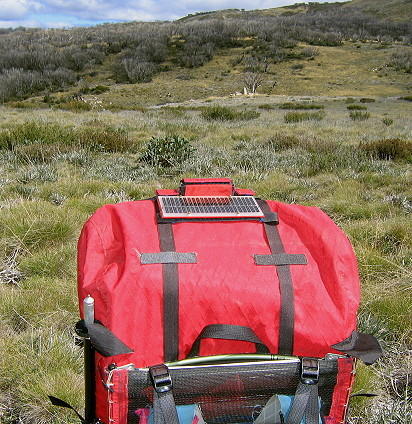
I too my Steripen Adventurer with me through
France for 3 months
and used a solar panel to keep the rechargeable batteries always fully charged.
Solar Recharger

This worked fine, but it was a custom unit I had made up to handle the specific batteries. It rode on top of my pack as you can see (to get the sun), and took an hour or two to recharge the batteries after each Steripen use. Granted, the Steripen Adventurer is kinda hungry.

Cheers

Roger Caffin BPL Member
PostedJan 23, 2009 at 12:25 pm

> wrapped around hiking poles, lenses of my sunglaases
Wrapped around poles would not be facing the sun. Ineffectual, and too small.
Small enough to be on sunglasses – too small to be of much use, and not facing the sun.
These things MUST face the sun to get enough incident energy to be of any use. See all the pics of solar panel arrays.

> "hidden" in weight that I already carry and therefore an additional feature at no weight penalty.
Ain't no such thing. Always adds weight.

Cheers

Jeff Jeff BPL Member
PostedJan 23, 2009 at 3:06 pm

I just built one from plans on the internet for a grand total of $40. I don't think it weighs over an ounce.
Worked great in the sierra with all the sun and during long lunch siestas, but I just never used it that much.

PostedJan 23, 2009 at 3:08 pm

Solarfilm 4 AA charger:
http://tinyurl.com/c682xs

4.3OZ, weather proof, has built in battrey holder and charging electronics, $60 or so.
With good sun, 2 batteries fully charged in 4 hr.
They make one with USB plug too.

PostedJan 23, 2009 at 3:34 pm

I have experimented with solar power while backpacking extensively. I own 3 chargers including a lightweight homebrew model. It works well if:

1) The sky is sunny AND…

2) There is an absence of tree cover/deep canyons or anything else that blocks the sun AND…

3) The panel is properly oriented toward the sun.

In my experience on the JMT, HST and TRT these 3 conditions did not exist often enough to justify the weight and bulk of the charger. I came to the conclusion that simply carrying extra cells was lighter and simpler and cheaper. Of course that was just my personal experience and YMMV under different conditions.

One specific example: I was on the TRT (Tahoe Rim Trail) for a week at the time of the Summer Solstice. My goal was to charge 2 NiMh 800mA AAA cells at a rate equal to the power consumption of my Garmin Foretrex 101, switched on for 6-8 hours per day. I used a homemade solar array with an output of 100mA and 3.6 volts. Physically my panel was about 18 square inches (3"x6") and the weight was 1.1 ounces. I carried two sets of AAA's, one in the charger and one in the GPS.

In addition, I carried a Solio 3 leafed charger. I planned to use that to recharge my Ipod 30gig classic which I used for about 3 hrs of music and maybe an hour of video every day.

I had both chargers on my pack all day long and I set them up in camp to catch more sun in the evening. When I went to bed I oriented the panels to the east to catch the next day's rising sun. This was during the longest days of the year. My charger also had a diode to prevent the loss of current back to the panel at night.

In my case neither charger came close to keeping up with demand. After an entire (solstice) day of exposure my 2xAAA charger was only able to move the cells up one bar on the GPS's state of charge display. The Solio fared no better with my Ipod.

The problem was, even with a sunny sky I had to fight a constant battle to keep the panels properly oriented. The top of my pack had barely enough surface area for the two chargers. My head and hat constantly shaded them. Some days were cloudy. Some days were spent mostly under tree cover. They worked well if I placed them on the front of my pack (as in the pic above) AND the sun was at my back AND I wasn't under tree cover but that was rare.

Keep in mind that the rated output from any solar charger is a maximum under ideal conditions. In the real world it will be less and sometimes much less. Those recharge times claimed by the manufacturers are under perfect conditions. And when you check the weight of a charger factor in a set of cells as well.

I haven't given up on solar power for backpacking but it does have severe limitations. If it's ever going to work for me on another thruhike I'll have to lower my consumption, increase my output and generally lower my expectations. If one were to base camp in a sunny spot without excessive power demands it would be ideal. On a long trip without the possibility of resupply it would also be ideal. I'm considering the idea of doubling the output of my AAA charger to 200mA but that will require 36 square inches and that's a lot of real estate on my pack. Even at 18 square inches it compromised easy access to part of my pack.

If you have the ability to keep a fairly large panel in the sun for most of the day and your power needs are not too high, solar power may be for you. Hopefully thin cell solar panels will become much more efficient in the future.

PostedJan 24, 2009 at 7:04 am

The Solarfilm one I referenced above is rated at 3.6V, 400mA. The Solar panels are about 14" x 5.5". It is made with what looks like heavy pack cloth for the cover and could be reworked to lighten it. They also make a 600mA model:
http://tinyurl.com/c4tayx

Miner BPL Member
PostedJan 24, 2009 at 7:54 pm

I'm an electrical engineer, so I like the idea of generating power on the go. However, for backpacking, everytime I've done a budget of my power needs verses the weight, solar has always lost. Carrying spare batteries (if needed) and recharging/swapping them out in the next resupply has always been the lighter solution. Then there is the issue of charging proprietary camera batteries that don't use USB charging which means more weight with custom adaptors.

Just as I buy lighter weight specialized gear for my backpacking trips, I tend to buy my backcountry electronics with weight and power usage in mind rather then trying to make heavy and power hungry devices work in an environment they are a poor choice for. For instance, my 16GB MP3 player goes almost 50hours on a single charge which is good for almost about 2 weeks of backcountry usage by my needs. I bought my cell phone based on its battery life as well as its weight.

So for me to buy a solar solution for the backcountry, it needs to be lighter then existing solutions such as Solio. While integrating it into a pack would be nice, the pack would have to be the same weight or lighter then I currently use. If it adds more weight then carrying spare batteries (assuming they are even needed), I won't buy it.

Monty Montana BPL Member
PostedJan 24, 2009 at 9:13 pm

For an interesting read on a successful solar campsite go to The Complete Walker IV by Colin Fletcher and Chip Rawlins. Chip calculates that by dispensing with his gas stove and fuel, replacing it with a Ti Sierra Zip stove and solar charger, he ends up with a lighter pack. (A Zip stove is similar to a Bushbuddy but with a fan.) He gives a several page description of his experiment and in the end is a confirmed proponent of solar: "On the whole, though, solar powered trekking is not just practical and range extending, but actively pleasing. In regions of dependable sunshine it may in the long run prove more fail-safe than fossil fueled stoves." I doubt that it would be a viable option here in the tropical PNW, so I'll just stick to the plain old Bushbuddy.

An additional note is that there's a small (2 oz) crank-up cell phone charger called the Sidewinder that costs only $24. Now that could prove useful in the PNW! Happy trails.

PostedJan 25, 2009 at 7:07 am

So I've read and re-read the comments. Thankyou.

Here's the deal with solar – perfect conditions reduce charging time :) It WILL weigh more than spare batteries IF you can replace batteries in all the devicdes.

If you are a 10lb 1week traveler, solar isnt for you….

The quality of the panel is PARAMOUNT to the success of your charging. the reason we are considering external permanently charging AND storing is that, over a day, it can charge your 'main' battery, from which you can charge your devices at night. Can you afford the weight? NO/YES..depens on your needs.

We have tested numerous 'small, light' solutions, most of which take FOREVER to do something effective. By using a larger panel, easily attachaable, good power out and collection of sun, I think my solution has merits. I can make gian boxes full of panels that'll heat your jacuzzi – but they dont pack well (the jacuzzi that is )

So, light is the name of the game – but for around 200g, the ability to charge 'all sorts', in a decent time, might just work!

PostedAug 31, 2009 at 12:20 pm

We just returned from our JMT hike two weeks ago, northbound, and one of my sons used a solar charger about the same size as that pictured in the origninal post and very light weight. He kept his iPod charged the whole trip without any problems and he used it one afternoon to put a charge on my Kindle. Actually the Kindle didn't need it but we just wanted to see if it would work and apparently it was successful. My other son attempted to charge his nano with it but it wouldn't charge. We believe that the problem was with the iPod nano rather than the charger.

I mention the northbound direction for the reason that the sun was to our back the whole trip. It may have been more difficult to position on our packs heading southbound.

Viewing 25 posts - 1 through 25 (of 31 total)
Loading...