Topic

Has anyone only cooked on a fire?

  • This topic is empty.
Viewing 19 posts - 1 through 19 (of 19 total)
PostedJan 21, 2009 at 6:44 pm

Im still trying to get my pack down to UL and I was thinking about you SUL guys. Has anyone ever not taken a stove and only cooked with a pot when they had a fire? You wouldn't be guaranteed a warm meal every night, but it would save some weight if you thought you could do it. I don't know..I was just having a thought and this has probably been discussed before.

PostedJan 21, 2009 at 7:23 pm

I had a buddy that I hiked with for a while that cooked over a fire every night. He was not doing it for pack weight he just liked cooking over a fire. It takes a bit more work but if you like building a fire at night anyway you can make that fire dual purpose so go for it.

Dale Wambaugh BPL Member
PostedJan 21, 2009 at 8:51 pm

The Leave No Trace issue is big with me and when fires are banned, that's the end of it.

Campfires are fun and very primal, but they have their place. We should all know how to cook on a fire if needed. It doesn't take much to boil water, but real cooking needs a nice bed of coals and that takes time and a little practice.

Stoves like the Bush Buddy are the best compromise I can think of.

Mary D BPL Member
PostedJan 22, 2009 at 3:18 am

Near or above timberline, there is little or no useable firewood. Any dead wood should be left in place to add to the nutrient-poor soil. Vegetation grows so slowly at that altitude that fire scars last for centuries. This is not a place to build a fire.

When the forest is tinder dry and the fire danger is extreme, any fire is unpardonable and might get you arrested–deservedly so.

In the other hand, in a low-altitude, relatively damp, thickly forested area with dead wood all over the place, cooking with firewood actually helps to use up excess wood, which might otherwise contribute to a conflagration in dry weather. Stick to existing fire rings, use a fire pan or dig out the top part of the soil and replace it after dowsing the fire. In this way you won't be contributing to fire scars.

Fred eric BPL Member
PostedJan 22, 2009 at 5:39 am

Only the 5 days winter hike when my wife lost our bushbuddy and 1,1 pot, i used fires + our MSR 0,4l titan cup.
However as soon as our path crossed a refuge, i took an empty tea candle.
Using some strips of cotton and the oil i bringed to cook it did a not so bad oil stove.
There isnt huge unhabited area here, so not enough room for people to cook on fires without damaging the area.oil stove

PostedJan 22, 2009 at 8:26 am

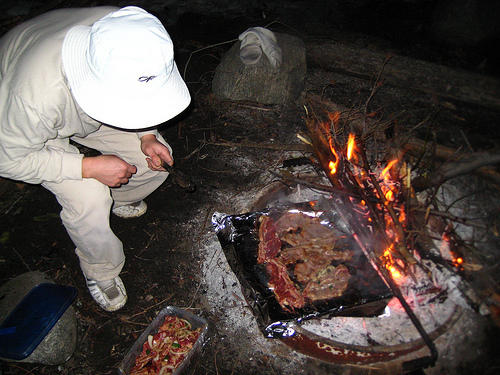
I usually do boil in bag meals. I have a friend that never brings a stove and puts his pot in the fire (to boil water). He may go really hungry if it rains or we camp where no fire is permitted. I've been known to do a big "first night meal". A foil pack with steak, potatoed and onions I chuck on a bed of coals. If you hike the pack in frozen it keeps all day. This is not Ultra Light but it's ultra yummy. You have to tend to the cooking quite a bit as to not burn or over cook the pack.

PostedJan 22, 2009 at 9:10 am

We live in Southeast Alaska’s Tongass rain forest and use fire to cook all of our meals. Most are set on a beach below tide level, but sometimes we will stumble upon a hunter’s fire ring in the forest. There is no lack of dead standing spruce for our fires, and the drift wood, though often too saturated to start a fire, will burn well once the belly has matured. A solid pot with a decent handle or bail is important for cooking over fire; so are wool gloves. I’ve been taught by some fire masters here and have been able to start and keep a fire even after a week of steady rain.

Stephen's Passage , AlaskaFire and snow

Monty Montana BPL Member
PostedJan 22, 2009 at 8:00 pm

Back in the day, decades ago, that was a given as there were no lightweight stoves as yet. I was raised up learning to cook on an open fire, and as pointed out, there is quite an art to it in order to start a fire in any kind of weather. But back then the world was young and there were 2/3 fewer people in the world as now; because of increasing pressure on our few remaining wild areas by the burgeoning urban areas, we have no business building fires to cook or socialize. Perhaps in an emergercy situation a fire can be justified. Whenever I come upon a fire ring in the backcountry, I always take it apart and scatter the charcoal so that someone doesn't come along and think "hey, cool, a fire ring! I guess it's ok to buil a fire here." No, it isn't. Not any more.

PostedJan 22, 2009 at 8:15 pm

Cooking on a fire with an ultralight ethic in "sensitive" areas demands LNT accountability.

To that end, the vast majority of our forests, including subalpine forests, contain plenty of fuel for solo fire cooking, which when you are boiling only a pot of water, requires only a few fistfuls of small dead wood.

Fire rings and other higher impact practices are easily avoided when you are traveling solo and using a small pot.

Stoves like the Bushbuddy and the Caldera Ti-Tri make it all the more feasible because they require much less wood, no fire ring, and don't scar the ground on which they are built.

Fire cooking is a glorious reward of wilderness travel. You just have to be sensible with it.

PostedJan 22, 2009 at 8:31 pm

"Whenever I come upon a fire ring in the backcountry, I always take it apart and scatter the charcoal so that someone doesn't come along and think "hey, cool, a fire ring! I guess it's ok to build a fire here." No, it isn't. Not any more."

As long those rings aren't built by park officials to designate planed fire pits thats cool.
No one has any business building fire rings if they dont have the authority to do so. Unless of coarse they carefully dismantle it afterwords, but I would wonder why anyone would go to the trouble of building one in the first place since it dosn't help you build a fire or cook with one.

PostedJan 22, 2009 at 8:54 pm

I've been thinking about fire quite a bit lately (I seriously just came in from a practice session with a fire drill made from wood I collected on today's trail run).

I don't want to steer too far off here, but in many ways it's really a tragedy that so many areas are so sensitive to fire (due to the sheer volume of us crawling around in the woods these days).
I find it sad that the question "How many of you cook with fire?" can even be seriously posed to a bunch of backpackers.
Yes, I understand why things have changed in many areas, but this doesn't alleviate my romantic/philosophical musings.

It's impossible to overstate the importance of humans learning to use and create fire.

And yet here we are, a large group of outdoors(wo)men becoming very disconnected- by laziness, by choice, by law, by ecological necessity, by whatever…

Sad.

PostedJan 22, 2009 at 9:22 pm

It is sad.
and I dont think as many places are as sensitive to fires as many seem to believe. I think that since the art of practical fire making is a lost art many people assume a fire is a fire- cooking, heat, signaling, atmosphere -its all the same.
People have a picture of what a generic camp fire is and think thats what all fires look like i.e. a fire ring with a big fire.
I think many would be astonished to see how simple and low impact a cook fire designed to boil water in a snowpeak 600 would be like.

PostedJan 22, 2009 at 10:06 pm

Rock rings are sometimes essential for cooking over a fire in the back country. With skill, a wonderfully effective wind "screen" can be made from rocks and can also serve as a pot support. But my perspective is skewed by the environment I grew up in; I have always thought it neat to find an old ring of scorched rocks in the middle of some alpine meadow way out in the middle of no where. With so many people in "the lower 48", i can understand why it might be frustrating for some of you to come upon traces of other people, but here there is just so much wilderness that it is almost refreshing to find traces of "civilization". In conclusion, and to tie in with the philosophical aspect of this argument, the way in which we observe and interact with our environment defines our culture. There is no right way. Everyone shouldn't necessarily know how to build a fire because they just don't need too. Times change. Are you not going to have children so that more people can build fires in the future? Wow, how did I get here….?

PostedJan 22, 2009 at 10:26 pm

"Everyone shouldn't necessarily know how to build a fire because they just don't need too. Times change. Are you not going to have children so that more people can build fires in the future?"

Yeah, times change, but not always for the better. I think disconnection from the natural world only comes full circle to help fuel the destruction we wage on it.

As for my children, they know how to light a fire; it's just one part of teaching them to appreciate, live in, and respect wilderness.

Brian, I think you're totally correct. Many areas are not as fragile as people would believe. I honestly think the majority of fire restrictions out there are in place not due to environmental reasons, but to protect the forests from the lowest common denominator.

PostedJan 23, 2009 at 8:40 am

I abide by LNT where applicable. I think a lot of people on this forum are west coasters where wild fire is a real danger. You also have areas of low vegetation density. Most of the parks near me are lush, humid, wet, and highly dense in vegetation. Plenty of firewood and a very low chance of wildfire. Many of the national parks here have established steel fire rings. So not only do these parks not mind fires they are encouraging it.

I guess you just need to know where you are and the right thing to do for the wilderness area you are in.

I have hiked in no fire zones and have complied with no qualms.

PostedJan 30, 2009 at 6:45 pm

Coming from a background in ecology and natural resource management, I can tell you that an ongoing problem in many of the wilderness of the West has been the SUPRESSION of wildfires that are essential to healthy ecosystems, such to the point where certain species have had their habitats significantly reduced. This is such a problem that many national parks, national forests, BLM areas, etc. are now undertaking fuel removal efforts which can be very costly.

Now I understand that what your average person knows of ecology and LNT principles comes down, more or less, to what Al Gore said in an Inconvienent Truth, but I just wanted to throw that out there…

Nick Gatel BPL Member
PostedJan 30, 2009 at 7:29 pm

In the 60's I only cooked on a fire, because I did not know there was an alternative. It is time consuming to do in some areas/conditions, and most important to me it is a REAL pain to clean your pots or deal with the soot. When I saw a Svea 123, I was done with fires for good. A stove lets you cook when and where you want, with minimum time and clean up. Back then it was not an environmental decision, it was a matter of convenience and time.

PostedJan 30, 2009 at 7:47 pm

>>I dont think as many places are as sensitive to fires as many seem to believe.<<

Is this cookfire the one also used to burn T.P. rather than bury it? *wink*

The sensitivity is of course proportional to the impact. Smaller fire, less impact. Fewer fires, less impact. Better LNT education, less impact. Not for nothing, though, that fire use policies take into account the lowest common denominator types. It's hard to regulate in a nuanced way.

Viewing 19 posts - 1 through 19 (of 19 total)
Loading...